

How a single disruption cascades into worldwide supply chain chaos and what you can do about it.
In the intricate calculus of global trade, distance is an illusion. The stability of a manufacturing line in Detroit is directly linked to the maritime security of the Red Sea. This powerful interconnectedness, where a local disruption triggers a global chain reaction, is the defining challenge of modern logistics: the domino effect.
These global shipping disruptions are not random chaos. They are a predictable sequence of events, and understanding them is the first step toward building true supply chain resilience.
What’s Behind the Spike in Global Shipping Rates? The First Domino
The current crisis was triggered by a fundamental breakdown in risk management. As Kuehne + Nagel's Michael Aldwell explained previously in the Journal of Commerce, the situation became untenable because carriers simply "can't get insurance to sail through the Bab el-Mandeb Strait."
This single insurance failure was the first domino, forcing the entire industry to avoid the Suez Canal. The immediate impacts were severe:
Extended Journey Times: Detouring around Africa adds 10-21 extra days to voyages.
Massive Cost Increases: Shipping costs surged nearly five-fold on the most affected routes.
Reduced Capacity: The longer transit times effectively remove a huge portion of the global fleet from circulation at any given time.
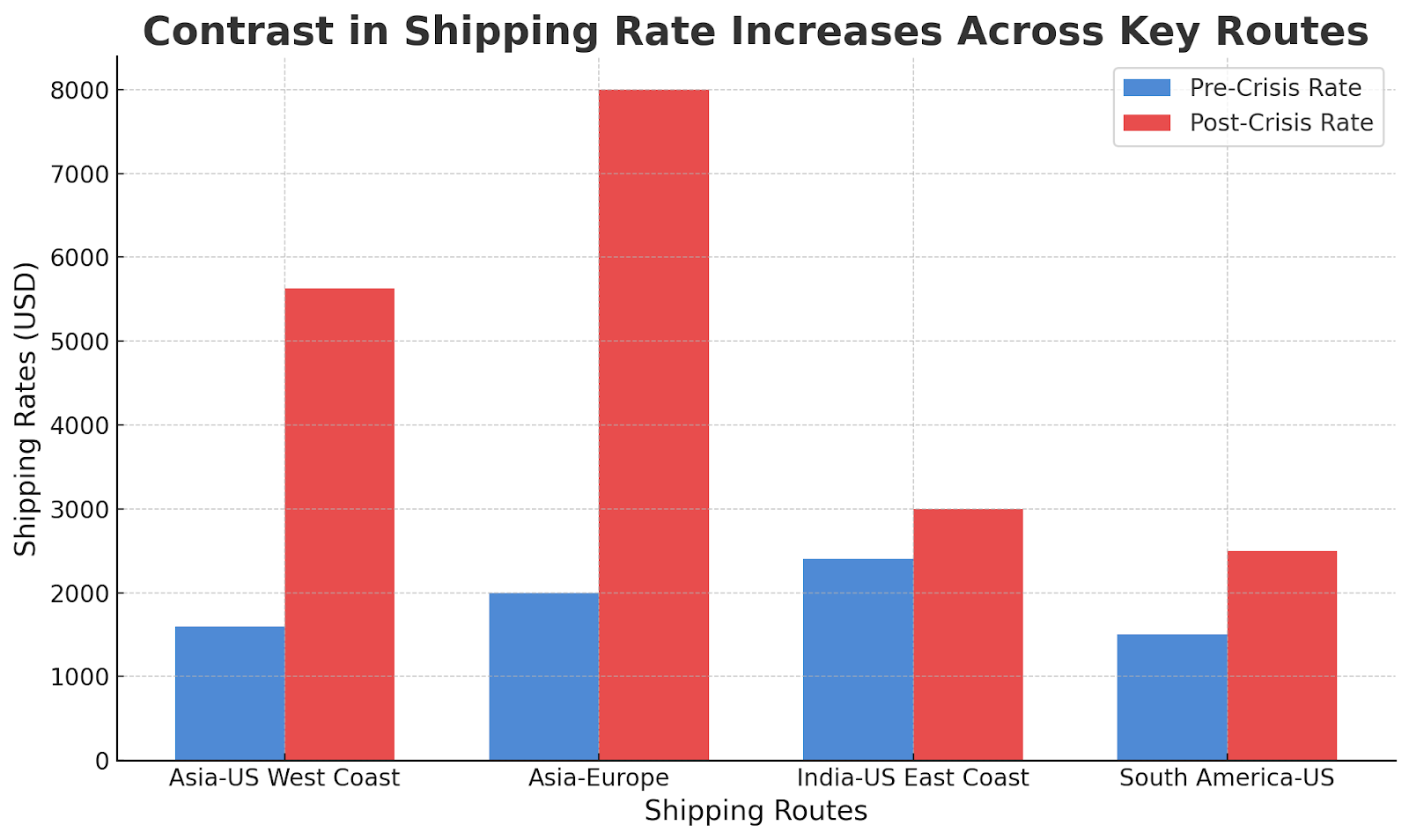
This isn't a temporary spike—it's a structural shift in global trade patterns.
How One Shipping Disruption Impacts Global Trade
When ships are forced off one critical route, they crowd the others, creating a cascading effect. A late 2024 Journal of Commerce report provides a perfect illustration of this principle in action, detailing how a US port strike and European port congestion combined to create a crisis on a completely different lane.
The report noted, "the domino effect on the trans-Atlantic trade lane will be exacerbated by port congestion in North Europe."
This is how the chain reaction works:
Vessel Bunching: Multiple ships, running off-schedule from various disruptions, arrive at the same port at once, overwhelming its capacity.
Port Congestion Spreads: This creates backlogs that ripple outwards. The same JOC report highlighted that yard utilization in Hamburg hit 112%, with operations "heavily disrupted."
Capacity Crunch: To manage the chaos, carriers are forced to reduce capacity. Analyst firm Sea-Intelligence, cited in the article, projected that the compounding delays could lead to a "temporary capacity reduction of up to 30%" on key lanes.
Rate Contagion: With capacity shrinking, rates on the affected North Europe to US East Coast lane rose by $600 to $2,700 per FEU—a 157% year-over-year increase, according to Platts data.
This shows how problems in the US and Germany can directly cause a rate spike for a shipment moving between France and Canada. The chaos is contagious.
The Domino Effect in Action
This chain reaction creates concrete, costly challenges for importers on the ground.
Automotive: A major European automaker saw their Asia-sourced component delays threaten production. By accelerating a plan to source from India and Mexico, they reduced their supply chain delays by 25% and saved an estimated 30% in potential emergency freight costs.
Inland Disruption: The chaos doesn't stop at the port. The JOC report also noted that inland transport in Europe was being affected by flooding and low water levels on the Rhine, with barge handling delays hitting 73 hours at Rotterdam. This shows how the domino effect pushes deep into a country's logistics network.
Supply chain flexibility has become more valuable than cost optimization alone.
The Solution: Strategic Freight Forwarding for Supply Chain Defense
Understanding the domino effect is crucial, but for importers, the most important question is how to protect your business from it. Theory is not enough; you need a partner with the on-the-ground capability to execute a smarter strategy.
The only effective long-term defense is a diversified supply chain managed by a freight forwarding partner who understands global risks, not just local ports. This means moving beyond simply booking shipments and actively designing a logistics network that is not overly reliant on any single route or region.
Ready to take control of your supply chain amidst shipping chaos? Our next guide shows how a strategic freight forwarder can help you leverage India to sidestep rate spikes and improve cost stability.
[Read Part 2: The Hidden Opportunity in Sourcing from India]
About Airlift USA
Navigating the 'domino effect' described in this article requires more than a standard freight forwarder. It requires a partner that understands the connection between global events and your bottom line. For over 28 years, Airlift has been that partner for US importers. We specialize in building resilient supply chains by combining deep market analysis with practical, on-the-ground execution. Our teams, including our extensive network in India, are experts in managing the complexities of a diversified supply chain, ensuring your cargo moves reliably even in the most volatile markets.Get a quote for your shipment
Have a shipment to move? Send the origin, the destination, the cargo and the container or weight; we reply with the rate, the routing and the services included.