


A data-driven guide to building supply chain resilience amid historic rate volatility.
While headlines focus on the 252% surge in Trans-Pacific shipping costs, a quieter, more strategic story is unfolding.
For India-US trade routes, major container lines have been forced to "drastically downgrade their peak season booking rate increase targets" in July amid persistent demand headwinds, according to a recent Journal of Commerce report.
The numbers tell the story
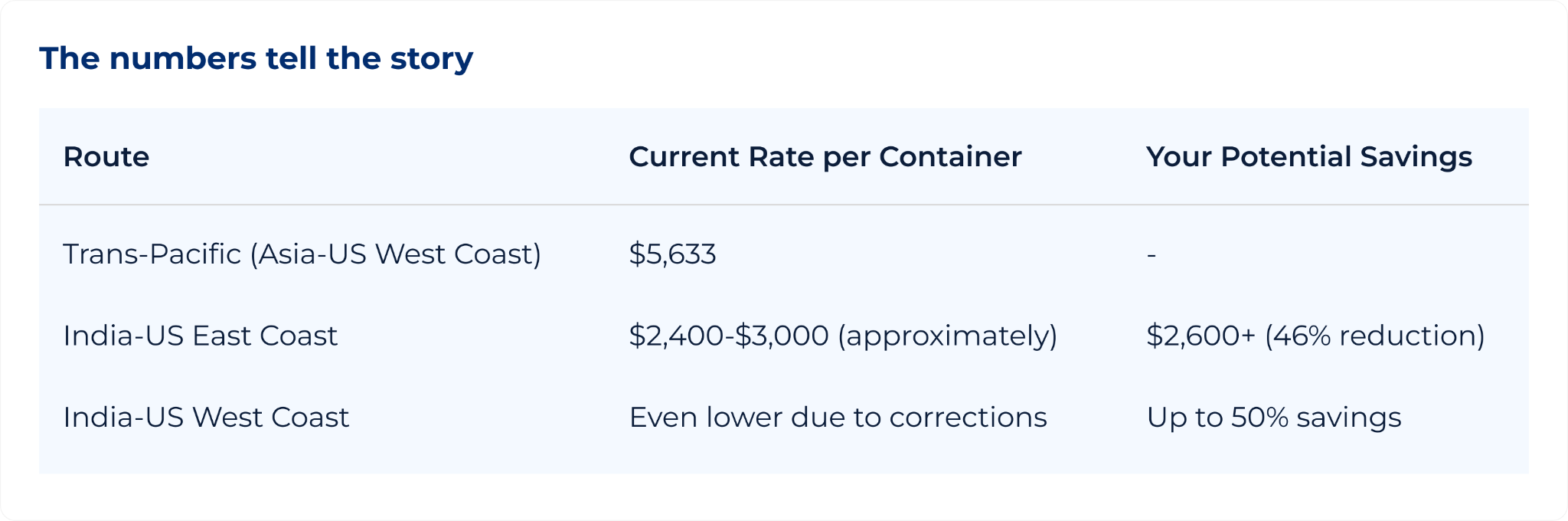
This guide provides a practical playbook for capitalizing on this market divergence to build both cost advantages and supply chain resilience.
The India Advantage: An Island of Stability in a Chaotic World
The data reveals a clear opportunity. While other major trade routes are roiling, the India-US East Coast lane shows remarkable stability.
Why India Rates Remain Stable: The Story Behind the Numbers
The stability on the India-US lane is due to a unique convergence of global and local factors:
Insulated from the Worst of Global Rerouting: The root cause of the global crisis is the forced rerouting of ships around Africa's Cape of Good Hope, a move that, as noted by Kuehne + Nagel's Michael Aldwell in the Journal of Commerce, adds 10-21 days to major voyages. While this squeezes vessel capacity worldwide, the current soft demand on the India-US lane is acting as a crucial buffer.
Softer Demand and Tariff Uncertainty: The demand from the US for Indian goods is currently moderate. As one carrier executive stated, "Some customers seem to be holding back on shipment plans, pending clarity on tariffs."¹
"Artificial" Fullness, Not Organic Demand: Even when vessels seem full, forwarders link this "’sold-out’ experience to capacity cutbacks and consequent cargo rollovers," not overwhelming demand.¹ This proves carriers lack the pricing power they have on other lanes.
The Proof: Global Giants Are Already Pivoting to India
This isn't just a theoretical opportunity. As reported in the Journal of Commerce, major companies are already rerouting their supply chains. A prime example includes "Apple iPhones made in India, where significant volumes produced for the European market have been strategically shifted to the US."
This move by one of the world's largest companies is a real-time validation of the India sourcing strategy.
This move by one of the world's largest companies validates what smart importers are discovering: India sourcing isn't just a cost play—it's a strategic advantage.
Consider this real-world success story: Here's how a Texas-based home goods retailer turned their supply chain crisis into a competitive advantage.
The Problem: Over-reliant on China (85% of volume), they were hit with crippling cost spikes and 4-5 week delays on the Trans-Pacific route, leading to constant stockouts.
The Solution: In a 6-month phased plan, they partnered with a logistics expert to shift 35% of their sourcing to India. Key moves included vetting new suppliers, launching a low-risk pilot program, and rerouting containers through the Port of Houston to be closer to their distribution centers.
The Results:
18% reduction in total landed costs for the new product lines.
On-time delivery rate soared from 65% to 89%.
Reduced dependency on the volatile Trans-Pacific lane by over 30%.
Your 3-Phase Roadmap to India Sourcing
We recommend a focused, three-phase approach to transition smoothly and mitigate risk.
Phase 1: Foundation (The First 90 Days)
The goal is to move from idea to action by validating the opportunity.
Assess Viability: Analyze your products to identify the best candidates for transition and calculate potential total landed cost savings.
Identify Partners: Research and vet a shortlist of high-quality Indian suppliers with proven export experience.
Launch a Pilot: Initiate a small-scale pilot program with 2-3 suppliers to test quality, communication, and logistics in a low-risk environment.
Phase 2: Execution (Months 4-9)
With a successful pilot complete, this phase is about scaling and optimizing.
Expand Volume: Gradually increase order volumes with your proven suppliers while building redundancy with backup partners.
Refine Logistics: Optimize your shipping and inventory strategies based on the real-world lead times from your pilot program.
Formalize Partnerships: Develop supplier performance scorecards and move towards more formal agreements based on strong performance.
Phase 3: Integration (Months 10-12+)
This phase is about making India a core, seamless part of your global supply chain.
System Integration: Fully integrate your Indian suppliers into your core demand planning and ERP systems.
Build Strategic Alliances: Move from transactional orders to long-term partnerships with multi-year agreements and capacity commitments.
Drive Continuous Improvement: Establish joint programs with your key partners focused on innovation, efficiency, and ongoing cost reduction.
Overcoming 3 Key Sourcing Challenges
Lead Time Management
Concern: India typically adds 2-3 weeks to lead times
Smart Solution: Implement strategic inventory positioning with safety stock optimization and utilize regional US distribution hubs to shorten final-mile delivery. Many successful importers find the cost savings more than offset the inventory investment.
Quality Assurance
Concern: Maintaining consistent quality standards
Proven Approach: Start with suppliers who already export to developed markets and have established quality certifications. Implement milestone-based quality checks rather than complex inspection processes. Most quality issues resolve quickly with clear specifications and communication.
Cultural Alignment
Concern: Communication and business practice differences Practical Solution: Partner with logistics providers who have on-ground presence in India and can facilitate relationships. The learning curve is typically 30-60 days, and India's English-speaking workforce significantly eases the transition compared to other sourcing regions.
Why This Opportunity Won't Last
Market Normalization: Global shipping rates will eventually stabilize, reducing the current freight cost advantage that makes India sourcing so compelling.
Increased Competition: As more companies recognize India's potential, competition for top suppliers will intensify, driving up costs and reducing availability.
Infrastructure Improvements: Continued investments in Indian logistics will attract more buyers, potentially tightening capacity and eliminating current advantages.
The Strategic Imperative: Companies that act now can establish supplier relationships, operational expertise, and cost structures that provide lasting competitive advantages even after market conditions normalize.
Early entry enables building preferred customer status with top-tier Indian manufacturers—positioning that becomes invaluable as the market evolves.
Is India the Right Move for Your Business?
The current market has created a time-sensitive window to gain a competitive edge. The importers who begin building these capabilities today will be best positioned to thrive long after market conditions normalize.
In this complimentary 30-minute strategy session, we will help you:
Identify Your Top 3 Risks in carrier selection, port dependency, and transit times.
Benchmark Your Current Freight Strategy against successful industry shifts.
Outline a More Resilient and Cost-Effective Logistics Plan
[Get Your Free Assessment] (CTA Button)
About Airlift USA
Airlift USA has extensive, on-the-ground operations across India's key commercial hubs and ports—including **Mumbai, Delhi, Chennai, Bangalore, Hyderabad, Mundra, and Nhava Sheva**. This deep presence, combined with our expertise in India-US trade lanes, makes us the ideal partner for companies looking to diversify their supply chains.
key cities and ports where Airlift operates from India.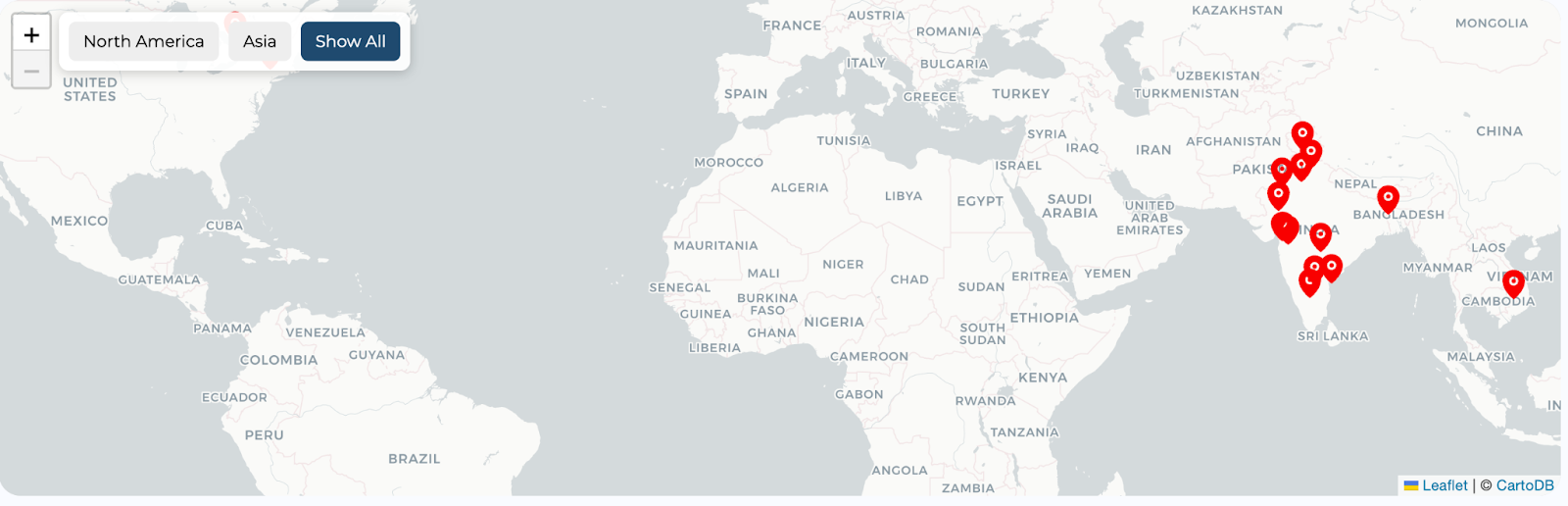
Sources
Journal of Commerce, "Container lines pull back on India-US pricing push" (Jul. 3, 2025).
Journal of Commerce, "Tariff-linked trade flow shift tightens Asian air freight capacity" (Jul. 30, 2025).
This analysis also incorporates current market data and general industry insights from leading trade publications.
Get a quote for your shipment
Have a shipment to move? Send the origin, the destination, the cargo and the container or weight; we reply with the rate, the routing and the services included.