

FOB vs DDP from India: Which Supplier Quote Actually Costs Less?
Two suppliers in India quote you a price for the same product.
One offers $40,000 FOB. The other offers $52,000 DDP.
At first glance, the FOB quote looks $12,000 cheaper.
But does that mean it will cost you less to get the goods to your warehouse in the United States?
Not necessarily.
The difference comes down to what each supplier has included in the price, where their responsibility ends, and which costs you will still need to pay.
For US importers sourcing from India, understanding those differences can prevent an attractive supplier quote from becoming a more expensive shipment.
FOB vs DDP: What are you actually paying for?
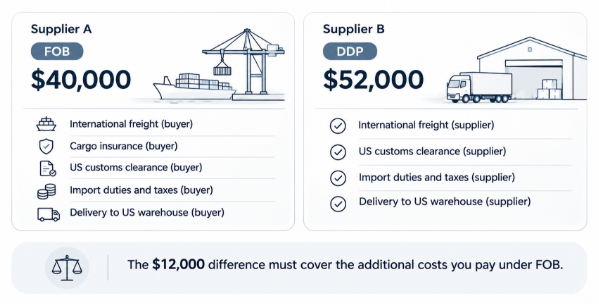
FOB (Free on Board) and DDP (Delivered Duty Paid) are two Incoterms® rules that determine how transportation responsibilities, costs and risks are divided between the buyer and the seller.
Under FOB, the Indian supplier is generally responsible for delivering the goods to the named port of shipment, completing export clearance and loading the goods on board the vessel. Once the goods are on board, the risk transfers to the buyer.
The US buyer then arranges the international freight and takes responsibility for the applicable costs that follow.
Under DDP, the supplier takes on substantially more responsibility, including arranging transportation to the agreed destination, completing import clearance and paying applicable import duties and taxes.
This is why an FOB price and a DDP price cannot be compared at face value.
What costs should a US buyer account for under FOB?
For an FOB shipment from India, the US importer would typically need to account for:
Ocean freight from India to the US
Cargo insurance, if the buyer chooses to arrange coverage or it is otherwise required under the transaction
Destination terminal and handling charges
US customs brokerage, duties and applicable government fees
Inland transportation from the US port to the final destination
Any additional charges arising during the shipment
Under FOB, the Indian supplier generally handles origin-side charges up to loading the goods on board the vessel. The US buyer arranges ocean freight and the applicable costs from that point onward.
FOB is intended for sea and inland waterway transport. For containerized shipments handed to a carrier at a terminal before vessel loading, FCA (Free Carrier) may be more appropriate.
Want to understand the different Incoterms?
We've covered all 11 Incoterms in a separate guide, explaining what each term means, who pays for what, and when risk transfers between the buyer and seller.
Read our complete guide: Get the Terms Right, Ship Smarter: A Practical Guide to Incoterms.
The $40,000 FOB vs $52,000 DDP comparison
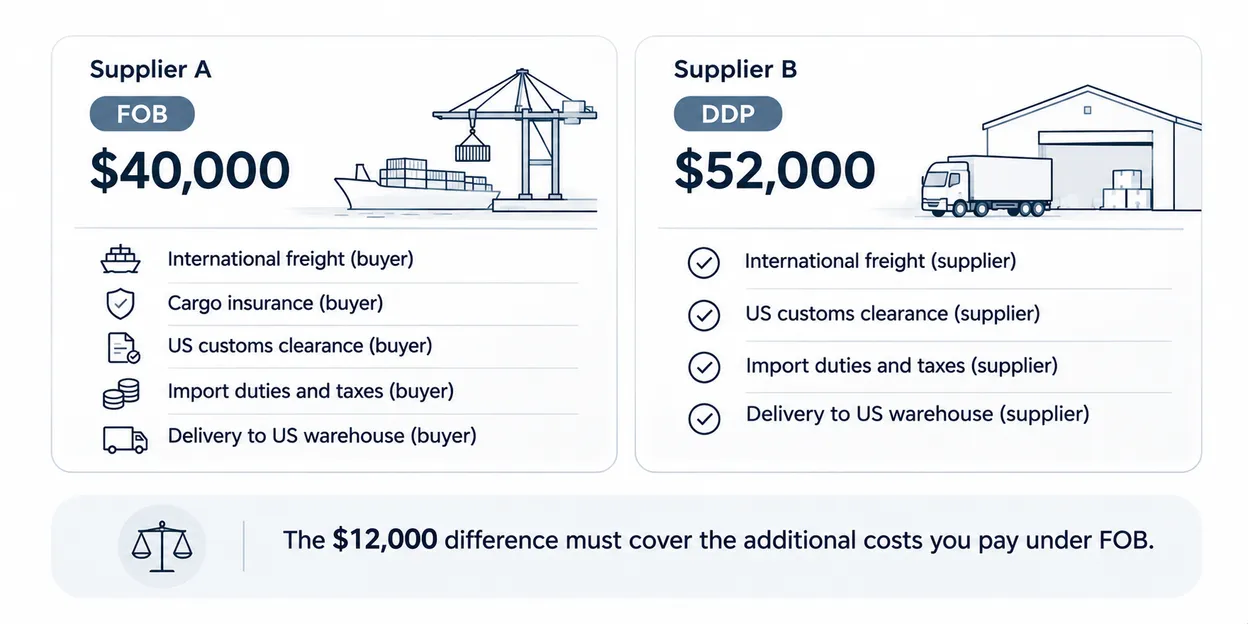
Consider a US importer comparing two Indian suppliers offering the same product, quantity and specifications, with delivery ultimately required at the same New Jersey warehouse.
Illustrative example only. These figures are not actual Airlift freight quotations.
Supplier A's price is $12,000 lower.
But that difference must cover the costs the importer takes on under FOB. These could include ocean freight, insurance, destination charges, customs brokerage, import duties and inland delivery.
The $12,000 question
If the additional costs of bringing Supplier A's goods to the New Jersey warehouse total less than $12,000, the FOB option may be cheaper.
If those costs exceed $12,000, Supplier B's DDP quote may offer a lower overall cost.
The comparison is straightforward:
FOB total landed cost = $40,000 + additional costs to the agreed destination
DDP total cost = $52,000 + any costs or exclusions not covered by the agreed DDP price
The important point is that the $12,000 difference is not automatically a saving. It is the amount available to cover the transportation, import and delivery costs that are not included in the FOB price.
Before making the comparison, importers should also establish the duties and government fees that apply to their products. These depend on factors such as product classification, country of origin and current import requirements.
What should you check in a DDP quote?
A DDP quote may make budgeting easier because the supplier takes on more of the transportation and import responsibilities.
However, that does not mean every DDP quotation covers the same services, or that the supplier has made the necessary arrangements for US customs clearance.
Before accepting a DDP quote, confirm:
The exact delivery address covered by the quoted price
Whether all applicable US duties, taxes and government fees are included
Whether the price remains fixed if applicable duty rates change before importation
Whether unloading at the destination is included
Under standard DDP terms, the seller delivers the goods ready for unloading. Unloading is generally the buyer's responsibility unless otherwise agreed.
Who handles US customs clearance under DDP?
DDP places import clearance responsibilities on the seller, but the arrangements must comply with US customs requirements.
An Indian supplier offering DDP may arrange to act as the importer of record, subject to the applicable requirements, or set up another compliant import arrangement. Not every supplier is familiar with US import requirements, so it is worth asking how they plan to handle them.
Under the new rule, a foreign importer of record must be CTPAT validated or use a CTPAT-validated licensed customs broker to make entry. Importers considering DDP arrangements with overseas suppliers should confirm that the proposed customs clearance structure meets the applicable requirements.
A DDP quotation alone does not establish that the supplier has a compliant US import arrangement.
Before accepting the quote, the US buyer should understand who will be responsible for the customs entry, the supporting documentation and any issues that arise during clearance.
A DDP quotation should not be treated as a guarantee that every customs requirement has already been addressed.
For more background, read Airlift's Importer of Record: Key Essentials.
Five questions to ask before accepting a supplier quote
Whether you're comparing FOB, CIF or DDP prices, these five questions can help establish what the shipment will actually cost.
1. What exactly is included in the quoted price?
Ask the supplier to clarify which transportation, handling, clearance, duties and delivery services are included.
Two quotes may cover very different parts of the shipment, even when the goods are identical.
2. Where does the supplier's responsibility end?
Confirm the Incoterms rule and the named port or delivery location.
A quote stating only "FOB India" or "DDP USA" is not specific enough to establish the agreed delivery point.
3. Who will handle US customs clearance?
Identify the importer of record, the customs broker and the party responsible for providing accurate product and shipment documentation.
This is particularly important when the supplier is offering DDP.
4. What additional costs could arise?
Ask whether customs examinations and related charges, demurrage, detention, storage and delivery-related charges are included or billed separately.
Also confirm the free days that apply and how any additional charges are calculated.
For a fuller picture of costs that don't appear on the first quote, read our guide to International Shipping Costs Explained.
For DDP quotes, clarify whether changes in import duties could affect the agreed price.
5. What will it cost to receive the goods at the same final destination?
Compare both quotes using the same delivery point and a consistent understanding of what is included.
That is the most useful basis for evaluating the actual cost difference.
Where does CIF fit into the comparison?
CIF (Cost, Insurance and Freight) is another term suppliers may quote.
Under CIF, the seller arranges and pays for ocean freight and insurance to the named destination port. However, the risk generally transfers to the buyer once the goods are loaded on board the vessel at the origin port.
Under Incoterms® 2020, CIF requires the seller to arrange a minimum level of cargo insurance coverage unless the parties agree otherwise. Importers should check the policy terms, exclusions and coverage limits to determine whether additional protection is needed.
CIF also does not automatically include US customs clearance, import duties or delivery to your warehouse.
For a full explanation of the different shipping terms, see our guide to Incoterms.
Whichever term a supplier quotes, the central question remains the same:
What will the shipment actually cost by the time the goods reach the destination you need?
Compare the full cost before choosing your supplier
FOB, CIF and DDP each offer different levels of cost responsibility and control. No single term is automatically the cheapest or best option.
Before accepting a supplier quote from India, make sure you understand what is included, what remains your responsibility and what the shipment will cost when it reaches you.
Planning a shipment from India to the US?
Airlift can help you with international freight and destination transportation arrangements so you can plan your shipment with a clearer understanding of the costs involved.
Get a quote for your shipment
Have a shipment to move? Send the origin, destination, cargo, and container size or weight. We reply with the rate, the routing and the services included.
