


Shopping in India? What to Know Before Shipping Your Purchases to the USA
Buying furniture, handicrafts or home décor in India? The price you pay at the shop may be only part of what it costs to get your purchase delivered to the United States.
You find a handcrafted wooden table in Jodhpur. The seller gives you a price, offers to arrange shipping to the United States, and assures you that everything will be taken care of.
But when the shipment reaches the US, you discover that customs clearance, import duties and delivery to your home were not included.
The seller may have arranged exactly what was promised. The problem is that you and the seller understood "shipping" differently.
For US residents shopping in India, interior designers sourcing unique pieces and small businesses buying furniture or handicrafts, that difference can become expensive.
The question to ask before paying isn't just "Can you ship it? " It's " What will it take to get this delivered to my address in the US?"
The purchase price is only the starting point
Getting a piece of furniture from a shop in India to a home in the United States involves several steps.
The goods may need to be professionally packed and crated, collected from the seller, cleared for export, transported internationally, entered through US customs and delivered from the destination port or airport.
Each step has a cost, and each needs someone responsible for arranging it.
Depending on the quotation, the total may include:
Packing, crating and pickup in India
Export documentation and origin handling
International air or ocean freight
US customs brokerage, duties and applicable fees
Destination handling, storage or examination charges where applicable
Final delivery, including any special handling for large or heavy items
Some of these charges may already be included. Others may be payable separately.
That doesn't automatically make them hidden charges. Often, they were simply outside the scope of the original quotation.
What matters is knowing where the quoted price ends.
Door-to-door" doesn't always mean duties are included
Suppose a seller offers to deliver a marble tabletop from India to your address in New York.
Does that mean the seller will also pay US import duties and arrange customs clearance?
Not necessarily.
Two commonly used international delivery terms help explain the difference.
Under Delivered at Place (DAP), the seller generally arranges transportation to the agreed destination, while the buyer handles import clearance and pays applicable import duties and taxes.
Under Delivered Duty Paid (DDP), the seller generally takes responsibility for import clearance and applicable duties as well as transportation to the named destination.
These terms should be expressly agreed upon. A verbal promise of door-to-door shipping does not, by itself, establish which arrangement applies.
For a buyer, the practical question is straightforward:
Who pays for customs clearance, duties, destination charges and delivery if they aren't included in the freight quote?
Ask for that answer in writing before making the purchase.
The importer of record is legally responsible for the accuracy of the US customs entry and compliance with applicable import requirements. Who acts as importer of record depends on the transaction and import arrangement.
A licensed US customs broker can help determine the entry requirements, applicable duties and documentation needed.
The material matters as much as the product
A marble sculpture, a wooden cabinet and a bamboo decoration may all be sold as handicrafts. But US import requirements can differ depending on what each item is made of.
Certain wood and plant products may require a declaration under the US Lacey Act. The requirement depends on factors including the product's tariff classification, entry type and whether the goods fall within the declaration rules.
Furniture made from rosewood, sheesham or other regulated timber may also require additional review under CITES, the international convention governing trade in protected species. The applicable requirements depend on the scientific species, product form and relevant exemptions.
Handicrafts containing bark, seeds, grasses or other natural plant materials can raise separate agricultural import concerns.
This does not mean such goods cannot be imported.
It means buyers need accurate information about the materials before shipping, rather than relying on descriptions such as "wooden furniture" or "handmade décor."
For products containing regulated plant or wildlife materials, confirm the requirements with a licensed customs broker and the relevant authorities before purchase.
Don't overlook the crate
Even if the furniture itself meets US import requirements, the packaging can create a separate issue.
Regulated solid-wood crates, pallets and bracing used for international shipments must comply with ISPM 15, the international standard designed to reduce the spread of wood-boring pests.
Compliant packaging must be appropriately treated and carry the required marking. Certain processed-wood materials, such as plywood and pressboard, are not subject to these wood-packaging requirements.
Shipments containing non-compliant regulated wood packaging may be refused entry into the United States.
Before the seller packs your purchase, confirm that the packaging is suitable for international export and US entry.
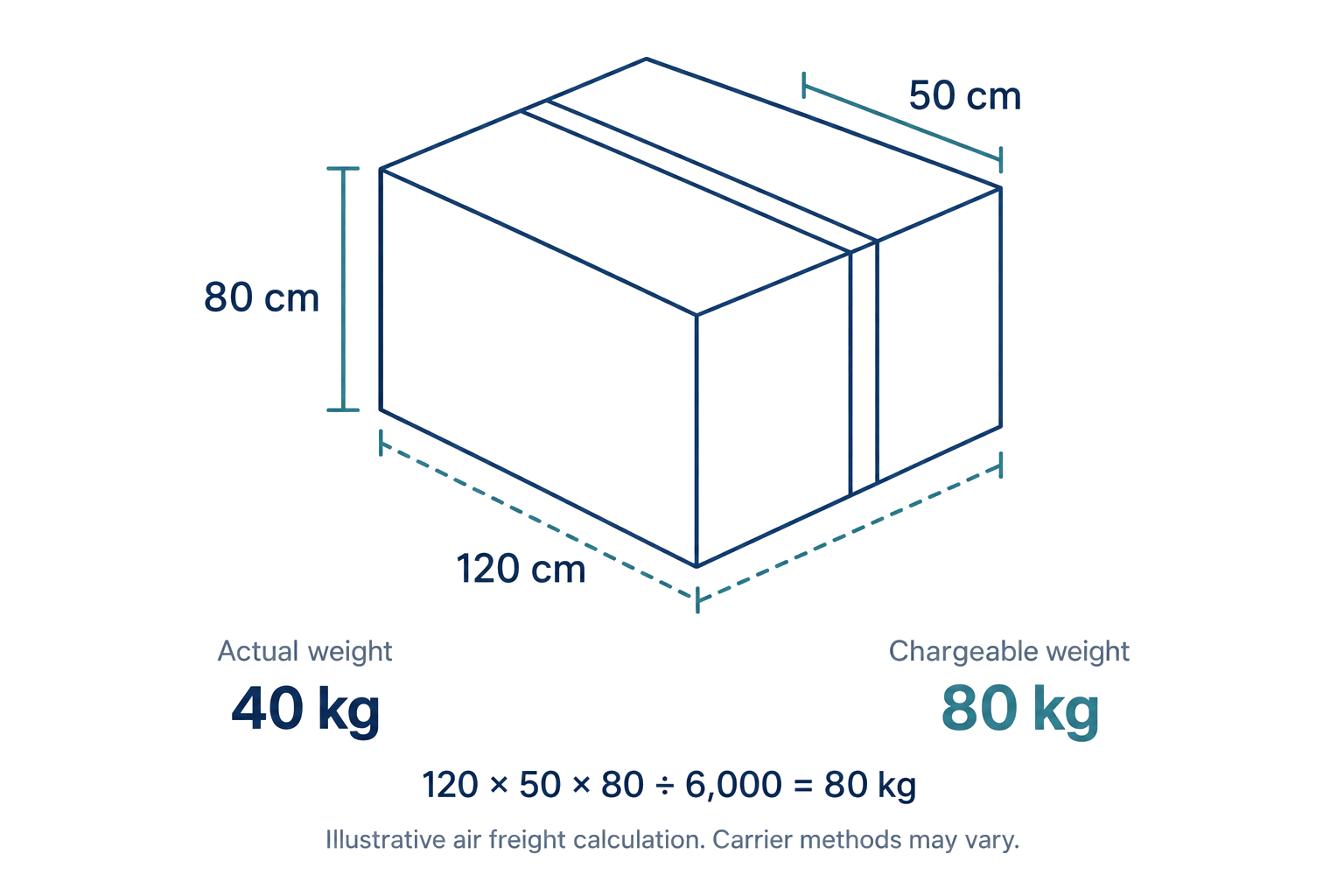
Why a 40 kg crate can be billed as 80 kg
Shipping costs can also surprise buyers who are unfamiliar with air freight calculations.
Air freight is generally priced using chargeable weight: the greater of the shipment's actual gross weight and its volumetric weight.
Volumetric weight accounts for the space a shipment occupies, not just what it weighs.
Consider this illustrative shipment:
Using a common air cargo divisor of 6,000:
120 × 50 × 80 ÷ 6,000 = 80 kg
The crate weighs 40 kg, but the freight calculation uses 80 kg because it occupies more space relative to its weight.
Different carriers and express services may use different volumetric calculations, so confirm the divisor used in your quotation.
For bulky furniture, the difference can be significant.
And remember: the dimensions that matter are the dimensions after the item has been packed, including its protective crate.
Should you ship by air or ocean?
For a single furniture purchase, the fastest shipping option isn't necessarily the most practical.
Air freight may make sense when delivery time matters and the shipment is relatively small. But bulky items can attract high chargeable weights, even when they aren't particularly heavy.
Ocean freight may be worth considering for larger furniture, heavier decorative pieces or multiple purchases.
With less-than-container-load (LCL) shipping, smaller shipments share space in a container. This can be useful when there isn't enough cargo to justify a full container.
However, ocean shipments also involve origin and destination handling, customs procedures and local delivery.
Before choosing a mode, compare the estimated total transportation cost to your final address, not just the international freight component.
A lower freight rate does not always mean a lower total delivery cost.
Arrival in the US is not the same as delivery readiness
Another common misunderstanding concerns transit time.
If a shipment is scheduled to arrive at a US port or airport on a particular date, that doesn't mean it will be ready for delivery that day.
The goods may still require customs processing, terminal release and onward transportation.
CBP or another government agency may request additional documentation or select the shipment for examination. Depending on the circumstances, this can affect the delivery schedule and create additional costs.
Documentation matters here.
A commercial invoice describing the goods only as "handicrafts" may not provide enough detail to determine the correct customs classification or identify additional import requirements.
A more useful description identifies what the item is, what it is made from, its quantity and its actual transaction value.
If the purchase is needed for a specific occasion, allow time for clearance and delivery rather than relying only on the expected arrival date.
Before you buy: seven questions worth asking
Whether you're purchasing one table or sourcing an entire collection, these questions can help you understand what you're committing to.
What exactly am I buying? Confirm the materials, including wood species or other natural components where relevant.
How will it be packed? Request the final packed dimensions, weight and packaging details.
Where does the seller's responsibility end? At the shop, an Indian port, a US port or your delivery address?
What does the shipping quote include? Confirm pickup, export handling, freight, destination handling and final delivery.
Who is responsible for customs clearance and duties? Identify the importer of record and consult a licensed US customs broker about entry requirements.
What could change the final cost? Ask about examinations, storage, special handling and other possible additional charges.
When will the goods actually be delivered? Distinguish international transit time from customs release and final delivery.
You may not be able to know every possible charge in advance, particularly when a shipment is selected for examination.
But you should be able to understand what is included, what is excluded and which costs remain estimates.
Check the shipping requirements before you commit
A handcrafted table or decorative piece purchased in India may be well worth bringing to the United States.
The mistake isn't necessarily buying something large, heavy or difficult to ship.
It's committing to the purchase without knowing what transportation, customs and delivery will involve.
Before paying the seller, get the packed dimensions, confirm the materials, establish the delivery terms and check the applicable import requirements.
The best time to understand the full cost is before the goods leave the shop.
Planning to ship furniture or handicrafts from India to the USA?
Airlift can help you explore air and ocean freight options based on your shipment details.
Have the pickup location, US destination, packed dimensions, weight, commodity description and cargo-ready date available when requesting a quote.
Explore Airlift's Rate Search.
For US customs entry, duties and commodity-specific regulatory requirements, consult a licensed US customs broker before shipping.
Sources and further reading
USDA APHIS — Lacey Act RequirementsGuidance on when declarations are required for imported wood and plant products, including applicable entry conditions and exceptions.https://www.aphis.usda.gov/plant-imports/file-lacey-act-declaration/requirements
USDA APHIS — Import ISPM 15-Compliant Wood Packaging MaterialTreatment, marking and compliance requirements for regulated wood packaging, including crates and pallets.https://www.aphis.usda.gov/plant-imports/wood-packaging-material/import
US Fish and Wildlife Service — Wood, Timber, and Other Tree ProductsGuidance on checking CITES-listed timber species, relevant annotations and permit requirements.https://www.fws.gov/international-affairs/permits/wood-timber-and-other-tree-products
International Chamber of Commerce — Incoterms 2020 Checklist and FlowchartsGuidance on the allocation of delivery, import-clearance and duty responsibilities under terms including DAP and DDP.https://library.iccwbo.org/content/clp/Others/incoterms_2020_checklist_2024-update.pdf
Disclaimer: This article is intended for general informational purposes and does not constitute legal, customs or regulatory advice. Applicable import duties, documentation requirements and agency rules depend on the goods and may change. Confirm current requirements with a licensed customs broker or the relevant government agency before shipping.
Get a quote for your shipment
Have a shipment to move? Send the origin, destination, cargo, and container size or weight. We reply with the rate, the routing and the services included.
