

After imposing 50% tariffs on Indian goods in August 2025, President Trump announced on November 10 that rates may come down due to India’s reduced Russian oil purchases.
And as of November 17, we now have the first concrete action:
Tariffs have been officially rolled back on 200+ agricultural and food items — including tea, spices, coffee, cashew nuts, and other speciality exports from India.
(Sources: Reuters, Times of India, Moneycontrol, Indian Express)
This is the first real evidence that broader tariff relief may be coming.
For importers of granite, machinery, textiles, industrial goods, and FMCG categories, this moment is critical:
Some Indian exports are now cheaper.
Others still face 50% duties.
A larger U.S.–India trade deal appears to be taking shape.
And the Supreme Court is reviewing whether these tariffs were even legal.
This blog breaks down what just changed, what hasn’t changed, and how importers should prepare for the next set of policy shifts.
LATEST UPDATE — Selective Tariff Rollback on Indian Goods (Nov 17)
Following Trump’s Nov 10 signal on broader tariff relief for India, the administration has now formally rolled back tariffs on over 200 agricultural and food products — including tea, spices, coffee, cashew nuts, and other speciality items exported from India.
Sources: Reuters, Times of India, Moneycontrol, Indian Express.
What this means
Indian exporters of spices, teas, nuts and specialty food items are likely to see improved market access and lower barriers in the U.S.
U.S. importers sourcing these categories may experience lower landed costs, improved margins, or restored competitiveness.
This rollback follows months of heightened duties — in some cases up to 50% — that had significantly disrupted India–U.S. trade flows.
But the relief is selective
Not all sectors benefit. Key Indian exports such as:
Rice
Seafood
Bulk agri goods are still outside the exemption list.
Early analysis also shows:
Compliance + quality standards remain high
Freight cost pressures continue
Competition hasn’t eased for many Indian exporters
Why this matters right now
This targeted rollback sits on top of Trump’s earlier remarks that the U.S. and India are “close to signing a deal” and that tariffs on Indian goods will “come down at some point.”
It signals:
A shift in U.S. policy direction
A possible expansion toward broader tariff relief
Time-sensitive opportunities for both importers and exporters
The Tariff Rollercoaster You’ve Been Riding
If you import from India, the past four months have been brutal.
July 2025: Trump announces 25% tariffs on Indian goods
August 2025: He doubles them to 50%, citing India’s Russian oil purchases
Sept–Oct 2025: Importers absorb massive cost increases
Nov 10, 2025: Trump signals possible relief:
“India has substantially reduced purchases of Russian oil… tariffs may come down.”
Meanwhile, on November 5, the Supreme Court heard arguments challenging whether the President even has the authority to impose these tariffs.
So you’re stuck between three major possibilities:
Scenario A: Tariffs get reduced
Scenario B: Tariffs stay at 50%
Scenario C: Tariffs get invalidated by Supreme Court
You can’t pause your business waiting for clarity.
Here’s how to navigate this uncertainty — starting with what’s real versus speculation.
What Just Happened (The November 10 Announcement)
Trump made two key statements in his latest remarks:
Statement 1
"India has substantially reduced their purchases of Russian oil. That was the primary reason for the tariff."
Statement 2
A trade deal with India is “pretty close.”
What this signals
The Administration is open to reducing the 50% tariff rate if India continues showing reduced Russian oil imports and agrees to other trade terms.
What’s unclear
How much reduction? (25%? 10%? 0%?)
Which products? (All imports vs select HS codes?)
When? (This week… or months away?)
What conditions must India meet?
This is not a final decision — but it is the strongest hint of relief since August.
The Legal Wild Card: Supreme Court Review
On Nov 5, the Supreme Court heard arguments on whether tariffs imposed under IEEPA (International Emergency Economic Powers Act) are even legal.
If the Court rules against the Administration
Some or all tariffs could be invalidated.
Timeline
Rulings typically arrive months after arguments. Expect Dec 2025 → Spring 2026.
Impact
Trump may reduce tariffs…
…but the Court could eliminate them entirely.
This creates three distinct scenarios importers must model.
What Recent Tariff History Actually Shows
To see what might happen next, look at the China tariff cycle.
When Trump imposed tariffs on China up to 130%, many expected global trade to shrink.
But the opposite happened.
Journal of Commerce data shows:
US–China trade dropped
Global container volumes grew ~6%
Importers shifted origins instead of reducing imports
Where cargo went:
Vietnam: +26% US imports
India: Significant gains (pre-Aug 2025 tariffs)
Thailand, Indonesia, Malaysia, Cambodia all grew
The insight:
Tariffs don’t kill trade — they redirect it.
This matters for India:
If tariffs stay at 50%, will you shift production to Vietnam or Bangladesh?
If tariffs drop, will you lock in long-term India supply?
If tariffs disappear, how will you scale volume back quickly?
Adaptation speed is the competitive advantage.
The Three Scenarios You Need to Model Right Now
Scenario A: Tariffs Reduced (Trump’s Signal)
Probability: Medium–High
Impact: Very positive
If tariffs drop:
✅ Landed costs fall immediately
✅ Margins recover
✅ India sourcing becomes competitive again
✅ You regain pricing advantage vs Vietnam/Thailand
Action Steps
Calculate landed cost under 25%, 10%, and 0% tariffs
Identify SKUs that become competitive at each level
Prepare to scale India orders quickly
Model customer pricing reductions
Consider long-term supply agreements
Critical question:
Will tariff reductions apply retroactively to cargo already in transit?
Scenario B: Tariffs Stay at 50% (No Deal)
Probability: Medium
Impact: Painful
If negotiations stall:
❌ Landed cost remains elevated
❌ Margins compress further
❌ Customers may shift suppliers
❌ India may become temporarily unviable
Action Steps
Start evaluating alternatives (Vietnam, Indonesia, Thailand, Mexico)
Request comparative quotes
Compare total landed cost (not just tariff differences)
Assess which SKUs to discontinue
Prepare a timeline for strategic sourcing shifts
Scenario C: Supreme Court Invalidates Tariffs (Legal Win
Probability: Low–Medium
Impact: Extremely positive, but complex
If tariffs are struck down:
✅ Duties eliminated
✅ Potential refund eligibility (if ruling is retroactive)
✅ Return to pre-August cost structure
✅ India regains competitive advantage
Action Steps
Track Supreme Court ruling calendar
Maintain tariff payment documentation
Understand refund procedures
Avoid drastic sourcing shifts until ruling is clear
Claims may be time-consuming but financially significant.
What the Past Four Months Taught Us
❌ What Didn’t Work
Waiting for relief
Not exploring alternative sourcing
Absorbing losses quietly
Rigid pricing contracts
✅ What Worked
Modeling alternatives early
Transparent customer communication
Cost-sharing negotiations with suppliers
Diversifying origins
Adding tariff-adjustment clauses
Lesson:
In volatile policy environments, optionality beats optimization.
Where Airlift Fits in All This
We can’t predict whether tariffs drop next week or next quarter.
But we can ensure you’re ready for every scenario.
What We Do Differently
Real-time policy monitoring
Multi-origin cost analysis (India, Vietnam, Indonesia, Thailand, Mexico)
Flexible routing & sourcing strategy
Scenario-based planning
Why It Matters
Your competitors are already adjusting.
The winners will be those who prepare — not those who wait.
What Happened This Week in India–US Trade
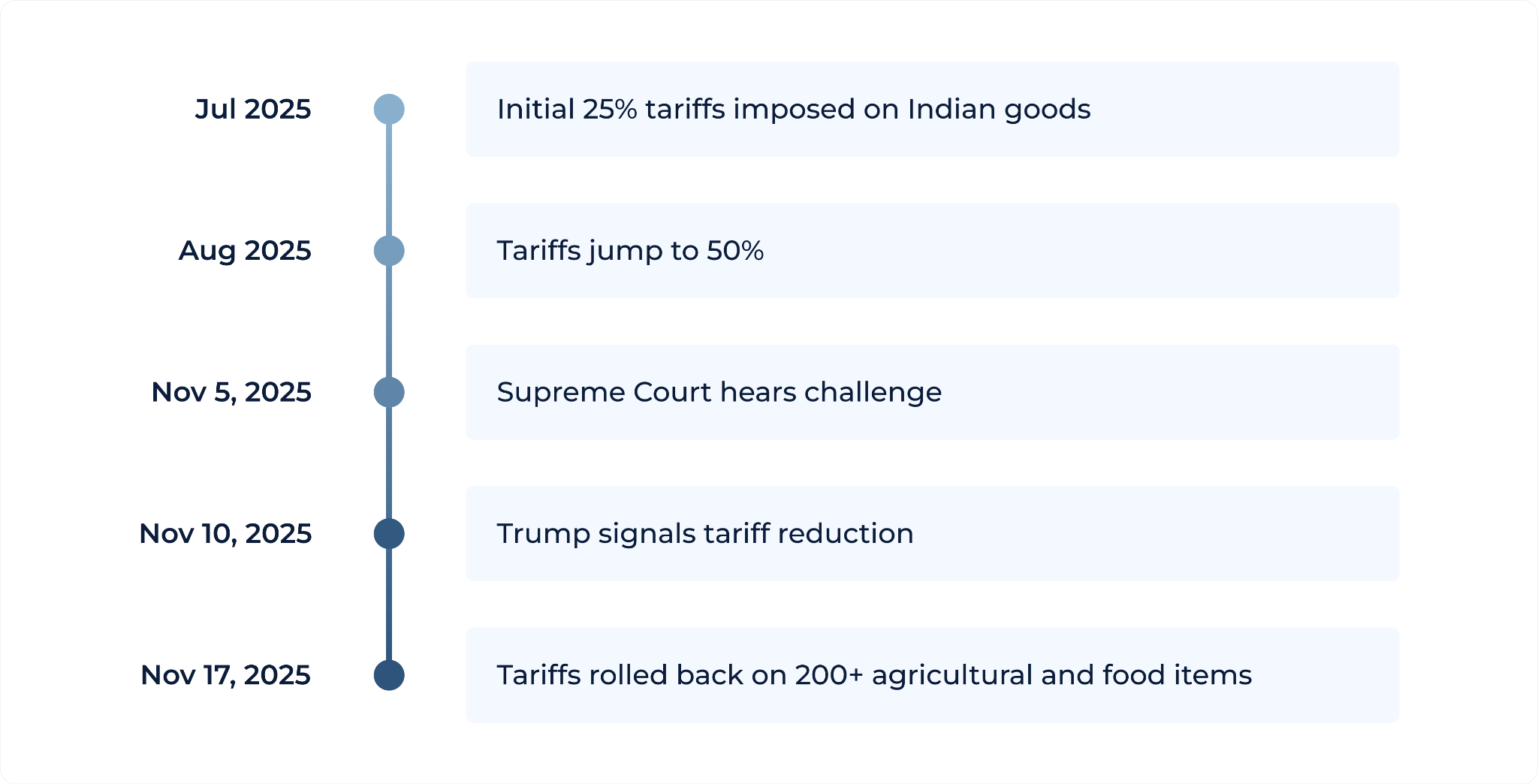
Result: Four months of volatility, uncertainty, and rising costs.
Download: India Tariff Scenario Cheat Sheet (1-Page Guide)
Based on updates reported by Reuters, Times of India, and Indian Express (Nov 10–17)
We put together a simple 1-page worksheet to help importers model the impact of:
You can use it to calculate your current tariff exposure and model three possible outcomes for your HS codes.
Download the cheat sheet here (PDF)
Related Reading — Engineered Freight Series
Part 1 : The 20-Foot Container Solution
Part 2 : HS Code Fundamentals
Part 3 : Heavy-Cargo Delivery BlueprintGet a quote for your shipment
Have a shipment to move? Send the origin, the destination, the cargo and the container or weight; we reply with the rate, the routing and the services included.