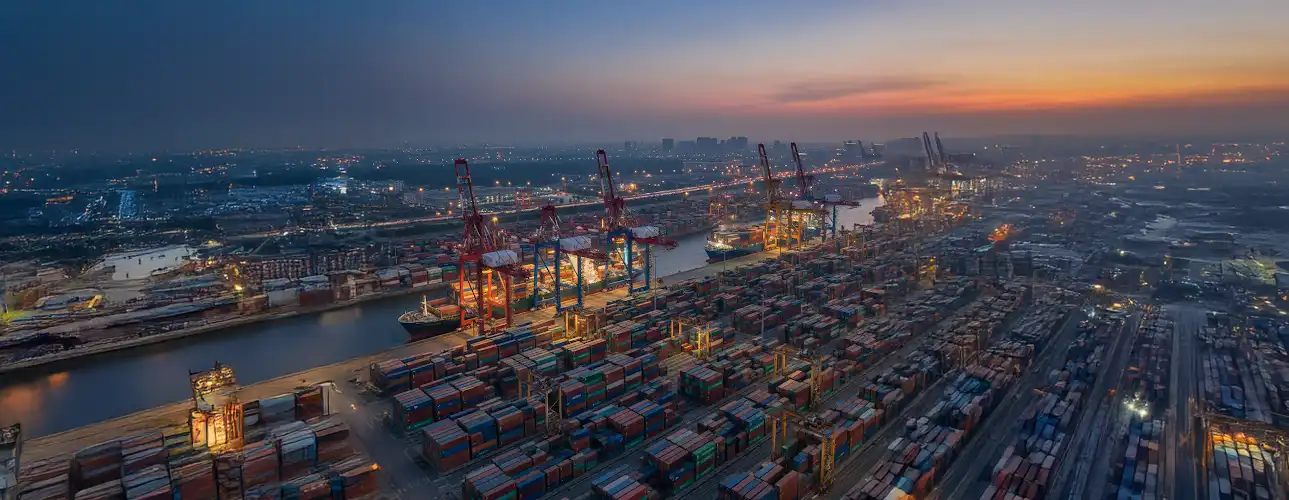


The "India Advantage" is no longer a forecast. It's a fact.
Bilateral trade between the US and India reached a record $132.2 billion in the fiscal year ending March 2025, up more than 10% from the previous year. Businesses acting on their "China+1" strategies are diversifying supply chains to India to escape punishing tariffs and build long-term resilience. For US importers, India represents opportunity, stability, and growth.
Yet in November 2025, as 50% US tariffs slam India exports and infrastructure strains under record volumes, this advantage faces its greatest test.
This is the India Infrastructure Paradox: the country's trade growth is outpacing its logistics capacity, creating a high-stakes environment where success is defined not by your sourcing strategy, but by your freight execution. Based on the realities our teams are managing at key Indian ports right now, here is your complete guide to what is happening and how to navigate it.
Part 1: Understanding the US Tariff Crisis on Indian Exports
The 50% Tariff Structure Explained On August 27, 2025, the Trump administration imposed what became a 50% tariff structure on most Indian goods—10% baseline, 25% reciprocal tariff, plus 25% penalty for India's purchases of Russian crude oil.
The impact has been severe and measurable:
India's merchandise exports to the US fell 11.9% to $5.46 billion in September
Between May and September 2025, Indian exports dropped 37.5%, from $8.8 billion to $5.5 billion
The Indian government estimates $48.2 billion worth of exports are impacted
Which Indian Exports Are Hit Hardest?
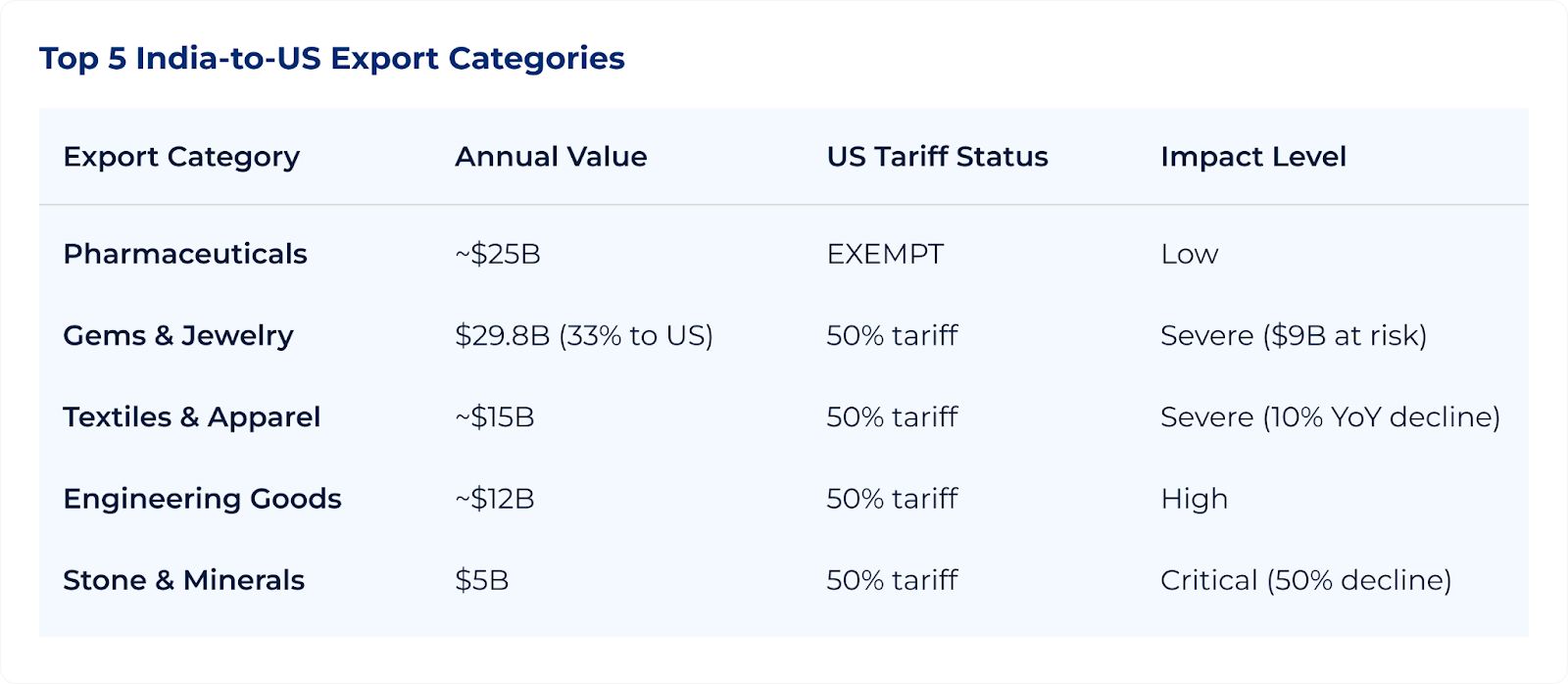
Exempted Sectors: Pharmaceuticals, semiconductors, energy equipment, and critical minerals remain exempt to protect strategic US supply chains. India supplies nearly 50% of the US pharmaceutical market with generic drugs.
Stone, Granite, and Quartz: The Tariff Impact For those of us who move stone—granite, marble, dimensional stone, and engineered quartz—the situation is particularly acute:
50% tariff caused an estimated 50% decline in stone exports short-term
Projected job losses exceeding 200,000 in India's stone industry
India's stone industry historically contributed $5 billion annually to foreign trade
Quartz producers send approximately 95% of output to US—containers now stalled at ports
India, Brazil, and China accounted for 77.3% of processed quartz value and 86% of granite value imported into the US
The binary challenge: At 50%, most shipments become economically unviable unless you have unique materials or customers willing to absorb significant cost increases.
US-India Trade Deal: Potential Tariff Reduction to 15-16%
Latest developments (October 22-24, 2025): Multiple sources including Mint and Bloomberg report that India and the US are close to finalizing a trade agreement that could reduce tariffs from 50% to approximately 15-16%.
Key components under negotiation:
Energy concession: India gradually reducing Russian crude oil imports (currently 34% of total)
Agriculture: Increased import quotas for non-GM US corn and soymeal
Review mechanism: Periodic tariff adjustments
Commerce and Industry Minister Piyush Goyal confirmed discussions are progressing with hopes for a "fair and equitable" deal. However, as of late October 2025, no formal resolution has been announced, and tariffs remain at 50%.
The uncertainty factor: Do you wait for a deal that might materialize this month? Ship now and potentially absorb 50% duties? The decision paralysis is real.
Part 2: India Port Congestion and Infrastructure Bottlenecks
JNPT, Mundra, and Chennai: Current Port Conditions While tariffs dominate conversations, massive operational challenges at Indian ports continue regardless of policy changes. Even if tariffs drop tomorrow, these infrastructure constraints will persist.
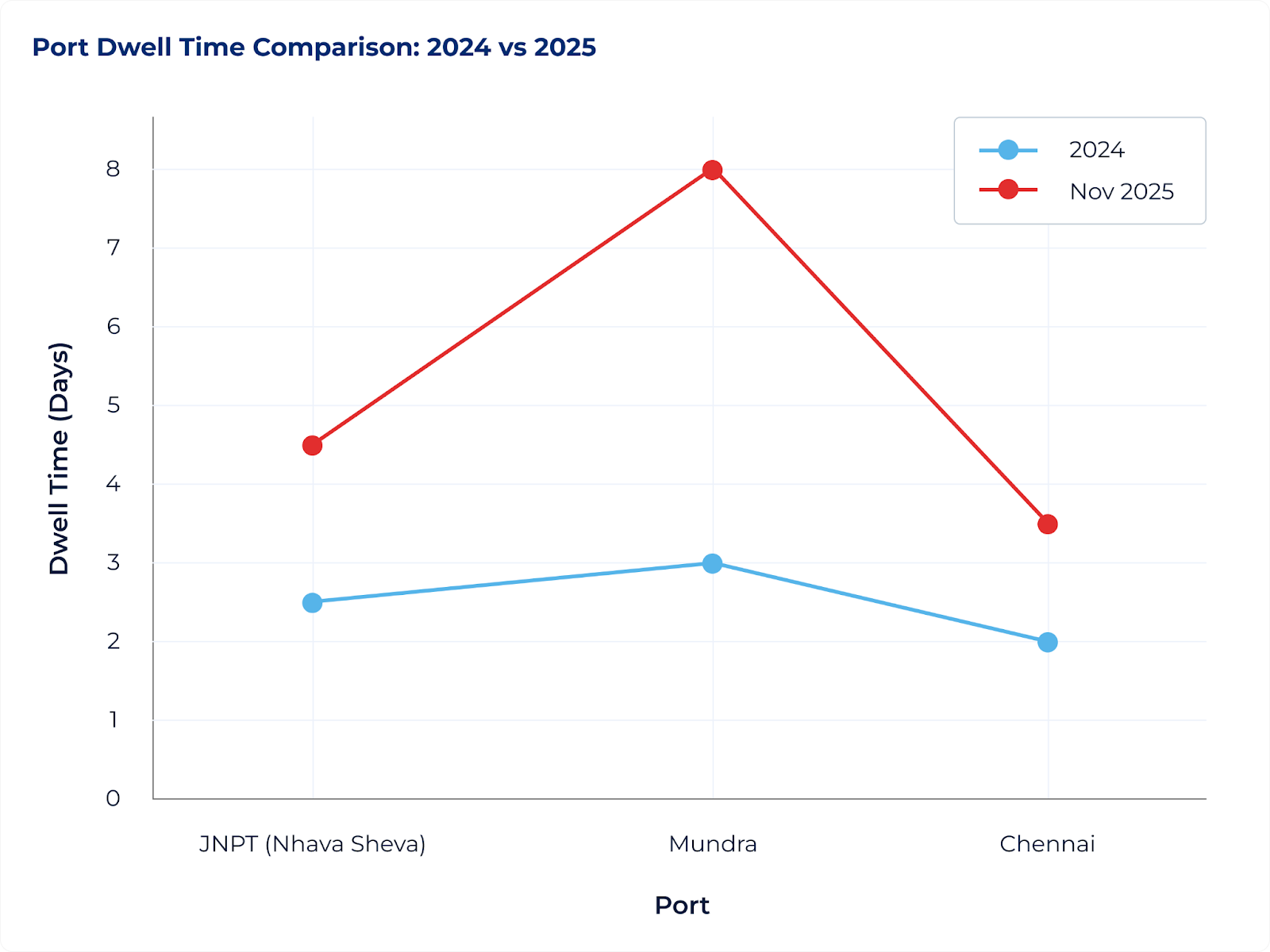
Vessel Bunching and Yard Congestion at Mundra Port The influx of cargo from North America and Europe is putting unprecedented pressure on India's primary western ports: Mundra and JNPT (Nhava Sheva). These two ports are the main gateways for cargo heading to and from North India's industrial heartland.
What we're seeing on the ground:
Vessels waiting at anchorage for berths to open up
Yard density critically high—container yards operating at 85-95% capacity
Equipment stretched thin—cranes, reach stackers, and chassis in short supply
Port dwell times extending from typical 3 days to 7-10 days during peak periods
Drayage Strikes and Inland Transport Challenges The problem isn't just on the water. In September 2025, drayage operators (truck drivers) at Mundra port staged strikes to protest deteriorating road conditions and operational inefficiencies.
Impact cascade:
Trucks stop → Containers pile up at terminals
Yard congestion worsens → Vessels can't discharge
Backlog takes 2-3 weeks to clear even after strike ends
Next cargo wave hits before system recovers
The Demurrage and Detention Cost Trap This is the direct financial cost of the paradox—and it's hitting every importer's bottom line.
How the charges work:
Demurrage: You are charged by the shipping line for every day your full container sits at the port past its "free time" (usually 3-7 days). When the port is congested or trucks are on strike, you can't get your container out, but the clock keeps ticking.
Detention: You are charged for every day you are late returning the empty container. When inland transport is gridlocked, this becomes a major hidden cost.
Real cost example: A simple 2-day drayage strike can easily become $2,000 in unavoidable demurrage fees on your invoice. One of our granite importers faced $1,800 in demurrage charges last month due to a 4-day delay at Mundra that was completely outside their control—port congestion meant no trucks were available even though their customs was cleared.
This is the "hidden cost" of cheap freight—the operational reality that erases all savings from a good quote.
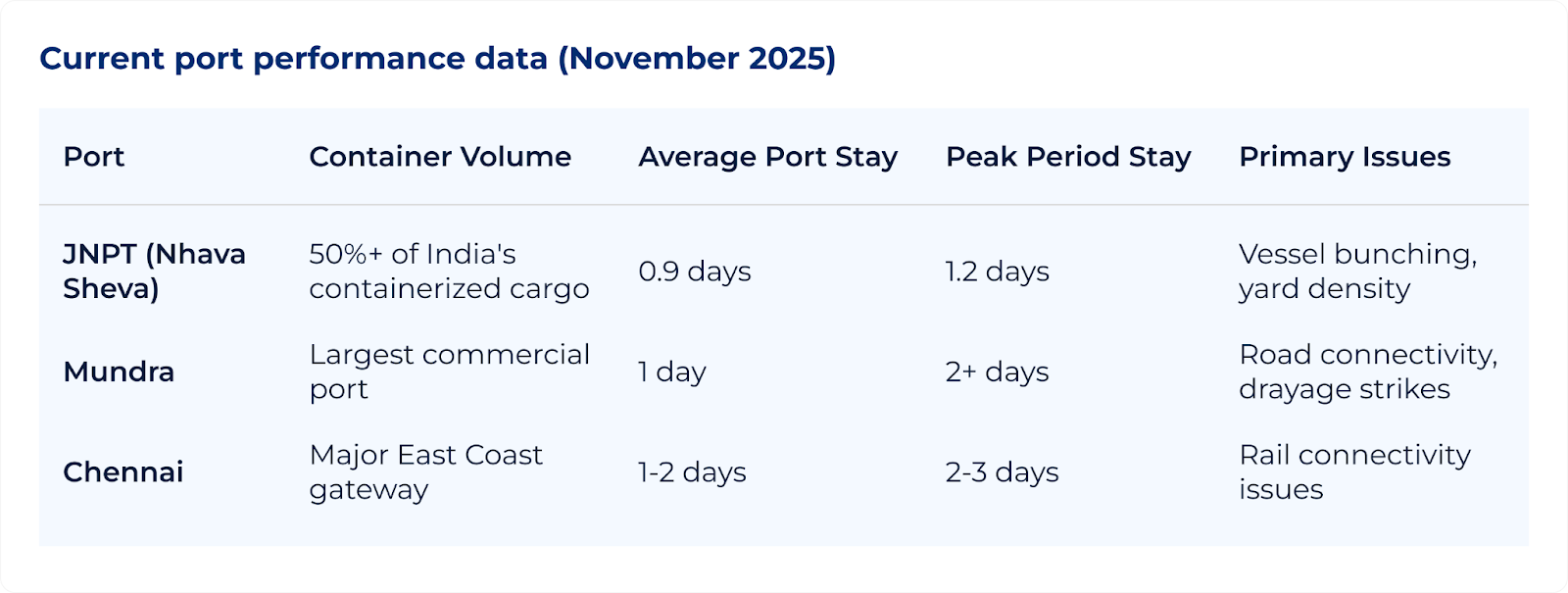
Key insight: Port congestion has nearly doubled across all major Indian ports in 2025, with Mundra experiencing the most severe deterioration. This isn't a temporary spike—it's the new baseline until infrastructure catches up with trade volume.
Part 3: Why Stone and Granite Importers Face Unique Challenges
While all importers feel the squeeze from both tariffs and infrastructure constraints, importers of granite, marble, and dimensional stone are uniquely vulnerable to this paradox.
Challenge #1: The 20-Foot Container Equipment Shortage
The weight problem:
Stone is dense. A 20-foot standard container (20'DC) loaded with granite or quartz will hit its maximum legal road weight limit of 44,000 lbs (approximately 20,000 kgs) long before it runs out of space.
This creates two immediate problems:
Equipment Imbalance:
Market is flooded with 40-foot containers for light, bulky consumer goods
Stone importers fight constantly for the limited supply of 20'DCs
During port congestion, 20' containers are even scarcer
Higher Per-Slab Cost:
You pay for more containers to move the same product volume
Every demurrage charge, every delay hits harder
Sensitivity to fees and delays is 2-3x higher than light cargo
Challenge #2: Specialized Heavy-Duty Trucking Requirements
This is the single biggest operational risk for stone importers.
Moving a 28-ton, fully-loaded 20' container from Mundra port to an inland factory doesn't just require a truck—it requires a specialized heavy-duty trailer and permit.
When drayage strikes hit or congestion creates truck shortages:
Standard trucks can move apparel containers (40' high-cube)
Stone importers cannot find alternatives
Specialized heavy trailers disappear first
Stone importers pay 2x to 3x normal rates to secure the only trucks that can legally move their cargo
Challenge #3: Handling Risk and Product Damage
Stone is heavy, but it's also fragile.
Slabs and tiles require:
Specialized handling equipment
Robust crating, blocking, and moisture protection
Careful lifting and loading procedures
Dry, stable ground conditions
A congested port is a fast port — not a careful one. And when weather disruptions occur, the risks multiply.
Real Operational Impact – October 2025 Flooding at Mundra
In late October 2025, heavy rainfall flooded key operational zones at Mundra Port. Several container stacks were positioned in low-lying areas that became waterlogged, temporarily halting equipment movement. Importers of granite and marble reported moisture intrusion in containers and extended delays in retrieving discharged cargo. For stone importers, even a small amount of water exposure can lead to surface staining, resin discoloration, and insurance disputes—turning what appeared to be a routine delay into a costly operational setback.
With 50% tariffs already tightening margins, these weather-related disruptions highlight an important reality:
Stone importers are not just fighting policy and congestion. They are fighting environmental exposure and handling risk every time a shipment sits in a congested yard with no movement.
Part 4: Your 4-Strategy Playbook for Navigating India-US Trade Now
Strategy #1: Track Port Dwell Time, Not Vessel ETA
Stop relying on carrier ETAs. Start tracking what matters.
Your carrier's vessel ETA is a fantasy. The only number that matters is port dwell time—the real, on-the-ground average of how long a container sits at the terminal after discharge before getting on a truck.
What good partners provide:
Real-time dwell time data by terminal
Historical averages vs. current conditions
Alerts when dwell time spikes above normal
Knowing your ship is "on time" is useless. Knowing that current dwell time at Mundra is 9 days instead of 3 is actionable intelligence. You can:
Manage customer expectations realistically
Adjust production schedules
Execute proactive solutions (Strategy 2)
Critical for November 2025
Strategy #1:
Monitor tariff deal announcements alongside port data. If tariffs drop from 50% to 15%, expect a cargo surge that will temporarily worsen congestion as exporters rush to fulfill backlogged orders.
Strategy #2: Operate on a 14-Day Pre-Arrival Timeline
The 72-hour post-booking execution window doesn't exist in congested markets.
For India, you must operate on a 14-day pre-arrival timeline.
Three non-negotiable actions:
1. Pre-Clear Customs Before Vessel Arrival
File Bill of Entry and all documentation before vessel berths
Clear customs while container is still on water
When discharged, container is ready for immediate pickup—not waiting for paperwork
2. Book Heavy-Duty Trucks Before You Book Your Shipment
Critical for stone importers: Secure specialized heavy-duty drayage days in advance
By the time your container is available, you're competing with hundreds of importers for a handful of available trucks
You must be first in line, not part of the scramble
3. Establish 24/7 Human Escalation Paths
When a container is "stuck" in the yard, algorithms can't fix it
You need a person on the ground in India who can call the terminal manager and trucking dispatcher
Physical location and problem-solving in real-time
Strategy #3: Diversify Port Routing Beyond Mundra and JNPT
Are all your suppliers routing through JNPT or Mundra? It's time to ask why.
Analyze total door-to-door transit time, not just ocean transit:
It may be worth paying your supplier to truck cargo an extra day inland to a less-congested port like Chennai.
The math:
Ocean transit from Chennai (East Coast) to US East Coast might be 3-5 days longer
But you shave 7-10 days of port congestion off the front end
Net result: You're positive by a week, with lower demurrage risk
Don't be fooled by cheaper freight rates from Mundra. The total landed cost—including demurrage fees, detention charges, and inland transport premiums—is the only number that matters.
Strategy #4: Demand Human Expertise, Not Just Digital Tracking
This is the ultimate lesson of the India Infrastructure Paradox: technology alone will fail you.
A digital tracking portal can tell you your container is "delayed." It cannot tell you why. It cannot tell you drayage drivers are on strike. And it absolutely cannot negotiate a solution.
In a volatile, infrastructure-constrained, tariff-uncertain market, your partner's human expertise is the solution:
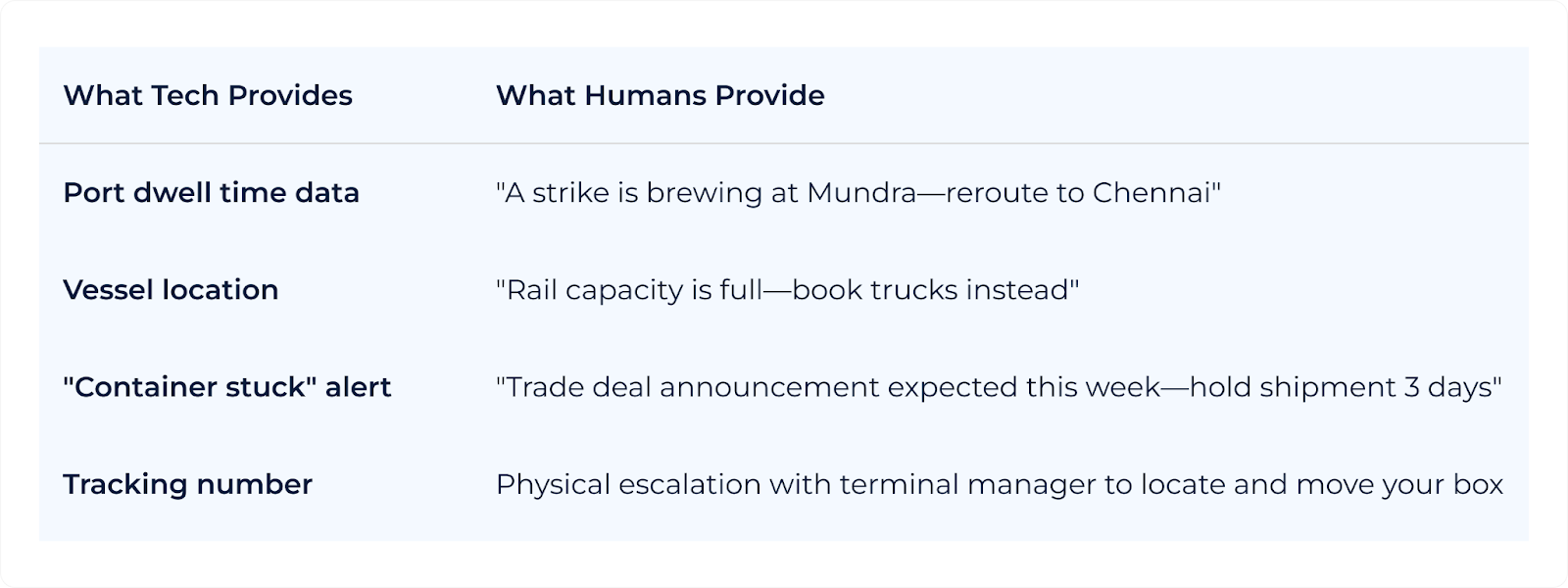
The "tech and human balance" isn't a marketing slogan; it's the only operating model that works in India today.
The Bottom Line: Chaos Exists. Experts Navigate It.
The India Advantage is real. The strategic opportunity to build a resilient, cost-effective supply chain by sourcing from India remains compelling, even in the face of temporary tariff challenges.
But here's what separates winners from losers in this environment: execution.
By focusing only on the macro "good news"—the record trade figures, the China+1 narrative—many US importers are being blindsided by the micro "operational reality" of a 50% tariff, a drayage strike, or a congested terminal. And in doing so, they are watching their hard-won savings get eaten alive by demurrage, detention, emergency trucking fees, and tariff costs that make shipments economically unviable.
The tariff situation adds another layer of complexity. At 50%, many shipments—especially in stone, textiles, and other labor-intensive sectors—simply don't pencil out. If tariffs drop to 15-16% through a trade deal, the economics improve dramatically, but the resulting cargo surge will test already-strained infrastructure.
The chaos is real. The question is: who's navigating it with you?
Why Airlift USA Exists for Moments Like This
We are a US-based freight forwarder with over 30 years of India-US trade lane expertise and operational teams in both countries. We were built for exactly this environment.
Here's what that means for you:
When Port Congestion Hits
Other forwarders send you a tracking alert: "Container delayed"
We send you intelligence: "Mundra yard density at 92%. We've pre-booked heavy-duty trucks and filed your customs while the vessel is still 2 days out. You'll clear same-day on discharge."
When Drayage Strikes Happen
Other forwarders tell you: "There's a strike, nothing we can do"
We tell you: "Strike brewing at Mundra. We've rerouted your next two shipments through Chennai and secured alternative trucking at locked rates."
When Tariffs Create Uncertainty
Other forwarders quote you a rate and disappear
We monitor trade negotiations daily and advise you: "Hold shipment 72 hours—deal announcement expected. If tariffs drop to 15%, we execute immediately."
When Equipment Shortages Cripple Stone Imports
Other forwarders say: "20-foot containers are hard to find right now"
We say: "We've secured 20'DC allocation through our carrier partnerships and pre-positioned specialized heavy trailers for your granite—you're protected."
This Is What Three Decades of India-US Expertise Looks Like
Working with Airlift doesn't just get you a freight rate. It gets you:
✅ Risk mitigation built into every shipment — We anticipate problems before they touch your cargo
✅ Real-time intelligence from both countries — Our teams in India and the US communicate daily about port conditions, strikes, weather, and policy changes
✅ India-based execution support when it matters — Physical presence at JNPT, Mundra, and Chennai with direct terminal and customs relationships
✅ US-based account management that understands your business — We speak your language, operate in your time zone, and answer to your standards
✅ Honest timelines based on ground truth — We don't sell you fantasy ETAs; we tell you what's actually happening and what it means for your delivery schedule
The solution isn't to abandon India. The solution is to partner with someone who has been successfully navigating these lanes since before "China+1" was a buzzword.
Surf the High Tides with Us
The next few weeks will be critical. Whether tariffs drop or persist, whether ports ease congestion or face new surges, Airlift will be on the ground in both countries navigating the reality as it unfolds—because we've been there for 30 years, and we're not going anywhere.
The chaos isn't going away. But with the right partner, it doesn't have to sink your strategy.
Ready to move your India cargo with confidence?
If you're a US-based importer shipping stone, granite, quartz, textiles, or any India-origin cargo, let's talk about how our dual-country presence and three decades of India-US expertise can turn operational complexity into competitive advantage.
? Contact Airlift USA today — Because in chaotic markets, experience isn't just valuable. It's the difference between profit and loss.
Airlift USA: US-based. India-experienced. Built for the India-US trade lane.
Get a quote for your shipment
Have a shipment to move? Send the origin, the destination, the cargo and the container or weight; we reply with the rate, the routing and the services included.