


Ocean freight invoices in 2024 began showing a new cost line: the ETS Surcharge. For many importers, it initially appeared as a minor environmental compliance fee with limited budget impact.
That is changing in 2025.
As of January 1, 2025, the European Union has increased its maritime Emissions Trading System (ETS) mandate, requiring ocean carriers to pay for 70% of their reported CO₂ emissions, up from 40% in 2024. This will increase again to 100% in 2026, making it a growing and permanent cost component of global ocean freight.
ETS Compliance Timeline: What Is Changing Between 2024–2026
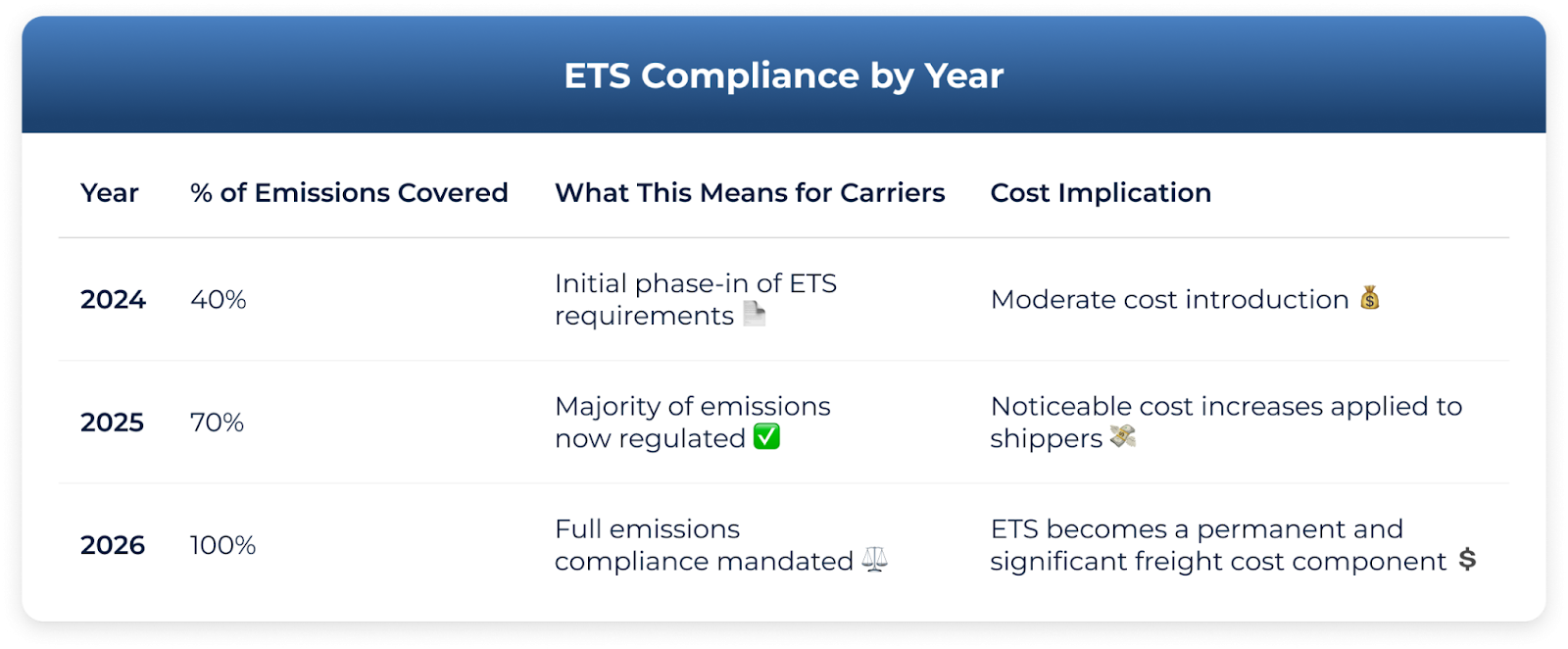
While the ETS is an EU policy, it is not confined to European trade lanes—importers on Trans-Pacific, South Asia, and Middle East routes are also seeing this surcharge applied. Understanding why this is happening is essential for accurate landed cost planning in 2025–26.
What Is the ETS Surcharge?
The EU Emissions Trading System (ETS) is a cap-and-trade mechanism designed to reduce greenhouse gas emissions. Under this system, ocean carriers must purchase carbon allowances (known as EUAs) to cover a percentage of CO₂ emissions for voyages involving EU ports.
These costs are not optional and must be paid by carriers to comply with EU law.
Why ETS Surcharges Are Appearing on Non-EU Trade Lanes
The ETS regulation itself only applies to voyages that load, discharge, or transship cargo at an EU port. However, most major carriers operate global fleets rather than dedicating single vessels to specific trade lanes. As part of their cost management strategies, some carriers have chosen to allocate ETS compliance costs across a wider range of routes—including those that do not directly call at Europe.
This allocation is not mandated by the EU, but a carrier-driven pricing practice. It has been noted in carrier advisories and industry reporting and has also been the subject of discussion among shipper associations and trade bodies.
What This Means for Importers:
A shipment traveling from Asia to the U.S. may incur an ETS surcharge even if the cargo never calls in Europe.
The surcharge reflects how carriers distribute overall fleet costs, rather than the regulatory scope of the individual shipment.
This practice has led to debate within the industry about transparency and cost justification.
For importers, the key takeaway: ETS surcharges are becoming a recurring cost factor that must be planned for—regardless of whether your cargo touches Europe.
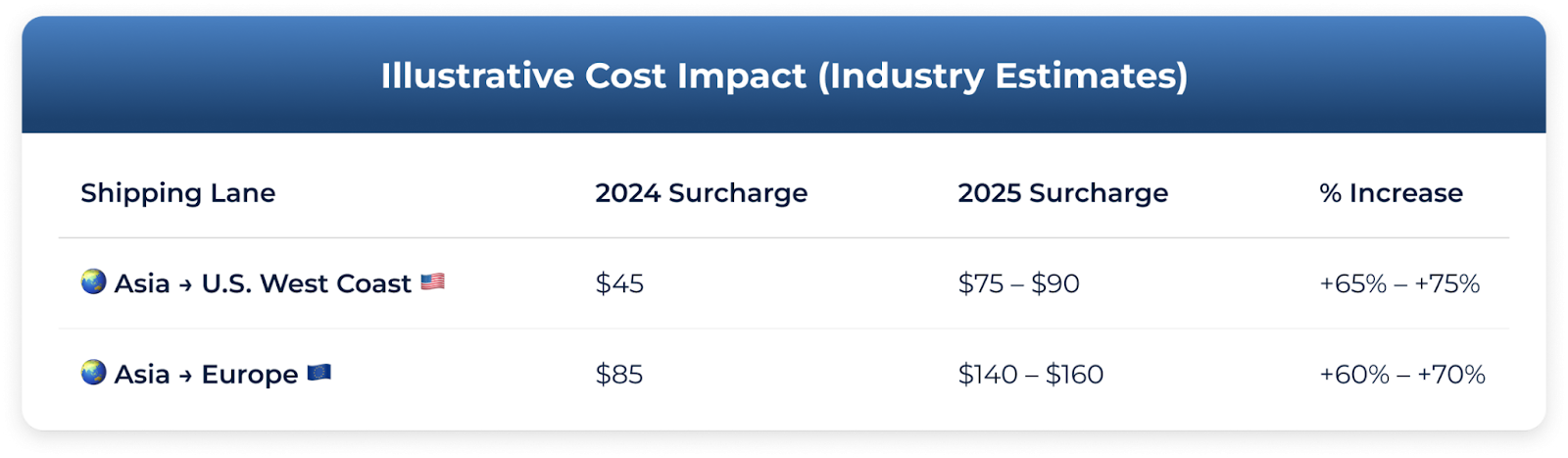
Note: Figures shown are illustrative estimates based on published carrier advisory ranges and prevailing carbon allowance market trends. Actual surcharges will vary by carrier, fuel type, and vessel emissions efficiency. Carriers such as Maersk and MSC have stated that ETS surcharge levels will be reviewed quarterly in line with EUA price adjustments.
What This Means for Importers
The ETS surcharge reflects carrier compliance with EU carbon regulations and cannot be negotiated or waived. However, industry groups have noted ongoing debate over how these costs are allocated across trade lanes, particularly on non-EU routes. As ETS coverage increases to 100% in 2026, and as carbon allowance prices fluctuate on open markets, its contribution to freight costs may rise significantly.
Importers who do not account for ETS in forward budgets may face unexpected cost overruns.
Conversely, those who proactively model ETS as part of their landed cost planning will be better positioned to manage pricing and preserve margins.
How Importers Are Responding
Industry data and importer behavior indicate a shift toward proactive freight planning:
1. Evaluating Carrier Emissions Profiles
Carriers deploying newer, fuel-efficient or alternative-fuel vessels may pass on lower ETS costs.
2. Requesting All-In Cost Visibility
Rather than evaluating base ocean rates alone, importers are increasingly requesting full landed cost forecasts—including ETS projections.
3. Including ETS in 2025–26 Budgeting
Many businesses are adding a “sustainability compliance” line to freight budgets to account for ongoing ETS increases.
Conclusion: Planning Now vs. Reacting Later
The ETS surcharge is no longer a short-term adjustment—it is now part of the global freight cost structure. While the regulation itself applies only to EU-related voyages, carriers’ cost allocation strategies mean that importers worldwide are seeing ETS surcharges applied across multiple trade lanes, including Asia–U.S. routes.
In an environment where freight costs are influenced not just by fuel and capacity, but also by regulatory and environmental compliance factors, understanding your true landed cost is essential to maintaining profitability.
At Airlift USA, we are actively monitoring ETS developments and carrier advisories to help importers gain early visibility into cost changes—not after invoices are issued.
If you would like a lane-level overview of how ETS may affect your freight costs in 2025–26, our team can share a neutral cost planning breakdown based on current carrier guidance.
This is not a sales consultation—it is a planning discussion designed to support cost transparency.
For importers navigating the year ahead, clarity is no longer optional—it’s a financial requirement.
Get a quote for your shipment
Have a shipment to move? Send the origin, the destination, the cargo and the container or weight; we reply with the rate, the routing and the services included.