


One year later, a clear pattern has emerged
A year after “Liberation Day”—the April 2025 tariff reset—there’s now enough distance to see what actually happened.
Over the past 12 months, tariffs didn’t just increase costs or disrupt trade flows.
They changed how decisions were made.
And one pattern stands out clearly:
Companies that reacted faster didn’t necessarily perform better than those that structured their decisions more carefully.
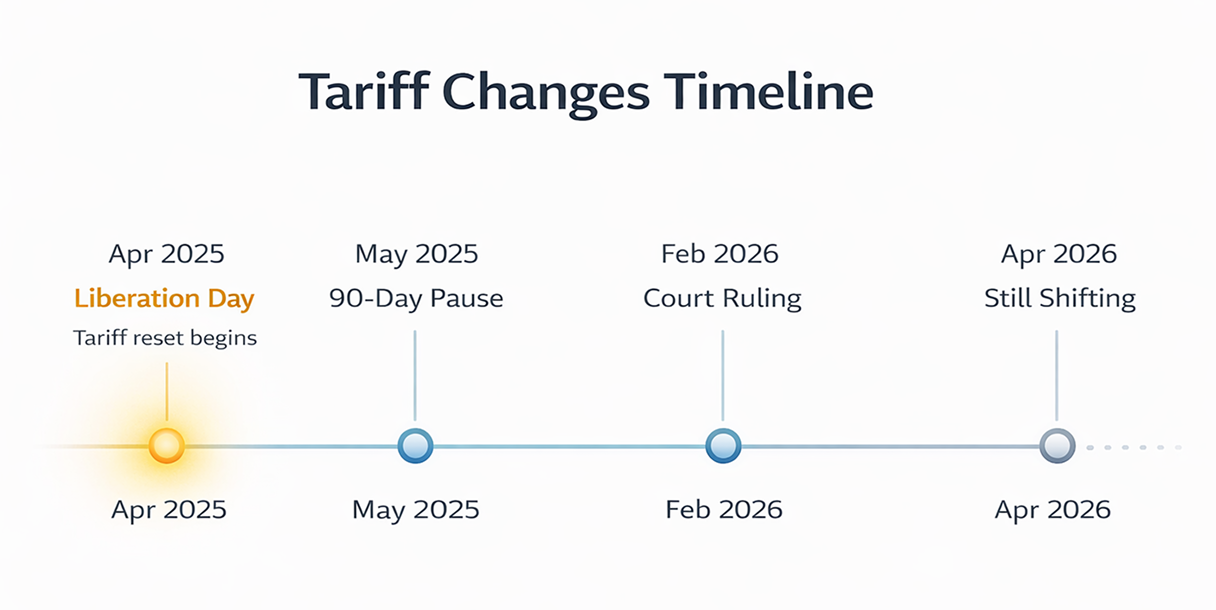
The assumption that didn’t hold
In the months following April 2025, most importers treated tariffs as a timing problem.
Move faster.
Ship earlier.
Adjust quickly.
The assumption was simple: speed reduces exposure.
But as policy expanded—across Section 232, Section 122, and sector-specific actions—it became clear this wasn’t a one-time disruption.
It was an evolving system.
And speed alone can’t beat a system.
When “reacting” created new problems
Over the past year, a consistent pattern emerged across the market.
Companies optimized for immediate tariff impact…
but created second-order issues.
Inventory pulled forward without demand certainty
Warehousing constraints tightening unexpectedly
Cash flow pressure from accelerated purchasing cycles
Pricing decisions made before policy clarity
None of these were irrational decisions.
They were fast decisions.
But in a system that kept shifting, speed without structure amplified risk instead of reducing it.
The real constraint wasn’t cost
Most early analysis focused on rising costs.
But the deeper challenge turned out to be something else:
uncertainty.
Costs didn’t just increase.
They became unstable.
Policy didn’t just change.
It became harder to anticipate.
And that changes what “good decisions” look like.
What actually worked
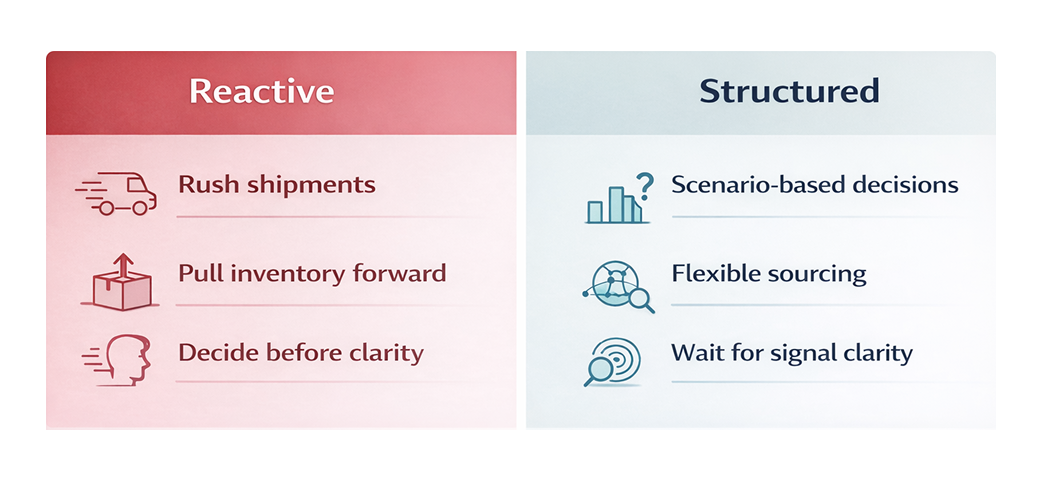
After a year in this environment, the dividing line is clear.
It isn't between fast and slow companies.
It’s between reactive and structured ones.
What didn’t work:
Optimizing for speed alone
Treating tariffs as isolated events
Acting on incomplete signals
What did:
Building flexibility into sourcing and routing
Structuring decisions around scenarios, not assumptions
Delaying commitment until key variables were clearer
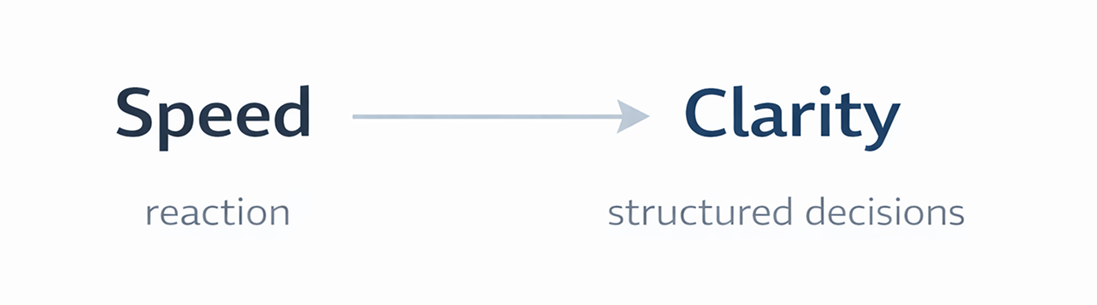
The advantage shifted from speed to clarity.
The takeaway most companies are missing
Tariffs are now driving decisions across supply chains.
But not all of those decisions are being made well.
The companies losing ground aren’t necessarily the slowest.
They’re the ones still reacting to each change—
instead of adapting how they decide in the first place.
Closing
You can’t control the policy. But you can control how you make decisions around it.
At Airlift, this is where the conversation has shifted.
Not just how cargo moves—
but how decisions are made before it does.
Get a quote for your shipment
Have a shipment to move? Send the origin, the destination, the cargo and the container or weight; we reply with the rate, the routing and the services included.