

Recent court rulings may lead to the reversal of tariffs imposed under the International Emergency Economic Powers Act (IEEPA), potentially affecting hundreds of thousands of U.S. importers.
Industry estimates suggest that $160B–$175B in duties could ultimately be refunded — making this one of the largest tariff reversals in U.S. trade history.
For companies that imported goods during the affected period, understanding the evolving refund process could have significant financial implications. While the operational process is still developing and several uncertainties remain, importers should understand what has happened so far, what may happen next, and what steps they may wish to consider now.
What Happened — The Timeline
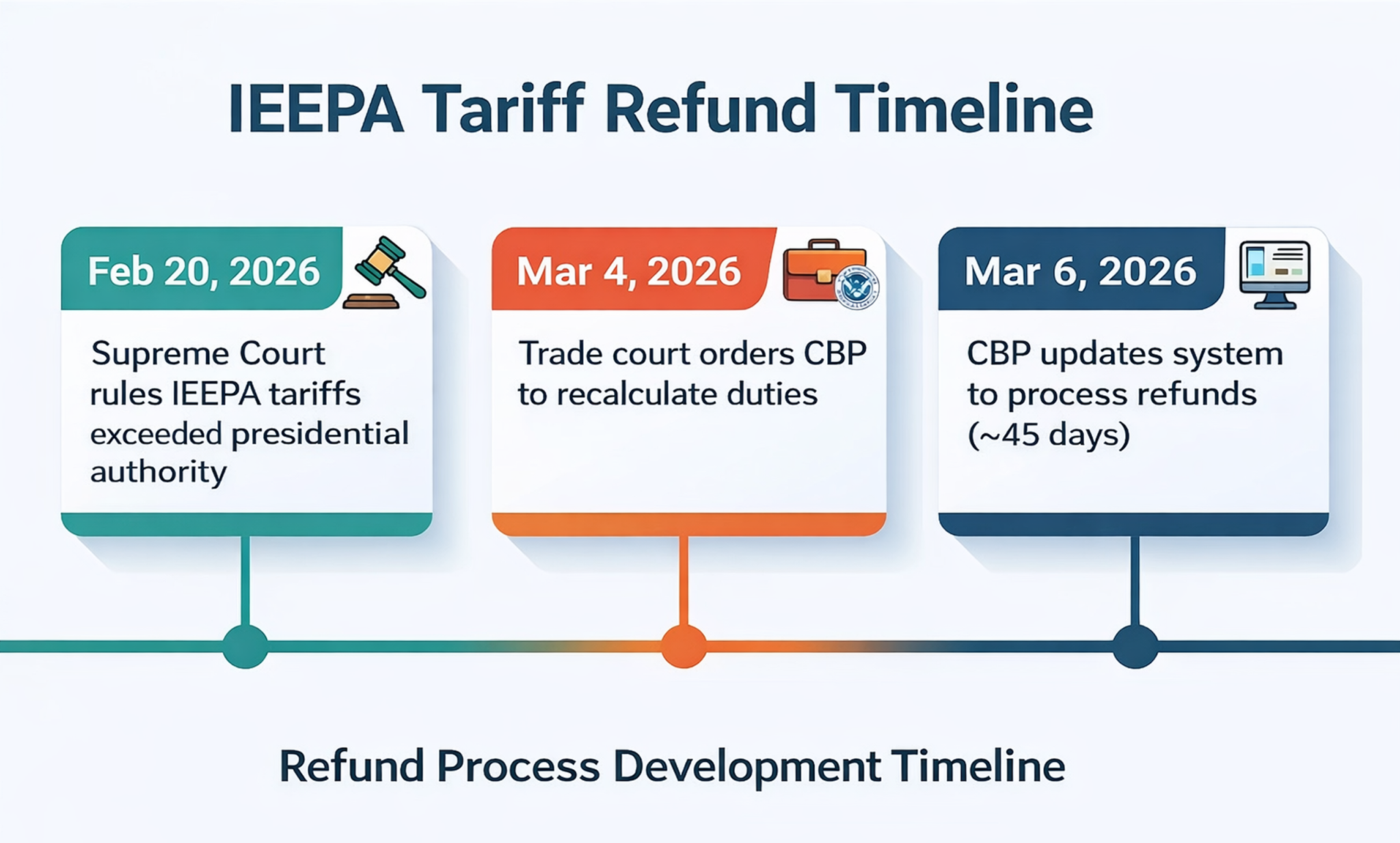
February 20, 2026 — U.S. Supreme Court Decision
The U.S. Supreme Court ruled that tariffs imposed under the International Emergency Economic Powers Act (IEEPA) exceeded presidential authority. The Court determined that emergency powers cannot be used to impose tariffs, effectively invalidating the duties that had been applied to imported goods under this authority.
For importers who paid these tariffs, the ruling opened the possibility that those duties may eventually be refunded.
March 4, 2026 — Court of International Trade (CIT) Order
The U.S. Court of International Trade (CIT) directed U.S. Customs and Border Protection (CBP) to begin recalculating duties on imports that were subject to IEEPA tariffs.
Importantly, the court clarified that all importers of record may benefit from the ruling, not just the companies that participated in the original lawsuits.
The order instructs CBP to:
Liquidate unliquidated entries without IEEPA duties
Reliquidate entries that have been liquidated but are not yet final
This means that many importers may now be eligible to pursue refunds depending on the status of their import entries.
March 6, 2026 — CBP Update on Refund Processing
Two days later, CBP informed the court that its systems are not yet capable of processing refunds at the scale required.
More than 53 million import entries could potentially be affected. To address this, CBP plans to implement new functionality within the Automated Commercial Environment (ACE) portal.
CBP indicated that it expects to develop these system capabilities within approximately 45 days, though the overall refund process could take months or longer due to the volume of entries involved.
The Refund Process — How It Is Expected to Work
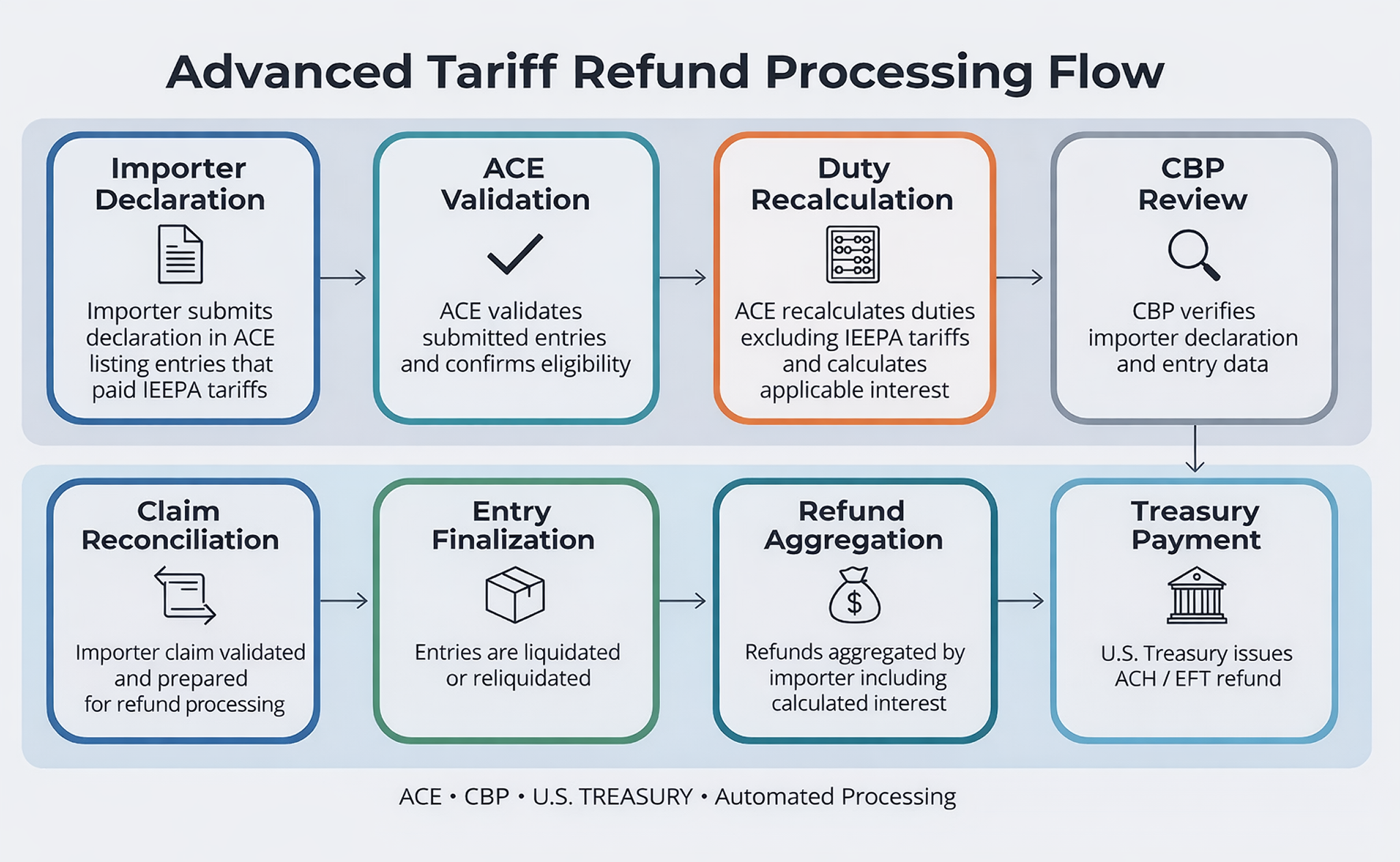
According to CBP’s court filing, the refund process will rely heavily on the ACE portal, the system used by importers and customs brokers to manage import data.
The proposed process may involve the following steps:
Importer Declaration in ACE
Importers submit a declaration listing the entries on which IEEPA duties were paid.ACE Validation
The system validates the listed entries and confirms eligibility.Duty Recalculation
ACE automatically recalculates duties owed without the IEEPA tariffs, including applicable interest.CBP Review
CBP reviews and verifies the importer’s declaration.Entry Finalization
ACE liquidates or reliquidates entries as required.Refund Aggregation
The system aggregates refunds and interest by importer, rather than issuing separate refunds for each entry.Treasury Payment
Once certified by CBP, refunds are issued electronically by the U.S. Department of the Treasury.
This approach is intended to streamline a process that would otherwise require millions of individual refund transactions.
⚠️ Important: Refunds Are Not Automatic
Importers may need to review their entries and take action depending on entry status.
Unliquidated entries may be adjusted automatically during liquidation.
Recently liquidated entries may require filing a protest within 180 days of liquidation.
Understanding the status of each entry will be important in determining whether action is required.
What Importers Can Do to Prepare
While the refund process is still evolving, importers may wish to begin preparing their internal data and systems. Early preparation may help companies avoid delays once CBP’s refund process becomes operational.
Key steps to consider include:
Confirm ACE portal access and ensure the appropriate importer account permissions are active
Verify ACH refund setup to ensure electronic refunds can be received through the ACE portal
Identify import entries where IEEPA duties were paid, particularly imports dating back to early 2025
Review liquidation status of affected entries to determine whether they are unliquidated or recently liquidated
Monitor protest deadlines for recently liquidated entries (generally 180 days)
Because procedures and timelines are still evolving, many importers may wish to consult a licensed customs broker or trade attorney to better understand their specific situation.
The Section 122 Tariff — The Other Side of the Equation
While the IEEPA tariffs have been invalidated, the tariff landscape continues to evolve.
Following the Supreme Court ruling, the administration implemented a temporary Section 122 tariff under the Trade Act of 1974.
Category | Details |
Tariff Rate | 10–15% |
Effective Date | February 24, 2026 |
Maximum Duration | 150 days |
Scheduled Expiry | July 24, 2026 |
For importers, this creates a new planning window around shipment timing, landed cost calculations, and supply chain decisions between now and the scheduled expiry date.
What’s Still Uncertain
On March 6, the Court of International Trade temporarily suspended its directive requiring immediate refund processing, allowing CBP time to develop new ACE functionality to handle the unprecedented volume of refunds.
Despite the court rulings, several factors could affect how quickly — or whether — refunds are ultimately processed.
These include:
The U.S. government has indicated it may appeal the CIT order
Litigation related to the tariffs may continue for an extended period
CBP is still developing the technical systems needed to process refunds at scale
Final administrative procedures have not yet been published
While the possibility of refunds exists, the timeline and final process remain uncertain. Importers should avoid treating refunds as guaranteed or imminent until additional guidance is released.
How Airlift (U.S.A.), Inc. Is Tracking These Developments
At Airlift (U.S.A.), Inc., we are closely monitoring developments across the global trade and customs landscape.
As CBP guidance and the refund process continue to evolve, we will share updates with our clients and partners to help them stay informed about changes that may affect their shipments and supply chain planning.
If your company imported goods during the period affected by the IEEPA tariffs, now may be a good time to review your import activity and consult with a licensed customs broker or trade attorney to better understand your options.
To stay informed as this situation develops, contact our team or subscribe to our trade updates.
Disclaimer:
This article is provided for informational purposes only and does not constitute legal or customs compliance advice. Importers should consult a licensed customs broker or qualified trade attorney for guidance specific to their situation.
© 2026 Airlift (U.S.A.), Inc. All rights reserved.
Get a quote for your shipment
Have a shipment to move? Send the origin, the destination, the cargo and the container or weight; we reply with the rate, the routing and the services included.