


The container shipping industry is consolidating — again.
On April 30, ZIM shareholders vote on a $4.2 billion acquisition by Hapag-Lloyd. If approved, the combined entity would operate more than 400 vessels with capacity exceeding 3 million TEU, further strengthening Hapag-Lloyd’s position among the world’s largest carriers.
Most coverage focuses on the deal itself.
But that’s not what matters.
The real story is what this signals about where the industry is heading — and what that means for how decisions need to be made going forward.
This Isn’t Crisis-Driven Consolidation
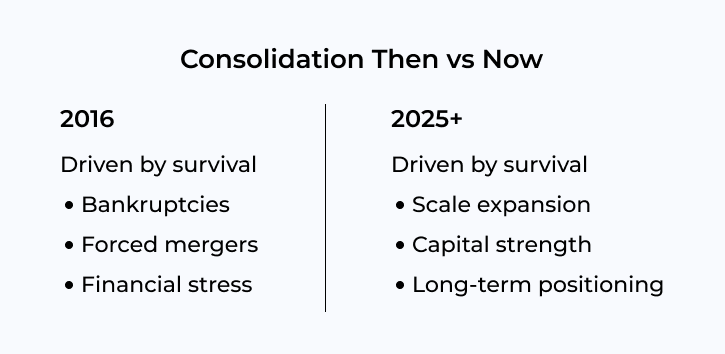
The last major wave of consolidation in shipping was driven by financial stress.
The industry at the time was fragile — marked by the collapse of Hanjin Shipping and a series of defensive mergers across major carriers. Consolidation was not a choice. It was a necessity.
Back then, the objective was survival.
Today, the situation is very different.
Carriers are entering this phase of consolidation from a position of financial strength, supported by the profits generated during the post-pandemic cycle.
That changes the nature of what’s happening.
As industry observers have noted, this creates a rare window where large-scale, strategic deals are not only possible, but rational.
This isn’t consolidation driven by distress.
It’s consolidation driven by intent.
Scale Is Becoming the Defining Advantage
The gap between the largest carriers and the rest of the market has widened dramatically.
The largest players now control a disproportionate share of global capacity and fleet expansion, while the top carriers collectively dominate the majority of the market.
For mid-sized carriers, this creates a strategic dilemma:
They are large enough to compete — but not large enough to dominate.
That is why consolidation is accelerating.
Not because the industry is collapsing, but because the competitive gap is widening.
At the Same Time, the Operating Environment Is Becoming Less Stable
While carriers are consolidating at the top, the environment they operate in is becoming more volatile.
Fuel costs are once again unpredictable, influenced by geopolitical tensions and supply disruptions.
Tariffs remain uncertain, forcing importers to either absorb rising costs or adjust volumes.
And network reliability — once taken for granted — is increasingly conditional. Routes that were stable a few months ago now carry risk, and cargo is being rerouted through alternative hubs.
The result is a system where:
Costs are not stable
Routes are not fixed
Policy is not predictable
Fewer Players, More Volatility
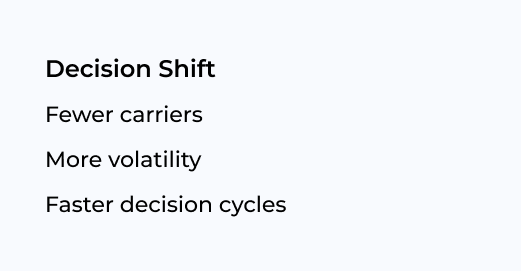
Put these trends together, and the shift becomes clear.
The industry is moving toward a structure where:
Fewer carriers control more capacity
But the environment they operate in is more unstable
That combination changes the nature of decision-making.
Short-term disruption increases
Mergers don't just change ownership. They change service structures, account relationships, and network strategies. Teams that managed your account get reorganized. Contracts get revisited under new commercial frameworks. Lane strategies shift as the combined entity rationalizes overlapping services.
Importers and forwarders operating on affected lanes will feel this operationally — in service reliability and response times — before it shows up in pricing.
Planning assumptions break faster
Even well-reasoned decisions can fail when the underlying variables shift unexpectedly. A rate locked in under one carrier structure may not reflect the market six months into an integration. A routing built around a carrier's current network may change as services are consolidated.
The problem isn't bad planning — it's that the assumptions the plan was built on have a shorter shelf life than they used to. In a consolidating market, that cycle accelerates.
What This Means in Practice
The challenge today isn’t just about choosing the right carrier or securing the right rate.
It’s about recognizing that the assumptions behind those decisions are no longer stable.
In practical terms, that means:
Shorter planning cycles
Scenario-based thinking
Continuous reassessment of cost and routing assumptions
Decisions that made sense six months ago may not hold today — not because they were wrong, but because the environment has changed.
The Bigger Signal
The ZIM–Hapag-Lloyd vote is not just an isolated event.
It’s part of a broader shift in how the shipping industry is being structured.
Carriers are consolidating while they are financially strong.
They are expanding scale while the competitive gap widens.
And they are doing so in an environment where volatility is increasing, not decreasing.
Final Thought
The question isn’t whether this merger goes through.
It’s whether your carrier strategy is built for a market where fewer, larger players hold more leverage.