


Last week, the Federal Maritime Commission increased civil penalties against Mediterranean Shipping Co. in a case involving late fees charged on non-operating reefer containers.
The numbers tell the story: 2,629 overcharges across eight months — roughly ten per day.
The carrier pointed to billing system limitations. Refunds were issued. No willful wrongdoing was claimed.
That explanation didn’t change the outcome.
The FMC’s position was unambiguous: frequency matters more than intent. When operational errors repeat at scale, they stop being mistakes. They become practices.
For freight forwarders heading into pre-Lunar New Year 2026, that distinction matters more than many realize.
When “Unintentional” Is No Longer a Defense
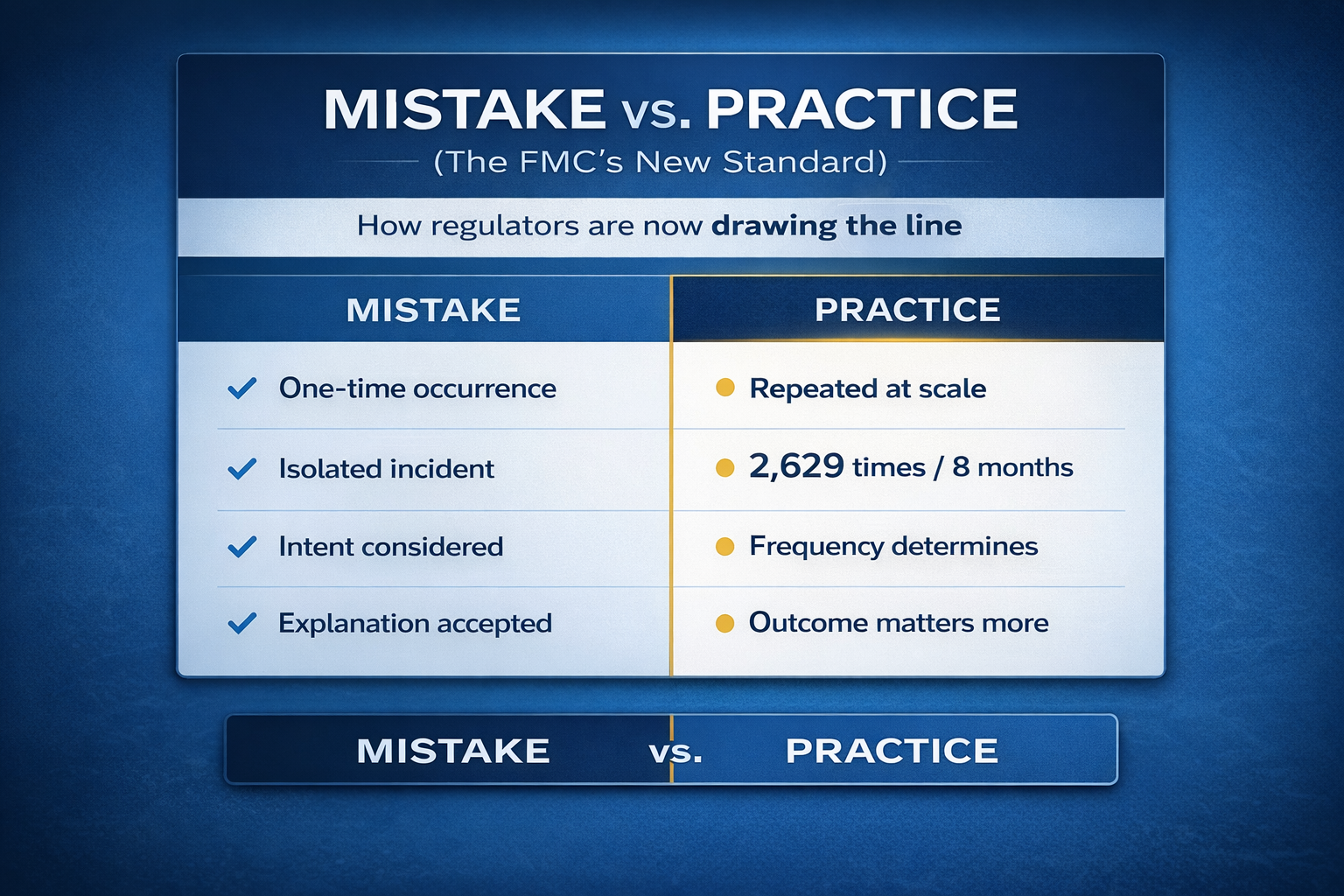
This case is not about a single carrier.
It’s about how regulators are now evaluating operational breakdowns.
The FMC made clear that automated systems are judged by outcomes, not explanations. Billing logic, equipment classification, and exception handling are no longer treated as internal process issues once their impact becomes systemic.
In this case, the issue centered on non-operating reefers — containers that function like standard dry equipment but were billed at live reefer rates, creating a materially higher cost. That distinction underscores why the Commission viewed the issue as more than a minor pricing error.
This is a meaningful shift — and one that forwarders should not ignore.
Why Forwarders Absorb the Friction
On paper, this looks like a carrier billing issue.
And to be clear, it was the carrier — not the forwarder — that was fined.
But in practice, the friction moves downstream.
Consider a common scenario in today’s environment:
A carrier blanks a sailing vessel. Cargo is rebooked on a different vessel with different equipment. Documentation needs amending. The
amendment triggers a review. The client’s cargo is placed on hold.
Who does the client call?
Not the carrier. The forwarder.
Who explains why a “system limitation” doesn’t resolve the issue?
The forwarder.
Who manages the inventory impact while the review runs its course?
Again — the forwarder.
The risk here is not regulatory penalties.
It is operational disruption, customer trust, and reputational
exposure — especially when charges are passed through without clear validation.
In a softer rate environment, where margins leave little room for rework, that friction has nowhere to hide.
Why Pre-LNY 2026 Raises the Stakes
Timing compounds the risk.
As the industry moves into the pre-Lunar New Year window:
Carriers are managing capacity more tightly
Blank sailings and quiet port rotation changes are increasing
Weather-driven disruptions — like last week’s fog-related diversions from Houston to Mobile — are forcing last-minute execution changes, often with minimal advance notice to cargo owners
Each adjustment creates knock-on effects for documentation, billing, and compliance workflows. And under the standard reinforced by the FMC, repetition exposes systems.
A three-day delay that once meant late delivery can now mean missing factory shutdown windows entirely during pre-LNY.
The Upside — and the Cost
There is a positive side to this shift.
Clearer standards reduce ambiguity. They push the industry to address broken workflows instead of tolerating them as edge cases.
But the short-term cost is real:
More disputes tied to automated charges
Less tolerance for “small” execution errors
Greater pressure on forwarders to explain and resolve issues they did not create
What Forwarders Should Be Considering in Q1
This is not about overhauling systems overnight.
It’s about tightening discipline where it matters most.
Forwarders should be asking:
Documentation timing: Are equipment condition, temperature settings, and carrier communications captured early — or only once issues arise?
Exception workflows: Is there a defined process for rolled cargo, port changes, or equipment substitutions — or is each case handled ad hoc?
Pattern recognition: If the same gap appears three times in a month, is it treated as a signal — or dismissed as bad luck?
Client communication: Can you clearly explain why a carrier’s “system limitation” does not eliminate downstream responsibility?
The FMC ruling suggests that regulators are already answering these questions for the industry.
The Real Takeaway
2026 is not a crisis year.
But it is proving to be a precision year.
Forwarders who approach compliance as paperwork will feel exposed.
Forwarders who treat it as an operational system will be better positioned — not because they avoid disruption, but because they manage it with discipline.
In this environment, the advantage doesn’t come from predicting every problem.
It comes from recognizing when a “mistake” is becoming a pattern — and acting before pressure makes that distinction for you.
Source: Federal Maritime Commission enforcement action on detention and demurrage billing for non-operating reefer containers, as reported by the Journal of Commerce (January 9, 2026).
Get a quote for your shipment
Have a shipment to move? Send the origin, the destination, the cargo and the container or weight; we reply with the rate, the routing and the services included.