


Rates feel manageable.
Capacity feels available.
Booking options feel open.
But the real risk heading into pre–Lunar New Year 2026 isn’t what importers are paying.
It’s how often their plans change after they’ve booked.
Every roll, substitution, or amendment increases exposure — not because it’s dramatic, but because the system’s tolerance for change is shrinking. As execution timelines compress and compliance expectations tighten, small deviations carry larger consequences.
That’s where importer risk sits in early 2026: not in pricing, but in repetition.
Where Importer Risk Actually Emerges
At first glance, a softer freight market should favor importers. Carrier capacity continues to outpace demand, and pricing pressure is evident across major trade lanes.
But a loss-making carrier environment doesn’t just influence rates — it changes behavior.
Blank sailings are deployed more selectively.
Networks adjust mid-quarter.
Port rotations shift with less notice.
Service variability increases, even when capacity appears abundant.
At the same time, compliance frameworks are becoming less flexible. Structured electronic filings, shorter amendment windows, and automated review processes do not absorb late changes easily. Precision matters more — and tolerance for error is lower.
When service variability meets compliance rigidity, importers absorb the friction.
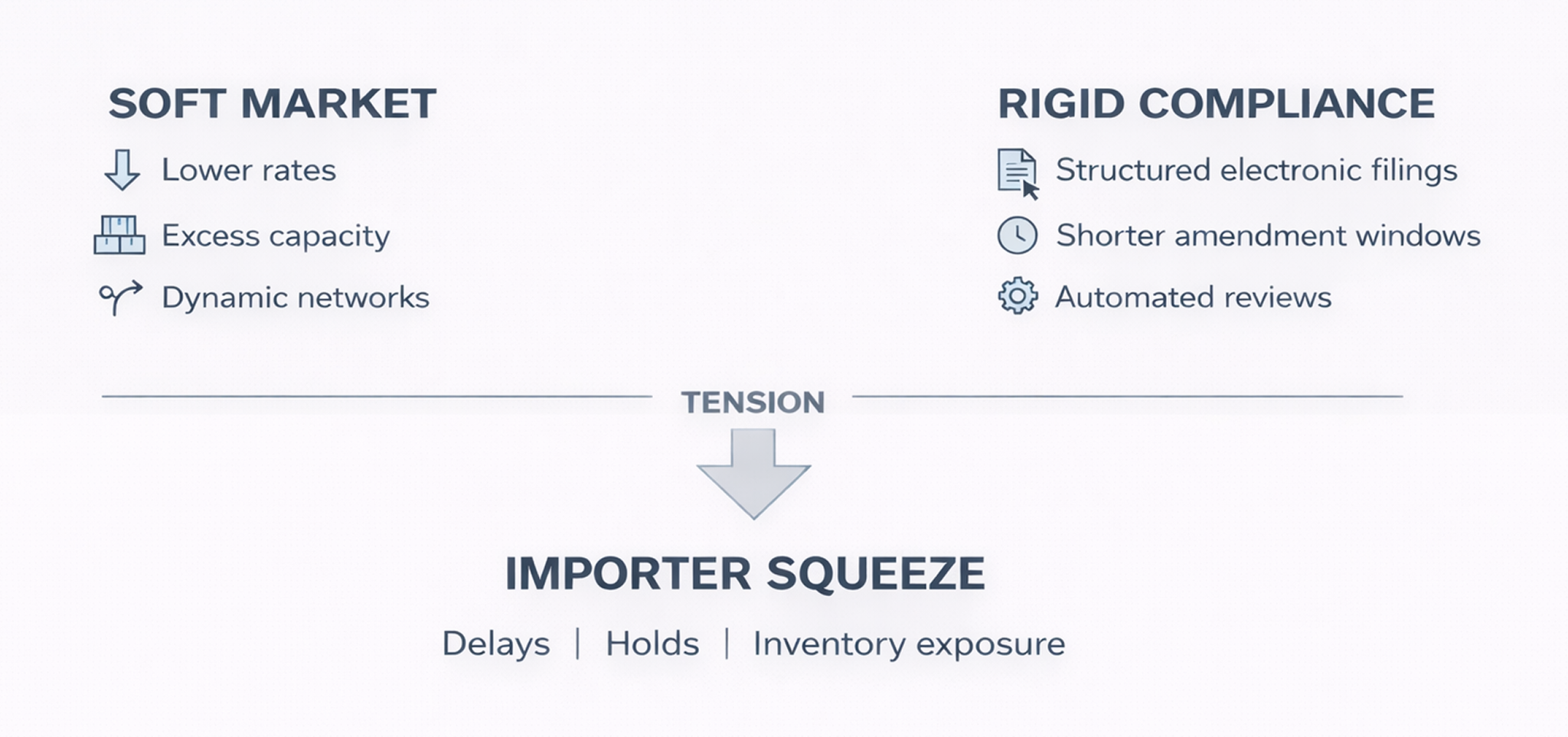
This is the new risk profile: repeated deviations that regulators and carriers increasingly flag as systemic failures — even when each individual change appears minor.
What used to be an operational inconvenience now becomes a clearance delay, a review, or a financial exposure.
Why “Soft Market” Thinking Breaks Down
In weaker markets, importers often rely on flexibility:
Book later
Assume capacity will be there
Adjust plans as needed
In 2026, that logic is fragile.
Cheaper freight does not offset the cost of:
Holds triggered by late amendments
Inventory delays caused by clearance reviews
Customer disruptions from missed delivery windows
This is why 2026 is not a pure pricing year.
It’s a timing and execution year.
The more an importer relies on last-minute adjustments to chase marginal savings, the more exposed they become downstream.
The Importer Reality in Q1
The first quarter sets the tone.
Carrier losses are expected to materialize early in the year. Demand remains uneven. Network adjustments are ongoing. Compliance expectations do not ease simply because the market is soft.
The risk is not that everything breaks at once.
It’s that small execution issues compound quietly and expensively.
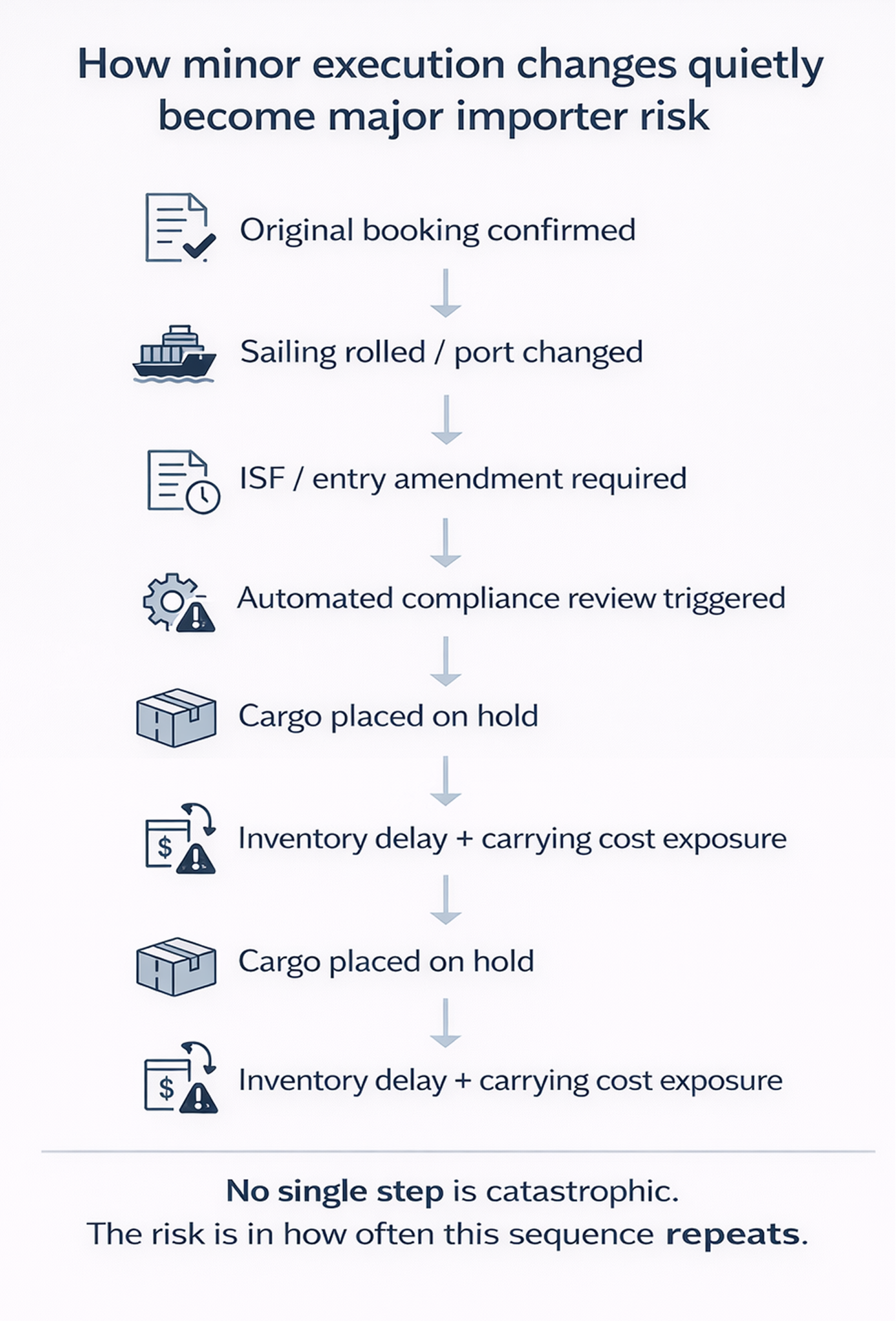
A blank sailing forces a port change from Los Angeles to Oakland.
The revised arrival triggers a late ISF amendment.
The amendment gets flagged for review.
What should have been a two-day dwell becomes a seven-day hold.
The compliance issue wasn’t catastrophic — but the inventory impact was.
This is how the squeeze shows up in practice.
What Importers Should Be Doing Now
This is not a call for alarm.
It’s a call for alignment.
1. Stress-test compliance workflows — not just rates.
Validate how filings are triggered, where data originates, and how exceptions are handled. The weak point is rarely the standard shipment; it’s the rolled container, the port change, or the last-minute substitution.
2. Build execution buffers intentionally.
Planning needs slack in a volatile service environment. That doesn’t mean rushing cargo or over-ordering — it means acknowledging variability and designing for it.
3. Clarify responsibility across partners.
Who owns data accuracy? Who updates filings when plans change? Who is accountable when something breaks? These answers need to be explicit before pressure hits.
4. Shift visibility from quarterly to weekly.
Average rates matter less than near-term execution signals. Schedule reliability, clearance cycle time, and — critically — amendment frequency should be reviewed continuously.
In practice, this means assigning clear ownership for weekly execution signals: someone responsible for spotting patterns early and escalating them before they turn into holds, delays, or inventory disruptions.
Weekly Importer Execution Signals
These signals matter more week-to-week than average rates — especially as pre-Lunar New Year pressure builds:
Schedule reliability by lane
How often original ETDs hold versus changeRoll frequency after booking
Containers moved to later sailings or alternate vesselsPost-booking documentation amendments
How often filings change after submission — a leading indicator of downstream riskClearance cycle time (planned vs. actual)
Early signs of friction before holds escalateRepeated exceptions
The same issue recurring across shipments, SKUs, or portsUnplanned substitutions
Vessel, port, or routing changes introduced mid-execution
If the same exception appears more than once in a week, it’s no longer noise — it’s a signal.
Who This Matters Most For
This risk window is especially acute for:
Importers operating with thin inventory buffers
Companies managing multiple product categories with different compliance requirements
Organizations where procurement, logistics, and compliance operate in separate silos
Importers who relied heavily on Q4 front-loading and are entering 2026 lean
For these groups, small disruptions cascade faster — and cost more.
The Bigger Takeaway
Periods of carrier profitability often hide inefficiencies.
Periods of carrier losses expose them.
In 2026, importers are operating in a market that looks forgiving on the surface but is increasingly unforgiving underneath. The companies that perform best will not be the ones chasing the lowest spot rate — they will be the ones that treat execution and compliance as integrated, not separate, functions.
The risk window before Lunar New Year isn’t about price pressure.
It’s about how often plans change — and how well those changes are managed.
Only by planning more deliberately.
Get a quote for your shipment
Have a shipment to move? Send the origin, the destination, the cargo and the container or weight; we reply with the rate, the routing and the services included.