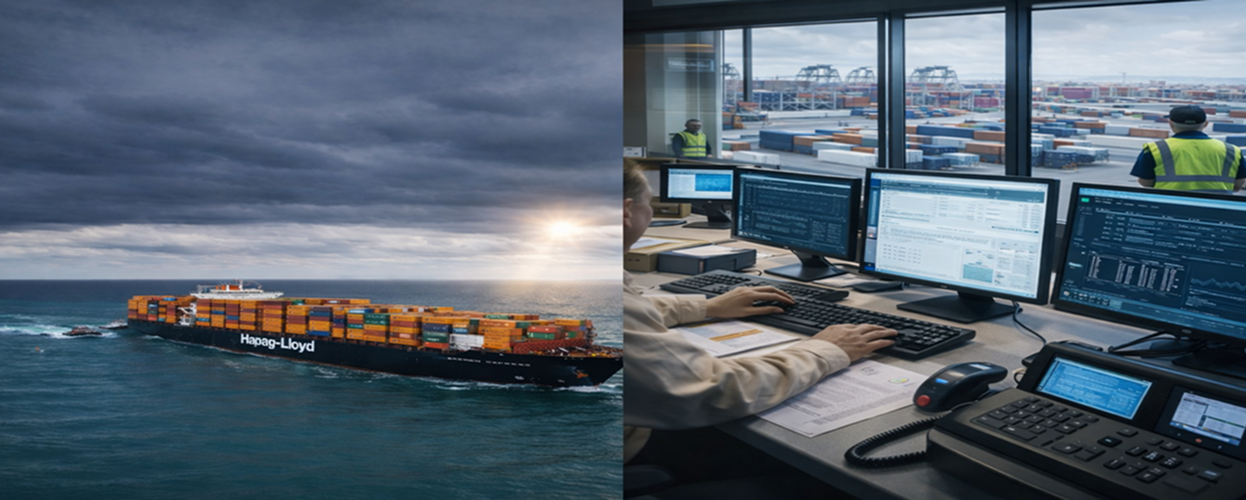


At first glance, 2026 looks like it should be a relief year for importers.
Ocean carriers are heading into a loss-making cycle. Capacity continues to outpace demand. Rate pressure is building across major trade lanes. On paper, this reads like leverage shifting back to cargo owners.
But beneath that apparent softness, something more complicated is forming.
As carriers adjust to margin pressure and networks continue to recalibrate, importers are entering 2026 facing less room for error, not more — at the exact moment compliance expectations and filing requirements are becoming more rigid. The result is the first real squeeze of the year: not driven by price alone, but by the collision of market behavior and regulatory precision.
This is not a carrier story. It’s an importer decision story.
Three Signals Importers Are Seeing — Separately
Over the past few weeks, three themes have dominated supply chain conversations, often in isolation.
First, industry reporting has made it clear that container shipping is entering a structurally weaker phase. Drewry forecasts $10 billion in carrier losses for 2026, with red ink expected as early as the first quarter as vessel capacity continues to outpace demand on major trade lanes. Periods like this historically don’t just pressure rates — they change how carriers manage capacity, service, and networks.
Second, compliance alerts have intensified. Electronic filing requirements, shorter amendment windows, and automated enforcement flags are becoming operational realities for importers moving goods into the US. For many companies, 2026 will be the first year where data quality and timeliness are tested at scale, not just during audits or exceptions.
Third, there is renewed attention on importer-of-record responsibility and accountability. Questions around who owns filings, who controls data accuracy, and who bears liability when something goes wrong are resurfacing across trade, regulatory, and policy discussions.
Each of these issues matters on its own. The mistake is treating them as separate problems.
Where the Squeeze Actually Comes From
The real risk in 2026 emerges where these forces overlap.
A loss-making carrier environment does not simply result in lower rates. It drives behavioral changes: blank sailings, mid-quarter network adjustments, last-minute schedule changes, and more aggressive yield management. Service variability increases, even when capacity appears abundant.
At the same time, compliance systems are becoming less flexible. Structured electronic filings and automated review processes do not accommodate late changes, rolling cargo, or documentation revisions easily. Precision matters more — and the cost of error rises.
When service variability meets compliance rigidity, importers absorb the friction.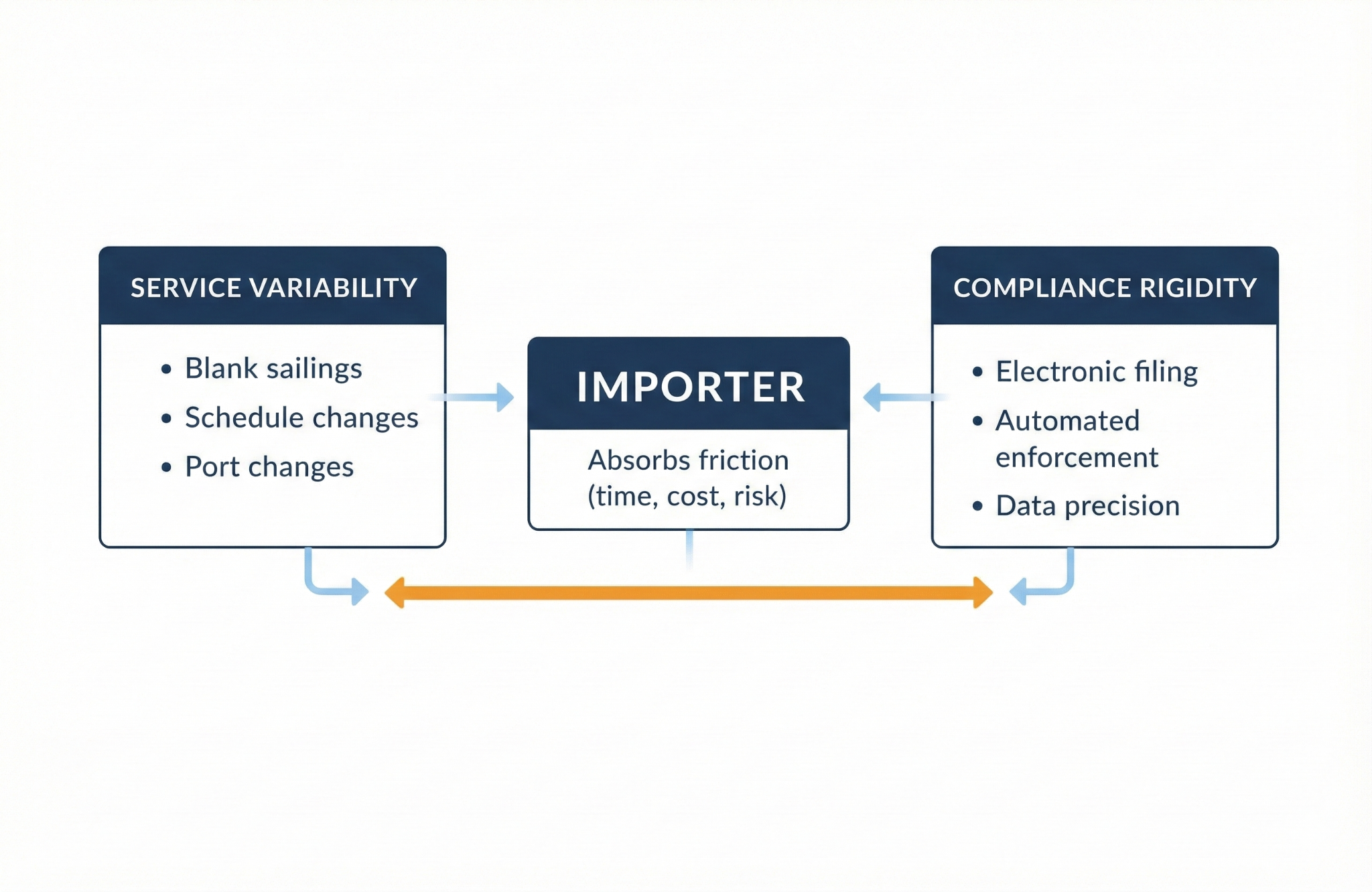
What might once have been an operational inconvenience — a delayed sailing, a reroute, a substitution — now becomes a compliance risk, a clearance delay, or a financial exposure. And because these issues often surface late in the execution cycle, importers have less time to respond.
This is the squeeze: not higher prices, but higher consequences.
Why “Soft Market” Thinking Breaks Down
In weaker freight markets, importers often adopt a wait-and-see posture. Book later. Stay flexible. Assume capacity will be available. Assume costs will remain contained.
In 2026, that logic is increasingly fragile.
As carriers manage losses, networks become more dynamic. Blank sailings are deployed surgically. Port rotations shift. Transit times change. Meanwhile, compliance frameworks assume consistency, accuracy, and advance preparation.
The more an importer relies on last-minute execution to chase marginal savings, the more exposed they become to downstream compliance and clearance issues. Cheaper freight does not offset the cost of holds, penalties, inventory delays, or customer disruptions.
This is why 2026 should be viewed as a timing and execution year, not a pure pricing year.
The Importer Reality in Q1
For importers, the first quarter sets the tone.
Carrier losses are expected to materialize early in the year. Demand remains uneven. Network adjustments are ongoing. At the same time, compliance expectations do not ease because the market is soft.
The risk is not that everything breaks at once. It’s that small execution issues compound into larger problems — quietly and expensively.
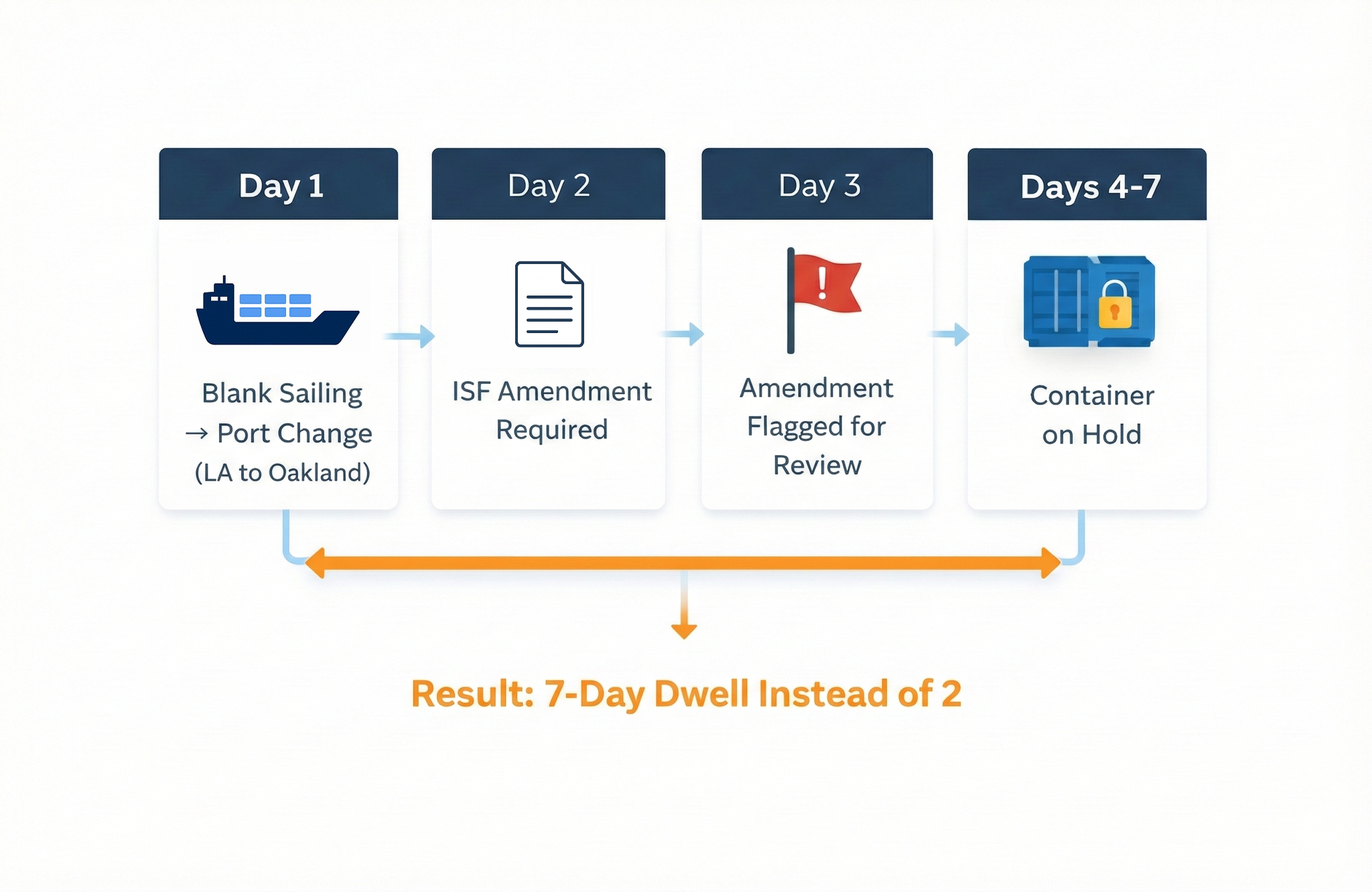
A blank sailing forces a port change from Los Angeles to Oakland. The revised arrival triggers a late ISF amendment. The amendment gets flagged for review. What should have been a two-day dwell becomes a seven-day hold. The compliance issue wasn’t catastrophic — but the inventory impact was.
This is how the squeeze shows up in practice.
What Importers Should Be Doing Now
This is not a call for alarm. It is a call for alignment.
1. Stress-test compliance workflows, not just rates.
Validate how filings are triggered, where data originates, and how exceptions are handled. The weak point is rarely the standard shipment — it’s the rolled container, the port change, or the last-minute substitution.
2. Build execution buffers intentionally.
In a volatile service environment, planning needs slack. That doesn’t mean over-ordering or rushing cargo forward; it means acknowledging variability and designing for it.
3. Clarify responsibility across partners.
Who owns data accuracy? Who updates filings when plans change? Who is accountable when something breaks? These questions need explicit answers before pressure hits.
4. Shift metrics from quarterly to weekly.
Average rates matter less than near-term execution signals. Schedule reliability, exception frequency, and clearance cycle times should be reviewed continuously.
In practice, this means designating clear ownership for weekly execution signals — someone responsible for spotting patterns early and escalating them before they turn into holds, delays, or inventory disruptions.
Who This Matters Most For
This squeeze is especially acute for:
Importers operating with thin inventory buffers
Companies managing multiple product categories with different compliance requirements
Organizations where procurement, logistics, and compliance operate in separate silos
Importers who relied heavily on Q4 2025 frontloading and are entering 2026 lean
For these groups, small disruptions cascade faster — and cost more.
The Bigger Takeaway
Periods of carrier profitability often hide inefficiencies. Periods of carrier losses expose them.
In 2026, importers are operating in a market that looks forgiving on the surface but is increasingly unforgiving underneath. The companies that perform best will not be the ones chasing the lowest spot rate — they will be the ones that treat execution and compliance as integrated, not separate, functions.
This is the first importer squeeze of the year. It won’t be the last.
And it won’t be solved by reacting faster — only by planning more deliberately.
Get a quote for your shipment
Have a shipment to move? Send the origin, the destination, the cargo and the container or weight; we reply with the rate, the routing and the services included.