


Update, September 27, 2026: The CAPE figures below come from the first week of CBP’s IEEPA refund process in April 2026, and we have corrected how this post first read them. CBP reported that by April 26 about 11.2 million entries had been accepted for IEEPA duty removal and about 2.1 million had been rejected at entry-level validation; the 1.74 million figure was the number of entries already liquidated and in the refund process, not the number that had cleared validation, so it did not mean that 85% of entries were stuck. CAPE still takes entries that are unliquidated or no more than 80 days past liquidation, and CBP says valid refunds are generally issued within 60 to 90 days of acceptance. The government has appealed the Court of International Trade’s IEEPA refund orders, and we found no Federal Circuit decision as of September 25, 2026; see our tariff refund guide for the current rules.
Whether you’ve already filed for IEEPA refunds—or assume this doesn’t apply to you—there’s a gap in how the CBP CAPE system is actually working right now.
Most companies think:
“We submitted. Now we wait for the refund.”
That is not how this process is behaving in practice.
When this post was published in May 2026, CBP’s IEEPA refund system had been live for two weeks. The early data shows a pattern that should concern every importer—whether you’ve filed or not.
What the first week of CAPE data actually shows
On April 20, CBP launched CAPE — the Consolidated Administration and Processing of Entries system.
Within six days:
Over 75,000 declarations were submitted
Of those, 47,315 passed file validation, covering about 11.2 million entries accepted for IEEPA duty removal
About 2.1 million entries were rejected at entry-level validation, and about 1.74 million accepted entries had already liquidated and moved into the refund process
That is roughly one entry in six rejected among those checked at entry level.
A rejected entry is dropped from the declaration with a reason, and no refund moves for it until the problem is fixed and the entry is filed again.
And unless you are actively reviewing your Validation Result File in ACE, you likely have no visibility into where your entries stand.
What CAPE does — and what it doesn’t
CAPE is a processing mechanism, not a compliance audit.
When you upload a CSV of entry numbers through ACE, the system runs validation in two stages:
Declaration-level checks (formatting, authority, duplicates)
Entry-level checks (existence in ACE, HTS code presence, prior declaration conflicts)
What it does not do:
Verify that your entry set is complete
Check whether your entries fall within the correct eligibility window
Resolve conflicts across multiple brokers
Correct underlying data issues
Validation ≠ eligibility. Acceptance ≠ approval.
Entry-level rejections happen after the file is accepted.
The CAPE refund process — four separate steps
Declaration accepted (format, authority, duplicates)
Entry-level validation — where entries are rejected
CBP review and reliquidation (60–90 days)
Payment issued via ACH
Each step is independent. Passing one does not guarantee progress to the next.
What this means for your refund exposure
To make this concrete:
If your company paid $500,000 in IEEPA duties across 100 entries on CAPE Declarations and 16 were rejected at validation, the duty on those 16 entries—about $80,000 if duty was spread evenly—is not refunded until they are fixed and filed again.
The duty on the other 84 entries moves on to CBP review and liquidation.
A rejection is not always a finding that the entry is ineligible.It can come from submission issues the system does not correct on your behalf.
Rejected entries are not lost.That duty is often recoverable—if you can identify which entries were rejected and why.
Use our IEEPA refund calculator to surface eligible entries and pinpoint what’s still stuck before the window closes.
Who is most exposed right now
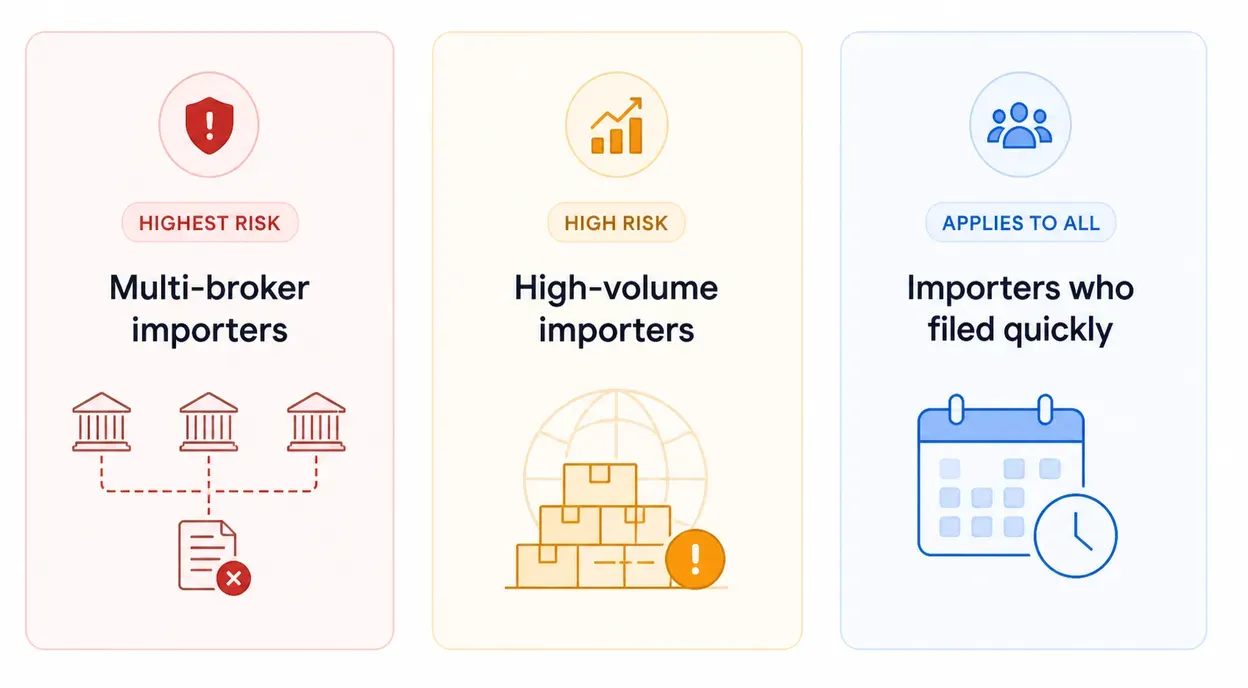
Not all importers face the same level of risk. Validation failures are most likely for:
Importers working with multiple customs brokersEntry duplication across declarations can permanently exclude entries from Phase 1.
Companies with long or mixed entry timelinesSubmitting full historical data without filtering for the 80-day eligibility window leads to validation rejections that are easy to miss.
Importers who filed immediately after CAPE launchedEarly submissions were often made without full clarity on validation behavior or system constraints.
High-volume importersThe larger the entry set, the higher the probability of mismatches, duplicates, and eligibility gaps.
If you fall into any of these categories, the likelihood that some of your entries were rejected is higher.
Three reasons refunds are being blocked
These failures are not random. Three issues come up most often:
1. Phase 1 eligibility window mismatch
Phase 1 covers only:
Unliquidated entries
Entries liquidated within 80 days of submission
Entries outside this window are rejected at validation.
Action: Filter by liquidation date before building your CSV.
2. Duplicate entries across declarations
Each entry number can appear on only one accepted declaration.
If duplicates exist across brokers or submissions:
The entry is locked out of Phase 1
There is no amendment path
Action: Consolidate and deduplicate across all brokers before filing.
3. Missing ACH setup
CBP no longer issues paper checks.If ACH is not configured in ACE, payment cannot be issued—even if everything else succeeds.
Action: Ensure ACH is enrolled before relying on any refund timeline.
Two deadlines most importers aren’t tracking
Two external pressures are narrowing the window for effective action:
Phase 1 eligibility windowThe 80-day window advances daily. Entries eligible today may age out if filing is delayed.
Government appeal — filedThe government has appealed the Court of International Trade’s IEEPA refund orders to the Federal Circuit. As of September 25, 2026, no decision had been published on those appeals, and CAPE was still accepting declarations.
These do not require rushing a flawed submission.They do require prioritizing a complete and accurate one now.
What to do if you haven’t filed
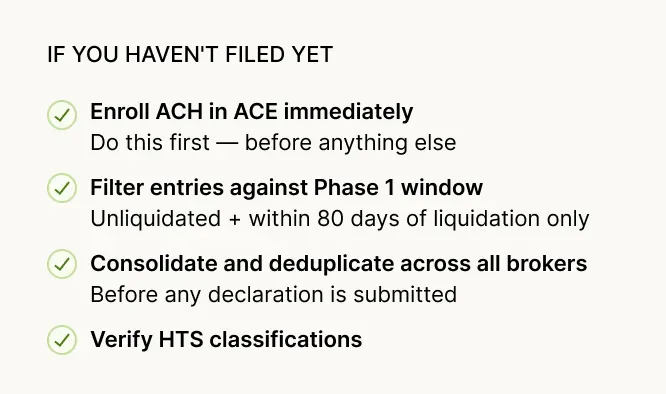
Speed is less valuable than accuracy.
A flawed declaration cannot be amended for affected entries.
What to do if you’ve already filed
Do not assume a confirmation means your refund is progressing.
Review your Validation Result File in ACE:
Identify which entries cleared validation
Isolate failures and error codes
Determine which entries can still be resubmitted
If multiple brokers were involved, confirm that no entries were duplicated across declarations.
What happens next
CAPE is still in its early phases, but its structure is unlikely to change fundamentally.
Future phases may expand eligibility to more complex entry types, but they will not resolve underlying data issues retroactively. The system is designed to process what is submitted—not to reconcile inconsistencies across filings.
Importers who treat this as a data integrity and coordination problem—not just a filing exercise—will be in a materially stronger position as additional phases roll out.
How Airlift approaches this
We are a licensed NVOCC (FMC OTI No. 016162); customs entries are filed through our licensed customs broker partners. Entry data management, ACE coordination, and compliance are core to what we do.
The IEEPA refund process is effectively a large-scale entry audit:
Verifying eligibility
Resolving cross-broker conflicts
Ensuring payment prerequisites are in place
At this point, you have two options:
You can work through this process internally—auditing entries, reviewing validation results, and reconciling data across brokers.
Or you can use our IEEPA refund checker:
Upload CBP Form 7501s
Identify eligible entries
Flag broker conflicts
Estimate recoverable duties in under a minute
For full pre-filing audits, our team works through your entries with you. The CAPE Declaration itself is filed by you as importer of record or by the licensed customs broker that filed the entries.
Either way, the time to act is before the Phase 1 window narrows further—not after.
Frequently asked questions
What is CAPE?CBP’s system for processing IEEPA refund claims through ACE using consolidated declarations.
Why are entries failing validation?Primarily due to eligibility window mismatches, duplicate entries, and missing payment setup.
How long do refunds take?Typically 60–90 days after successful validation and review.
Can declarations be amended?No. Entries on accepted declarations cannot be refiled in Phase 1.
Final takeaway
An entry that is rejected, or never filed, is not refunded through CAPE.
Checking each entry’s validation result is how you make sure every eligible entry reaches the stage where refunds are issued.
That is where the risk—and the opportunity—sits.
Get a quote for your shipment
Have a shipment to move? Send the origin, destination, cargo, and container size or weight. We reply with the rate, the routing and the services included.
