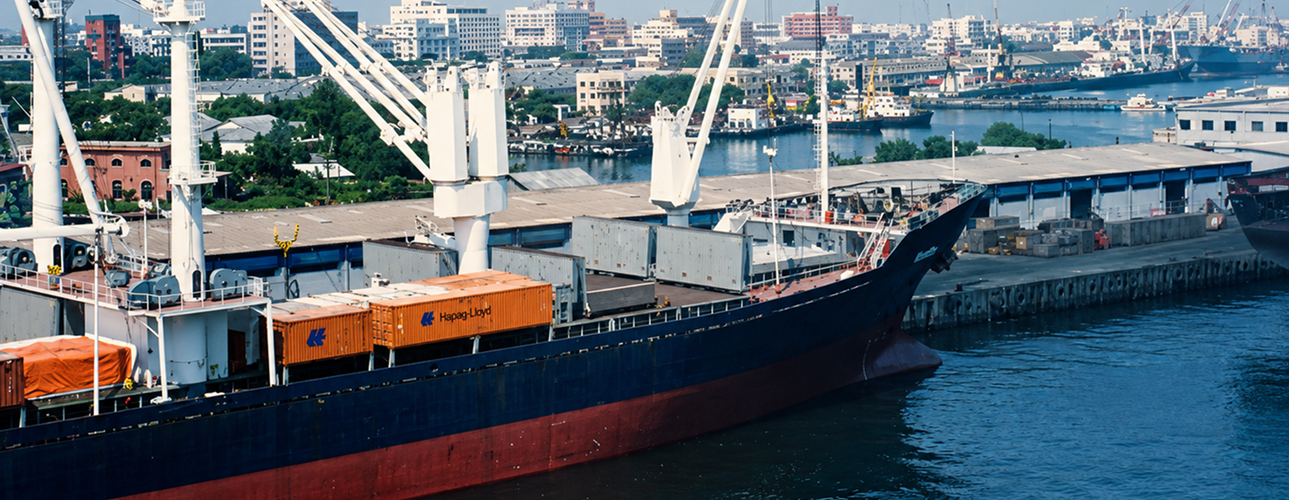


What Exporters and Importers Need to Know Now
India secured a bilateral tariff deal with the United States. Vietnam and Cambodia did not. For US importers, the issue is no longer just sourcing cost — it is whether shipments can physically arrive before the tariff environment changes. For both buyers and exporters, the rate goods enter at now depends on decisions being made in the next few weeks.
Three sourcing markets. Three different tariff realities.
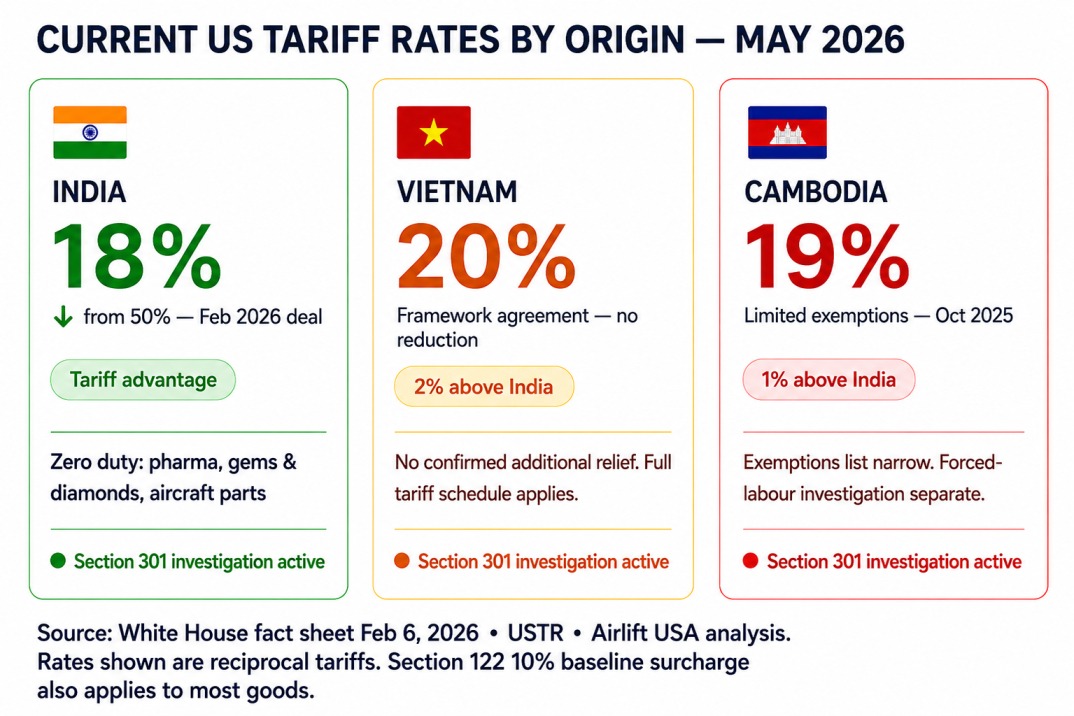
For the first time in the modern supply-chain era, India now holds a tariff advantage over Vietnam and Cambodia across several export categories entering the US market. For importers comparing landed cost at scale, even a 1–2% differential compounds quickly across high-volume shipments. US buyers are already recalculating sourcing economics.
What the India deal actually changed — and what it didn't
According to the White House fact sheet published February 6, 2026, the United States reduced reciprocal tariffs on most Indian goods from 50% to 18% under a bilateral trade framework. The agreement confirmed zero-duty treatment for generic pharmaceuticals, gems and diamonds, and aircraft parts. A separate 25% tariff tied to India's purchase of Russian oil was also removed.
The operational reality is more nuanced than the headline rate suggests. The agreement does not apply uniformly across all product categories, and the complete product-level tariff schedule has not yet been fully published. For importers, the practical question is not whether the tariff changed — it did — but whether your specific HTS classifications qualify, whether CBP is applying the treatment consistently at entry, and whether your origin documentation can withstand scrutiny at the border.
Vietnam and Cambodia received no equivalent reduction. Vietnam's existing framework agreement maintained its reciprocal rate at 20%, while Cambodia's October 2025 agreement produced only a limited exemptions structure rather than a broad rate cut.
For US importers comparing total landed cost across sourcing markets, India is now materially more competitive than Vietnam or Cambodia in several manufacturing categories — especially where margins are thin and tariff exposure directly affects purchasing decisions.
The Section 301 investigation — and why July matters
On March 11, 2026, according to the Office of the United States Trade Representative, USTR initiated Section 301 investigations into structural excess manufacturing capacity across sixteen economies, including India, Vietnam, and Cambodia. The public comment period closed April 15, followed by hearings on April 28.
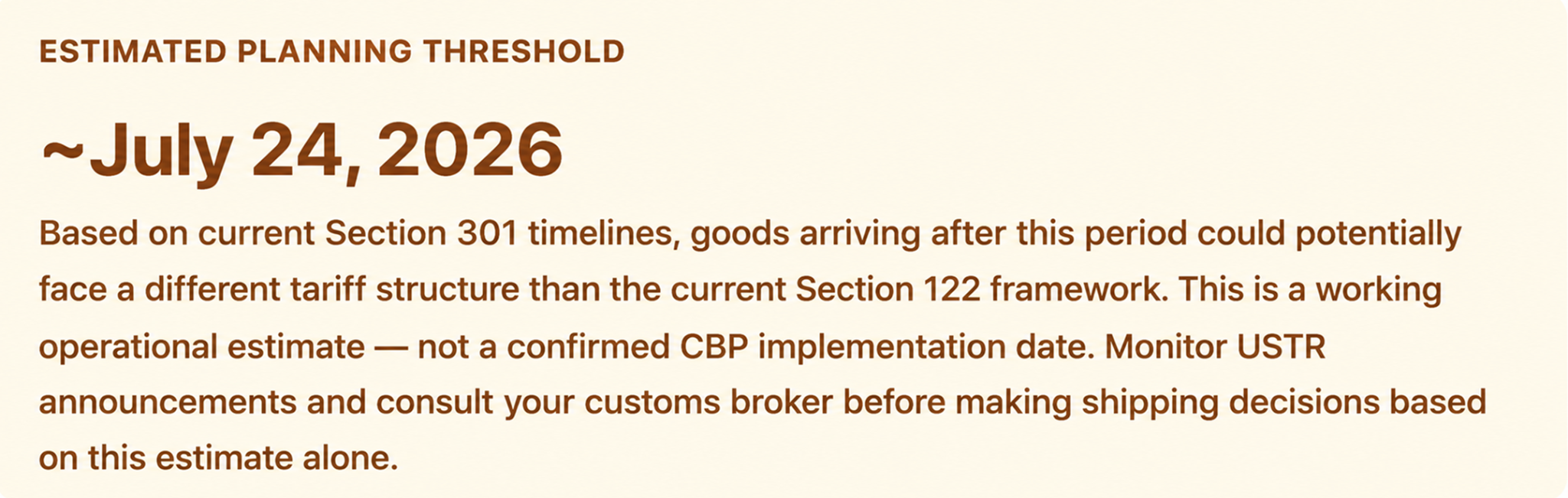
According to current trade-law timelines and industry analysis, these investigations may form the basis for a revised tariff structure later in 2026, following the February Supreme Court decision affecting the IEEPA tariff framework. While no implementation date has been formally confirmed, many trade compliance advisors and customs professionals are planning around the possibility of revised tariff treatment beginning in late July 2026.
Why freight timing now matters as much as tariff policy
The tariff story is only half the issue. The second half is transit time. Commercial traffic through the Strait of Hormuz remains heavily disrupted, with vessel tracking data from Lloyd's List and Kpler indicating traffic volumes far below historical norms. For cargo moving from India, Vietnam, and Cambodia into the United States, the operational consequences are immediate: Cape of Good Hope rerouting has become standard on several affected trade lanes, transit durations are extending materially, and carriers continue slow steaming at 14.5–15 knots to manage fuel costs and network reliability.
Under current routing conditions, shipments from South and Southeast Asia to the US East Coast are now frequently taking 42–45 days or more — directly compressing the available shipment window before any future tariff changes take effect.
Estimated arrival windows under current routing conditions
Departure date → estimated US arrival → tariff rate status
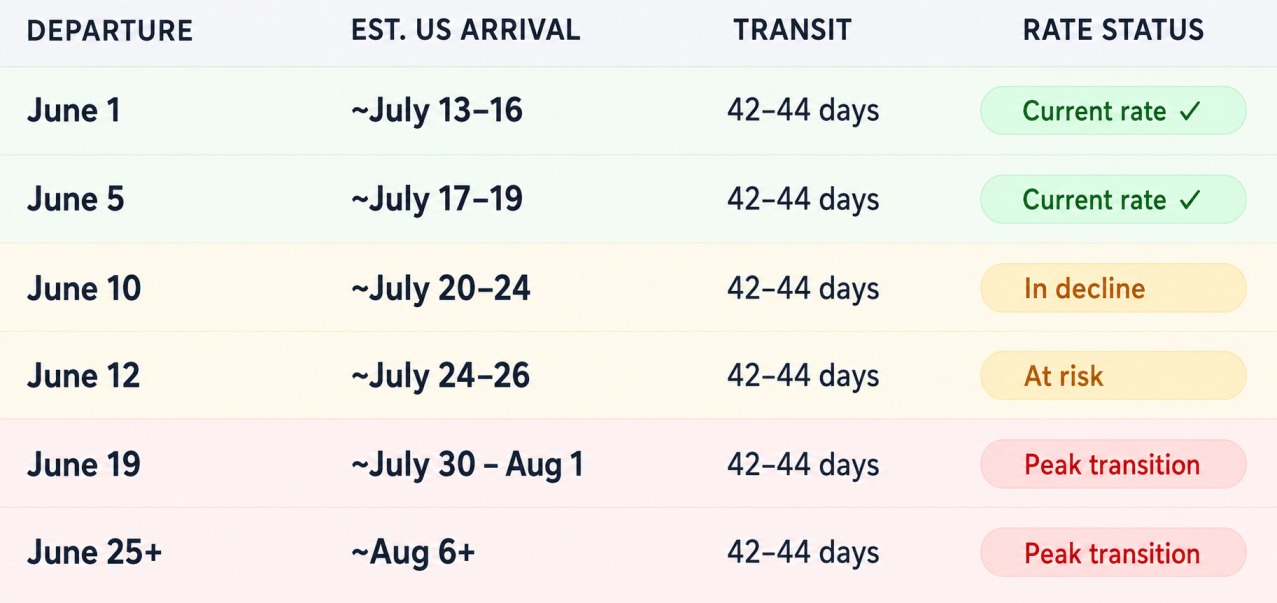
Importers using historical voyage assumptions may already be behind schedule. Under current routing conditions, a two-week delay in booking could determine whether cargo enters under the current tariff environment or a revised Section 301 structure.
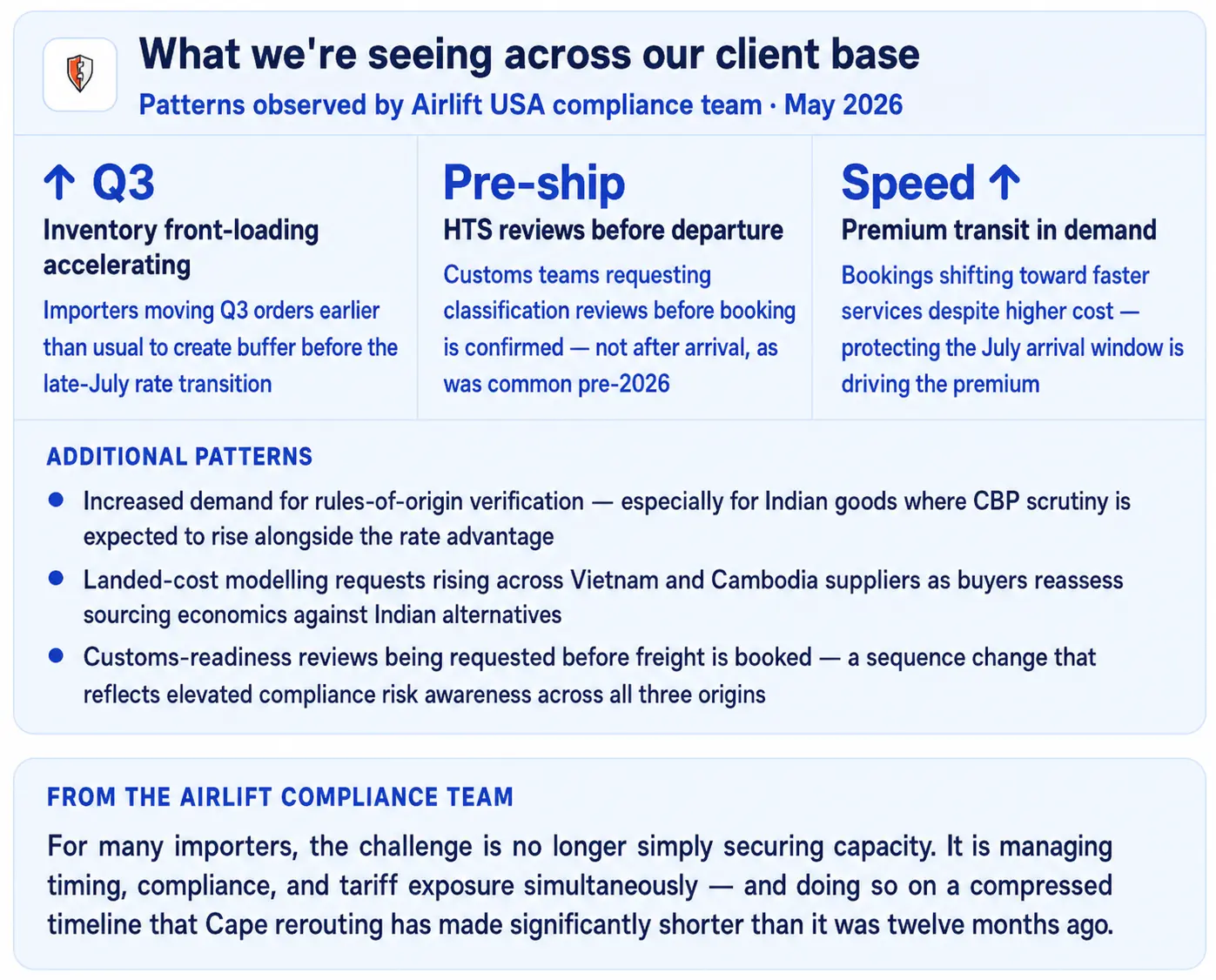
What Airlift USA is seeing right now
Ground-level intelligence — India, Vietnam and Cambodia client
The competitive shift — and what exporters should do next
The tariff differential between India and its Southeast Asian competitors is now large enough to materially affect sourcing economics across textiles, industrial goods, automotive components, chemicals, and consumer manufacturing categories. This does not mean Vietnam and Cambodia suddenly become uncompetitive. Lead times, supplier relationships, manufacturing specialisation, and product quality still matter enormously.
But exporters in Vietnam and Cambodia who are not actively quantifying the landed-cost difference for US buyers risk losing competitiveness gradually — without a single obvious trigger point. The most valuable conversation to have with US buyers right now is a landed-cost comparison that incorporates tariff exposure, Cape rerouting costs, and potential Section 301 risk. That analysis is increasingly becoming a sourcing requirement rather than just a procurement exercise.
What each origin should be doing right now
IN India — protect the advantage
Verify that your specific HTS classifications qualify for the reduced 18% tariff treatment — the deal does not apply uniformly across all product categories and the full schedule has not been published. Prepare stronger rules-of-origin documentation before entry filing, as CBP is expected to scrutinise Indian-origin claims closely given the commercial value of the rate. Where Section 301 exposure is material for your product category, accelerate Q3 departures to protect the July arrival window.
VN Vietnam — manage the differential
Model the landed-cost gap against Indian competitors on a category-by-category basis — in some categories the 2% differential is immaterial; in others it is decisive. Front-load tariff-sensitive shipments before late July and treat Cape rerouting timelines as a hard constraint on departure dates, not a variable. Monitor USTR Section 301 developments closely through Q3, as the investigation outcome will define your rate environment for the rest of 2026.
KH Cambodia — maximise the exemptions
Review your product categories carefully against the October 2025 exemptions structure — not all goods qualify, and misclassification at this rate level carries meaningful liability. Ensure forced-labour compliance documentation is current, as Cambodia faces a separate Section 301 investigation on this basis and CBP scrutiny will remain elevated. Build Cape rerouting transit durations into all departure planning — the July 24 window is approximately 10–14 days tighter than pre-war voyage estimates suggest.
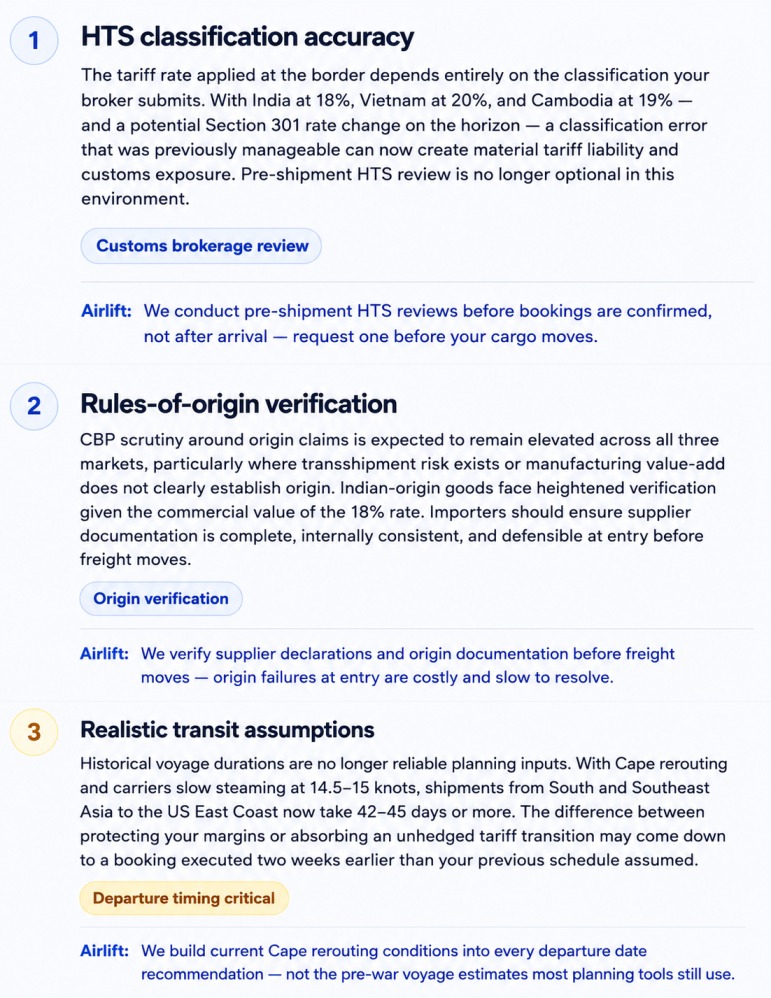
The three compliance requirements every shipment now needs
Regardless of origin, every shipment moving into the United States from these markets should have three things confirmed before departure.
Frequently asked questions
What is the current US tariff rate on Indian exports in 2026?
According to the White House fact sheet published February 6, 2026, the US reduced its reciprocal tariff on most Indian goods to 18%, down from 50%. Zero duty applies to generic pharmaceuticals, gems and diamonds, and aircraft parts. A separate 25% tariff linked to India's purchase of Russian oil was also removed. The 10% Section 122 baseline surcharge applies to most goods on top of the reciprocal rate. Product-level coverage depends on HTS classification — the full schedule has not yet been published.
What tariff rate does Vietnam face for US-bound exports in 2026?
Vietnam's reciprocal tariff rate is currently 20% under the 2025 framework agreement. The 10% Section 122 baseline surcharge also applies. USTR initiated a Section 301 investigation into Vietnam in March 2026, examining structural excess manufacturing capacity. If that investigation results in a positive determination, Vietnam could face a higher Section 301 rate — potentially from late July 2026. No implementation date has been confirmed by CBP or USTR.
What is the estimated July 24 deadline and why does it matter?
Based on current Section 301 investigation timelines — comment period closed April 15, hearings held April 28 — industry analysts and trade compliance advisors are planning around a possible tariff rate transition in late July 2026 for India, Vietnam, Cambodia, and other investigated economies. Goods arriving before that point would qualify for the current Section 122 tariff structure. This is a working planning estimate, not a confirmed CBP or USTR date. Monitor USTR announcements closely and consult your customs broker before making shipping decisions based on this estimate.
How does the Strait of Hormuz disruption affect shipments from India, Vietnam, and Cambodia?
According to vessel tracking data from Lloyd's List and Kpler, commercial traffic through the Strait of Hormuz is running at a small fraction of pre-war levels. Cargo that previously transited the Gulf is rerouting via Cape of Good Hope, adding 10–14 days per voyage. Combined with carrier slow steaming at 14.5–15 knots — a practice Maersk CEO Vincent Clerc described on the carrier's Q1 2026 earnings call as "quite economical at current fuel prices" — voyages from South and Southeast Asia to the US East Coast now take 42–45 days or more.
What is a Section 301 investigation and how does it affect these three countries?
A Section 301 investigation, conducted by USTR under the Trade Act of 1974, examines whether a trading partner's policies or practices are unreasonable or discriminatory and burden US commerce. A positive determination allows USTR to impose additional tariff rates. The March 11, 2026 investigations into India, Vietnam, Cambodia, and thirteen other economies specifically examine structural excess manufacturing capacity. A positive determination could significantly raise the effective tariff burden on exports from all three origins above current Section 122 levels.
Can a CAPE declaration be amended after submission — and how does IEEPA connect to this?
No. Once a CAPE Declaration is accepted by CBP, it cannot be amended. The IEEPA tariff framework — under which many duties were collected from India, Vietnam, and Cambodia origin goods — was struck down by the Supreme Court in February 2026. The CAPE system was established to process refunds of those duties. The Section 301 investigations are specifically designed to build a legal replacement for IEEPA. If you have entries from these origins already in the CAPE refund queue, the new tariff framework does not reset or pause your Phase 1 eligibility.
How does Airlift USA help exporters and importers from India, Vietnam, and Cambodia?
As a licensed NVOCC and customs broker, Airlift provides freight execution, customs brokerage, HTS classification review, rules-of-origin verification, and landed-cost analysis for exporters and importers moving goods between India, Vietnam, and Cambodia and the United States. We handle pre-shipment classification reviews and origin documentation verification, and we build current Cape rerouting timelines into all departure planning recommendations — not pre-war voyage assumptions that no longer reflect actual transit times
FROM THE AIRLIFT COMPLIANCE TEAM
Shipping to the US from India, Vietnam, or Cambodia in Q3?
The tariff rate your goods enter at may depend on when they depart, how they are classified, and whether your documentation withstands customs review. Airlift USA helps importers and exporters manage freight execution, customs brokerage, HTS classification, tariff exposure, and shipment timing before cargo moves — talk to our team before your next shipment is booked.