


In a recent post, we explored why freight forwarding communication breaks down when conversations scatter across channels — and how contextual communication creates accountability.
That accountability matters most when things go wrong.
This post is about what happens when execution breaks: the hidden cost that appears when exceptions aren't caught early, information doesn't flow across teams, and recovery happens too late.
We call it the Exception Tax.
If you haven’t read the earlier post, you can find it here: →In a recent post, we explored why freight forwarding communication breaks down when conversations scatter across channels — and how contextual communication creates accountability.
That accountability matters most when things go wrong.
This post is about what happens when execution breaks: the hidden cost that appears when exceptions aren't caught early, information doesn't flow across teams, and recovery happens too late.
We call it the Exception Tax.
If you haven’t read the earlier post, you can find it here: →https://airliftusa.com/blog/43/the-exception-tax-how-unreliable-freight-execution-quietly-costs-more-than-rate-increases
Once companies recognize the Exception Tax, a second realization usually follows.
They do not actually know how much unreliable freight execution is costing them.
Not precisely. Not consistently. And not in a way that informs decisions about carriers, routing, or recovery strategy.
The good news is that exception costs are far more controllable than freight rates — if they are measured correctly.
Clean Shipments vs. Exception Shipments
A practical way to understand real freight cost is to separate clean shipments from exception shipments.
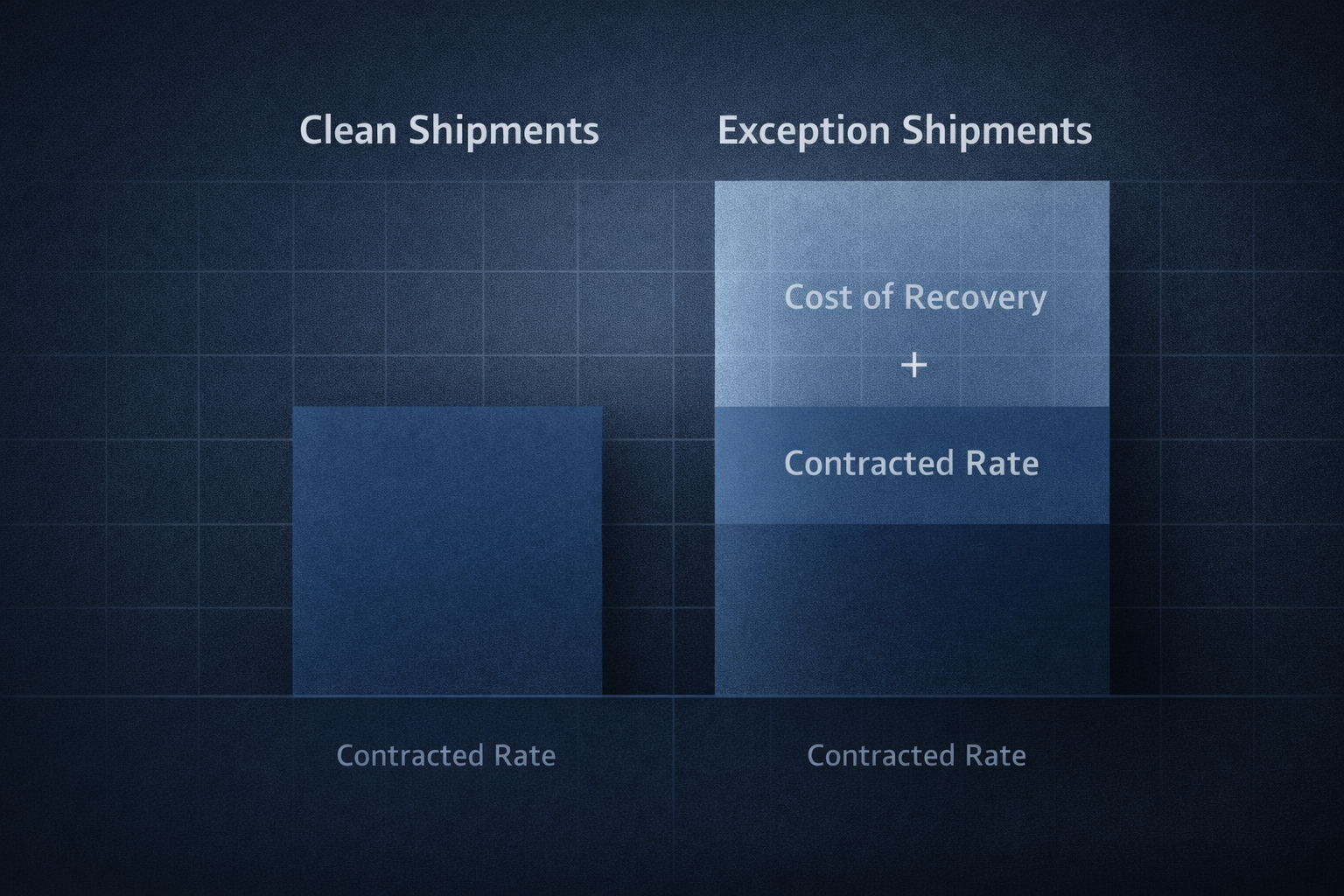
Clean shipments move as planned and incur only the contracted rate.
Exception shipments incur the contracted rate plus the cost of recovery.
When these two populations are combined, the effective cost per shipment often looks very different from the contracted rate that appears in an RFP.
When companies run this math, they frequently find that a relatively small percentage of exception shipments accounts for a disproportionate share of total freight-related overages. In several cases, fewer than one in five shipments generated the majority of unexpected freight costs in a quarter.
This is why measuring exception frequency matters as much as measuring rates.
Why Most Exception Costs Stay Invisible
The most practical starting point is an exception audit. The goal is not perfect attribution, but directional truth.
First, establish exception frequency. Count how many shipments in a recent period required manual intervention of any kind. This includes rollovers that required follow-up, customs issues that required escalation, or delivery problems that forced rescheduling — even if the shipment ultimately arrived.
Most teams underestimate this number until they calculate it.
Next, identify where exceptions originate. Some will be carrier-driven. Others will stem from documentation or compliance. Others will occur during inland execution. Patterns emerge quickly once exceptions are categorized, and those patterns point directly to where improvement is possible.
Then, tally direct recovery costs. Air freight, demurrage, detention, exams, penalties, chassis, yard storage, and rehandling charges are already recorded somewhere in the organization. They are simply not connected.
After that, estimate indirect costs. This includes internal labor spent managing exceptions, buyer chargebacks, and lost sales from missed delivery windows or stockouts. These costs are harder to quantify precisely, but even conservative estimates are often eye-opening.
Finally, combine these numbers to calculate the total Exception Tax over the period and divide it across total shipments.
The result is a hidden cost per shipment that leadership rarely expects.
What Changes Once the Exception Tax Is Visible
Once companies complete this exercise, behavior starts to change.
Carrier selection shifts away from lowest-rate-first thinking. Reliability and recovery performance become meaningful evaluation criteria because they correlate more closely with realized cost. Some teams begin weighting historical exception frequency heavily in RFPs, because a slightly higher rate with fewer exceptions often produces a lower total cost.
Operational behavior changes as well. Teams book earlier on critical lanes, build realistic buffer time into planning, and establish clear ownership for monitoring and escalation. Exceptions are identified sooner, when recovery options are cheaper.
Most importantly, exception costs move from being treated as unavoidable noise to being treated as a controllable operational variable.
Industry Signal: How Leading Importers Are Acting on This
Recent industry discussions among large importers point to a consistent response once exception costs become visible.
Rather than treating overages as unavoidable, leading organizations are building end-to-end control layers for their international freight operations. The focus is not simply on rates, but on improving forecast accuracy, eliminating silent leakage from misapplied contract terms, and strengthening day-to-day vendor relationships — especially around detention, demurrage, and other accessorial charges.
A common theme in these discussions is alignment. Procurement, logistics, and finance teams operate from a single source of information, allowing issues to be identified earlier and resolved with greater accountability.
The common thread is not aggressive rate negotiation, but control through visibility and communication.
From Measurement to Control: Why Technology Becomes Necessary
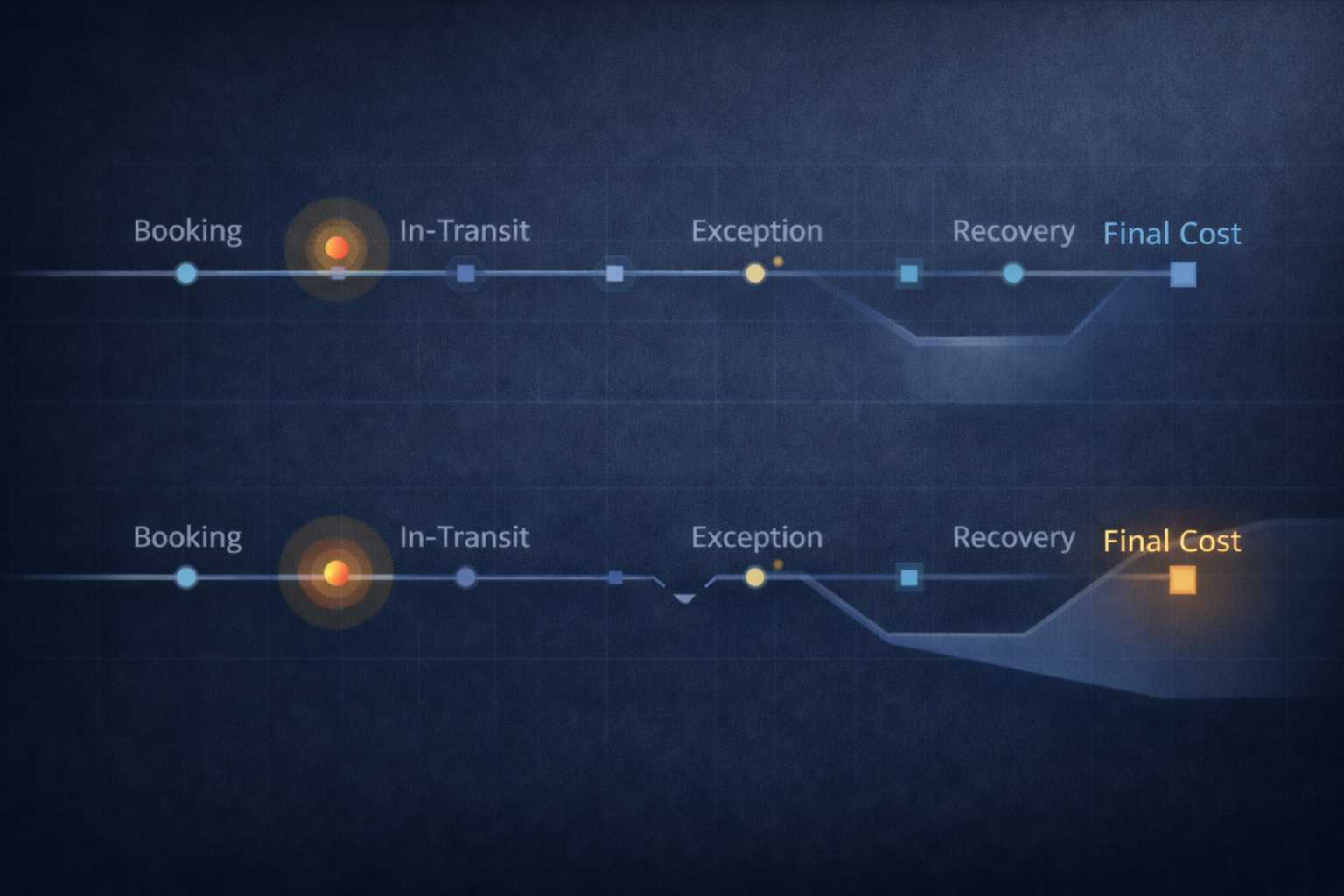
Once exception costs are visible, the next challenge is operationalizing control.
At a small scale, teams can manage exceptions through manual follow-ups and spreadsheets. At volume, this approach breaks down. Control erodes when information does not move as fast as the freight itself.
This is why technology becomes necessary — not as a replacement for human judgment, but as the infrastructure that allows teams to act in time.
APIs play a critical role in this transition. By enabling shipment-level data to flow directly into internal procurement, logistics, and finance systems, APIs reduce manual handoffs and ensure that exceptions, accessorial charges, and recovery actions are visible in real time. This shared visibility allows teams to intervene earlier, when recovery options are still available and less costly.
It is not automation for its own sake. It is faster alignment across teams.
Why Rate Visibility Alone Is Not Enough
Real-time spot rate data from ocean carriers is increasingly accessible through APIs and has become a baseline capability across the industry.
But rate visibility alone does not deliver control.
Spot pricing improves booking decisions, but it does little to reduce the downstream cost of unreliable execution — where most exception-related overages occur. Without connecting rates to execution, exceptions, and recovery workflows, organizations simply move faster into the same operational blind spots.
This is why leading importers are looking beyond rate aggregation and toward systems that connect pricing, shipment execution, and communication into a single operational view.
The Model That Endures: Human Judgment, Technology, and Service
Technology alone does not solve supply chain complexity. Neither does service without data.
The freight forwarders that will continue to thrive — and help their customers do the same — are those that combine:
Human expertise to manage exceptions and relationships
Technology to centralize information and reduce friction
Service-driven operations built around accountability and follow-through
At Airlift, this thinking guides how we approach system integrations.
By enabling APIs for customers alongside execution-level communication and experienced operations teams, we support the same control layers that leading importers are building — where data, decisions, and conversations stay connected throughout the shipment lifecycle.
Freight volatility is not new. What has changed is the gap between what companies think they are paying and what they are actually paying once recovery is factored in.
The Exception Tax sits in that gap.
Once it is visible, it can be measured.
Once it is measured, it can be managed.
And once it is managed, freight execution stops being a silent drain and starts becoming a competitive advantage.
Once companies recognize the Exception Tax, a second realization usually follows.
They do not actually know how much unreliable freight execution is costing them.
Not precisely. Not consistently. And not in a way that informs decisions about carriers, routing, or recovery strategy.
The good news is that exception costs are far more controllable than freight rates — if they are measured correctly.
Get a quote for your shipment
Have a shipment to move? Send the origin, the destination, the cargo and the container or weight; we reply with the rate, the routing and the services included.