


Peak season didn't end at Thanksgiving — it just changed shape.
We're entering the most volatile transition window of the shipping calendar:
The gap between Thanksgiving and December's end-of-year surge
Q4 decisions colliding with Q1 capacity allocations
And a compressed production cycle driven by an early Lunar New Year (January 29, 2025)
Lunar New Year follows the lunar calendar, so the date shifts each year. When it falls early — like in 2025 — factories shut down sooner, cutting 2–3 weeks out of normal production timelines and forcing importers to pull orders forward.
If you haven't adjusted yet, you're already behind.
Quick Market Check (20 Seconds)
FreightWaves' latest State of Freight webinar reveals an unusual dynamic in both ocean and domestic freight:
Freight demand is soft
But capacity is quietly tightening
Tender rejections creeping upward (6.79% vs 6.5% last year)
Spot rates showing early upward pressure
FMCSA cracking down on manipulated ELDs, removing illegally extended driving hours from the market
Why this matters:
Your supply chain faces pressure on both ends — Asia shutting down early for LNY and U.S. trucking capacity tightening due to regulatory enforcement. Even if your ocean freight arrives on time, the final mile may be less flexible than last year.
This is a dual-squeeze window.
Three Critical Dates You Can't Miss
Here's what the next 60 days really look like — and why timing matters more this year.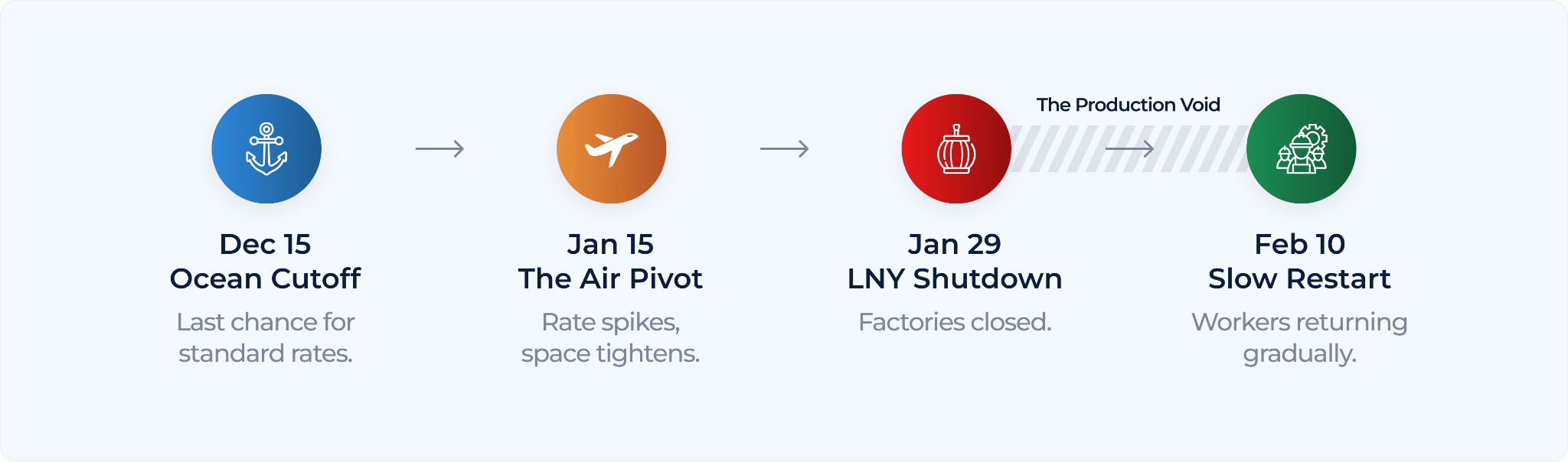
December 15 — Ocean Cutoff Reality Check
To land cargo before LNY disruptions, most Asia-U.S. sailings need to be booked and loaded by mid-December.
Why this deadline?
Transit to US West Coast: 32 days
Transit to US East Coast: 62 days (Source -Flexport)
Shanghai, Ningbo & Singapore hubs currently facing 14–21 day transshipment delays (C.H. Robinson) — and that's before holiday congestion peaks
Holiday trucking slows factory-to-port movement
Equipment availability tightening at origin as carriers reposition for post-LNY demand
When you add these factors together, mid-December becomes the practical cutoff for cargo that needs to be in the U.S. before late January.
Action:
If cargo must be in the U.S. by late January, your ocean booking window closes in 2 weeks.
January 15 — The Pre-LNY Freight Scramble
Most factories begin slowing production in mid-January and close 1–2 weeks before January 29. This isn't a sudden shutdown — it's a gradual wind-down as workers prepare to travel home for the holiday.
What this creates:
Chassis shortages at origin ports as everyone rushes to move cargo simultaneously
Trucking delays into export terminals (drivers work shorter hours heading into the holiday)
Carriers overbooking vessels to maximize utilization before the pause
Shippers panic-switching from ocean to air as they realize ocean windows have closed
Air freight rates from China to North America are already $5–6/kg — more than double the typical $2/kg off-peak rate (Freightos, Air Cargo News). When the pre-LNY rush intensifies, these rates climb even higher as shippers compete for limited cargo plane capacity.
Action:
If you're running lean on inventory, lock air capacity before January 10 — before rates spike and space disappears.
February 10 — Post-LNY Restart (Slower Than You Think)
Factories don't return to full production on February 1.
Lunar New Year involves hundreds of millions of workers traveling home — often across provinces or to rural areas. Their return is gradual, not immediate. This means stable output typically resumes by late February, not early February (Ascent Global Logistics).
What to expect:
Workers return over a 7-10 day period (not overnight)
Production lines ramp gradually as full crews reassemble
First export-ready cargo moves around mid-February
Carriers prioritize Q1 space for customers who committed capacity early (before LNY)
The factories that serve you face the same challenge: they need their workers to return and their suppliers to restart before they can fulfill your orders.
Action:
Don't plan your replenishment cycle around early February output. Build buffer stock now to cover through early March.
The Strategic Mode Mix: Ocean + Air, Not Ocean vs. Air
Most importers ask: "Should I go “ocean or air?"
The smarter 2025 strategy: Both, on purpose.
Instead of choosing one mode and hoping it works, successful importers are using a hybrid approach that gives them flexibility as conditions change.
Ocean = Your Base Load
Use for:
Predictable, high-volume SKUs
Goods with 45+ day forecast visibility
Heavier or lower-margin items where air economics don't work
The key:
Carriers assign Q1 space now, not in January. Early commitments get priority loading during and after LNY when space is tightest.
Air = Your Flexibility Insurance
Use for:
Fast-moving SKUs with shorter demand cycles
Stockout prevention (the cost of air freight is often less than the cost of lost sales)
Last-minute PO adjustments
Missed ocean cutoffs
E-commerce demand is driving 14% annual air cargo growth through 2026 (Bertling), keeping capacity tight year-round. Air freight isn't just for emergencies anymore — it's become a strategic tool for managing uncertainty.
The key:
Don't wait until you need air. Negotiate standby capacity with your forwarder now, before January rates spike and availability shrinks.
The 80/20 Hybrid Play (Best Practice)
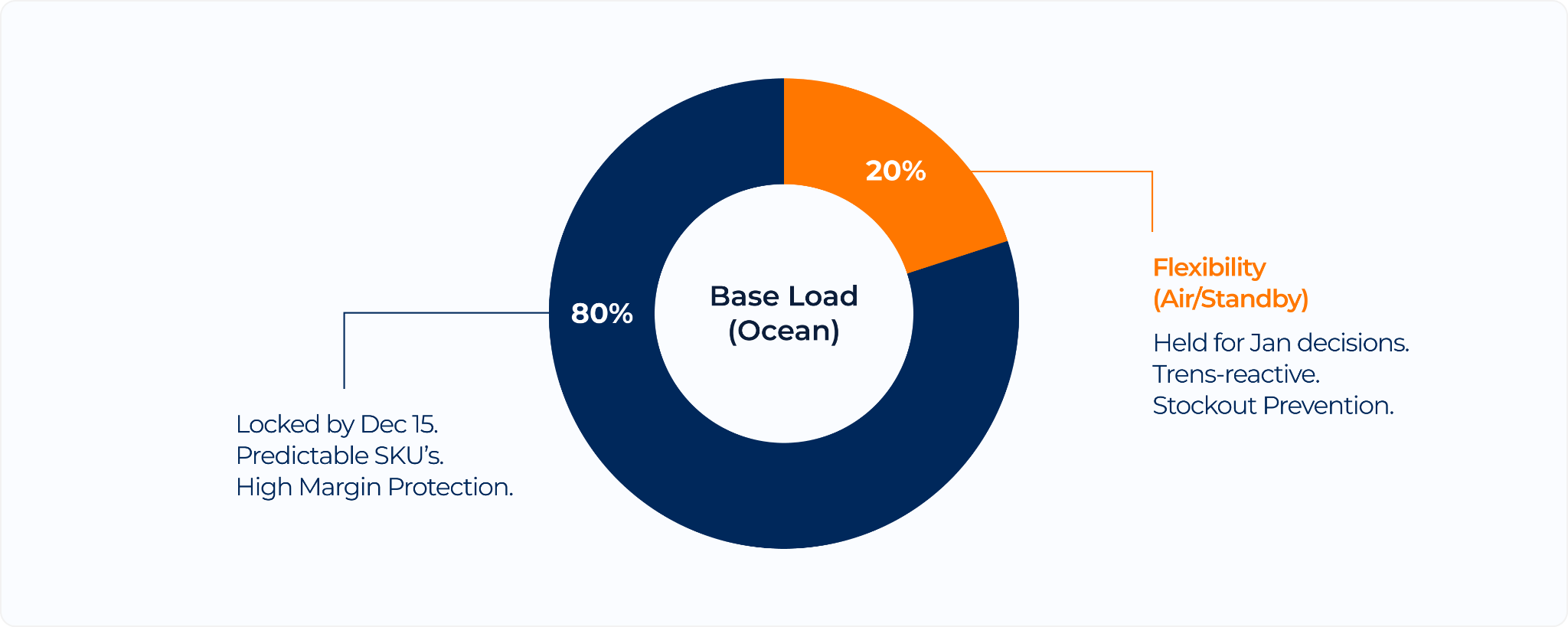
Here's how experienced importers are approaching this compressed season:
80% via ocean (locked by Dec 15) — covers your predictable base demand
20% held back — reserved for final decisions in late January
Air deployed selectively based on actual demand signals, not early forecasts
Why this works:
It avoids panic air freight (which can cost 5-8x ocean rates), protects margin, and gives you room to adjust as real customer demand becomes clear. You're not guessing in November — you're deciding with data in January.
What Happens If You Wait
Let's be clear about what delayed planning typically costs during an early LNY cycle.
Scenario 1: You Miss the Ocean Window
→ Forced into air during the Jan 15–25 surge when rates are highest
→ Rates spike 5–8x ocean costs
→ Capacity may not exist for your lane (planes fill fast)
→ What seemed like "saving money by waiting" becomes the most expensive option
Scenario 2: You Book Air Too Late
→ February stockouts while competitors are fully stocked
→ Lost sales during a critical revenue period
→ Customer disappointment (or worse, customers discovering your competitors)
Scenario 3: You Overcommit to Ocean Without Flexibility
→ Demand shifts, but your inventory is locked in 30–60 day transit
→ Cash tied up in slow-moving stock
→ No ability to pivot when market conditions or customer preferences change
Scenario 4: You "Wait for Better Rates"
→ Carriers allocate space to shippers who committed early
→ Your bookings get rolled to the next available sailing
→ February restock becomes March restock
→ The "better rate" you waited for never materializes — and you've lost time
The real cost isn't just higher freight rates. It's lost revenue, compressed margins, and competitive disadvantage while others serve customers you can't reach.
One Thing to Do This Week
Your first-week-of-December action plan:
Schedule a 15-minute capacity planning call with your freight forwarder.
Ask three specific questions:
"What's my guaranteed ocean allocation for January sailings?"
(This tells you if they've secured space or are hoping to find it later)"What standby air capacity can you hold for me in mid-January?"
(This reveals whether they can actually pivot when you need them to)"How quickly can we switch modes within 7 days if demand shifts?"
(This tests their operational flexibility and relationship with carriers)
If they can't answer these questions clearly and confidently, that tells you something important about your logistics partnership — before the pressure hits in January.
Closing
Peak season isn't one moment — it's a series of pressure points.
This Dec–Jan window isn't about finding the cheapest rate.
It's about securing options before constraints hit — so you have choices when others are scrambling.
The next 60 days will define your Q1 performance.
Make them count.
Need help navigating this transition? Let's talk about capacity strategy.

Get a quote for your shipment
Have a shipment to move? Send the origin, the destination, the cargo and the container or weight; we reply with the rate, the routing and the services included.