

On August 11, just hours before a midnight deadline, President Trump signed an executive order extending the US-China tariff truce by another 90 days. The decision prevented what many experts called a potential severe trade disruption between the world’s two largest economies (Reuters).https://www.reuters.com/world/china/us-china-extend-tariff-truce-by-90-days-staving-off-surge-duties-2025-08-12/?utm_source=chatgpt.com
While this avoided an immediate crisis, it left businesses—large and small—facing three more months of uncertainty. If you’re wondering what all this means, why it matters, and how to prepare, this guide breaks it down step by step.
What Actually Happened
Think of tariffs like a tax added to goods crossing borders. The higher the tariff, the more expensive those goods become for businesses and consumers.
The current deal (extended): The US is charging 30% on Chinese imports, while China is charging 10% on US goods (Axios).https://www.axios.com/2025/08/11/us-china-tariffs-pause-90-days?utm_source=chatgpt.com
What almost happened: Without the extension, those rates would have jumped to 145% (US) and 125% (China)—levels analysts warned would have brought trade close to a standstill. (Reuters)https://www.reuters.com/world/china/us-china-extend-tariff-truce-by-90-days-staving-off-surge-duties-2025-08-12/?utm_source=chatgpt.com
The new deadline: November 10, 2025. That’s when we’ll know if the truce holds, breaks, or gets extended again.
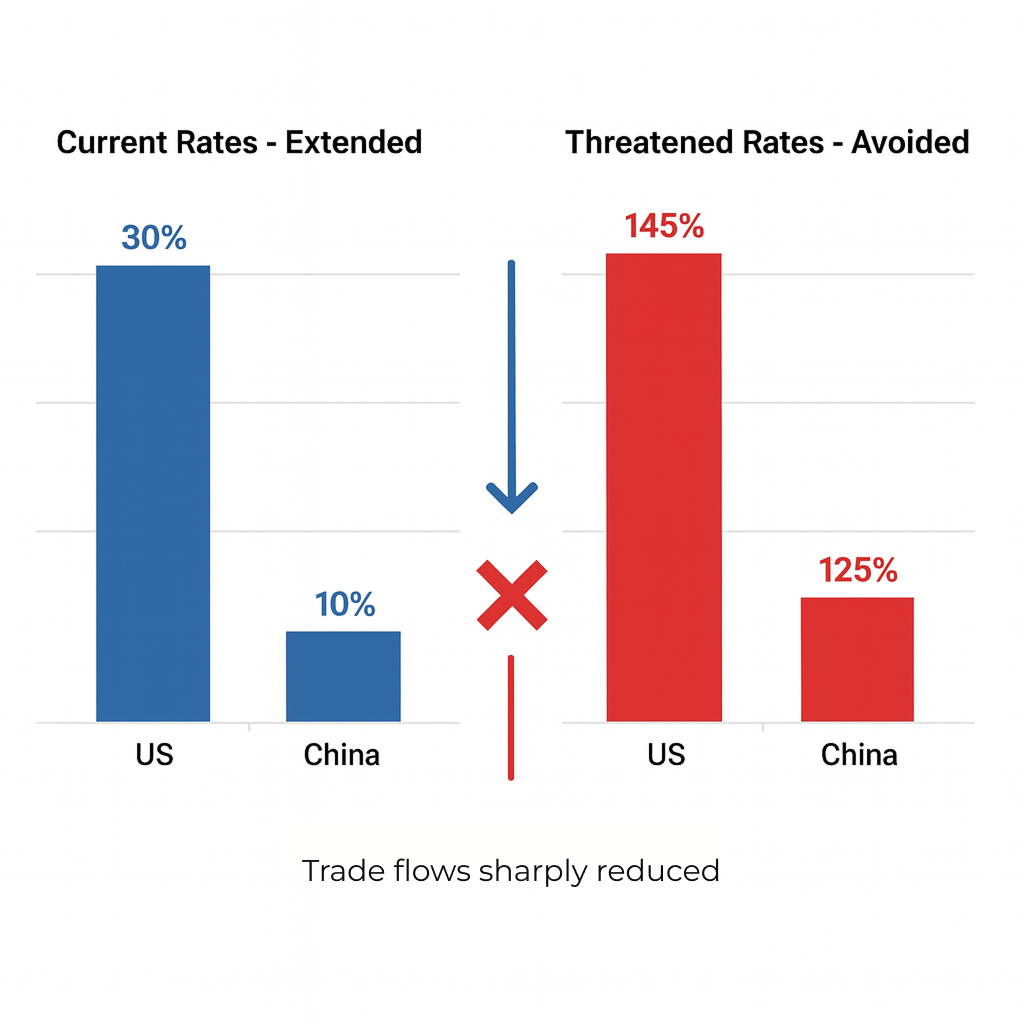
Tariff Comparison: Current vs. Threatened
Direction | Current Rate | Threatened Rate | Impact if Implemented |
US → China | 30% | 145% | Trade flows sharply reduced |
China → US | 10% | 125% | Severe retaliation, consumer price spikes |
Why It Matters to Businesses and Consumers
Tariffs don’t just live in government policy—they ripple into markets and consumer behavior.
The Tax Foundation estimates the broader tariff regime amounts to an average tax increase of $1,300 per US household in 2025 (Tax Foundation).
According to NRF’s July Retail Monitor, US consumers responded to tariff fears by buying ahead of time, boosting sales as families stocked up before possible cost increases (NRF).https://nrf.com/media-center/press-releases/cnbc-nrf-retail-monitor-shows-strong-spending-in-july-as-consumers-responded-to-sales-and-bought-ahead-of-tariffs?utm_source=chatgpt.com
Financial markets remain highly sensitive to trade headlines, with stock sell-offs in early August reflecting how tariffs weigh on investor sentiment (WSJ). https://www.wsj.com/livecoverage/stock-market-today-dow-sp-500-nasdaq-08-11-2025/card/trump-delays-higher-china-tariffs-SjRQOTlHKicacRQO8g4n?utm_source=chatgpt.com
Bottom line: These policies don’t just affect diplomats—they impact household budgets, retail strategies, and global market stability.
The Challenge of Uncertainty
Imagine planning a long road trip but not knowing whether a key bridge will be open or closed when you get there. That’s what businesses are facing with trade policy right now.
Every few months, companies prepare for massive tariff hikes, only to see them delayed at the last minute. This cycle forces businesses to:
Hold extra inventory “just in case”
Delay investments in new factories or products
Spend more time on risk management than on innovation
The International Monetary Fund (IMF), the global financial institution that monitors economic stability, warns that such policy unpredictability can weigh heavily on global growth. Businesses can plan around high costs; they can’t plan around constant uncertainty.
What Businesses Should Do Now
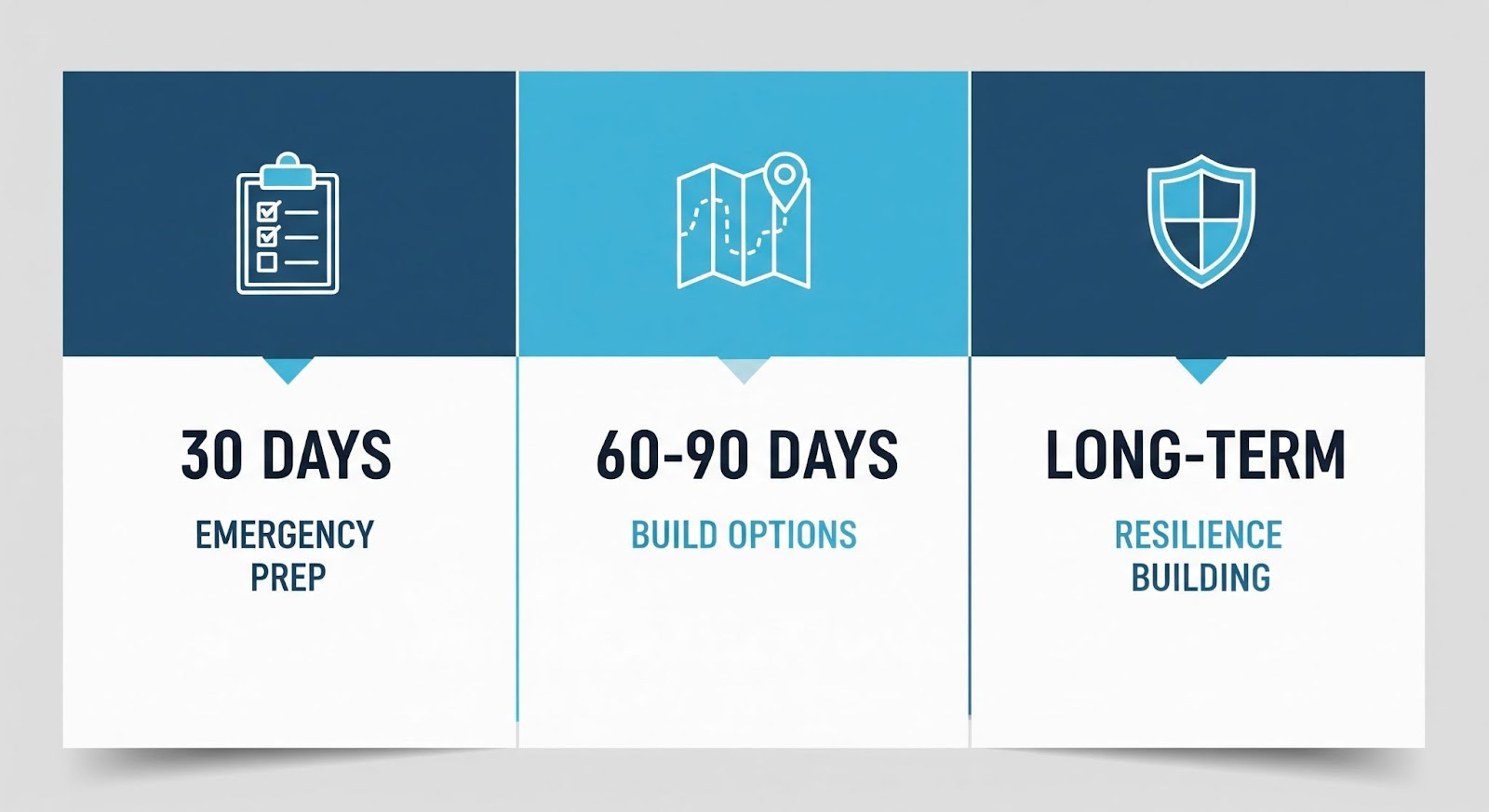
The next 90 days are not a pause—they’re a testing ground for resilience. Here’s how to use this window effectively:
1. Immediate Actions (Next 30 Days)
Before anything else, map your risks.
Scenario planning: Prepare for both extension and escalation outcomes.
Check contracts: Ensure supplier agreements allow for quick adjustments.
Audit inventory: Identify which products need buffer stock.
Think of this as your emergency checklist—like having batteries and water ready before a storm.
2. Medium-Term Preparations (60–90 Days)
Once stabilized, shift focus to building options.
Supplier diversification: Explore “China+1” or “China+many” sourcing strategies.
Pricing models: Adjust quotes to reflect potential tariff scenarios.
Supplier relationships: Stronger ties can mean faster, more flexible responses.
This is like mapping alternate routes on your trip. If one road closes, you won’t be stranded.
3. Long-Term Resilience Building
Beyond November, assume uncertainty is here to stay.
Invest in visibility tools: Real-time tracking reduces reaction lag.
Regional networks: Spread production across regions for flexibility.
Financial buffers: Maintain cash reserves for sudden pivots.
This is about turning your supply chain into a shock absorber, not a fragile glass tower.
Looking Ahead: November and Beyond
What we know:
Current tariffs (30% US → China, 10% China → US) stay in place until November 10.
Any further extensions require another presidential order.
Negotiations are ongoing, but without public details.
What remains uncertain:
Will tariffs spike in November?
Will another extension be granted?
Will a new long-term framework emerge?
Current tariffs (30% US → China, 10% China → US) stay in place until November 10.
Any further extensions require another presidential order.
Negotiations are ongoing, but without public details.
What remains uncertain:
Will tariffs spike in November?
Will another extension be granted?
Will a new long-term framework emerge?
The Bottom Line
The August extension prevented an immediate breakdown in trade, but it didn’t solve the bigger problem: uncertainty is the new normal.
For businesses, the message is clear:
Don’t assume stability.
Plan for volatility.
Use the next 90 days to build flexibility into every sourcing, inventory, and pricing decision.
The companies that succeed in this environment won’t be the ones waiting for certainty— they’ll be the ones ready to adapt the fastest when the next
deadline arrives.
Get a quote for your shipment
Have a shipment to move? Send the origin, the destination, the cargo and the container or weight; we reply with the rate, the routing and the services included.