


Costco's lawsuit over IEEPA-based tariffs has pushed a quiet issue into the spotlight: even if the Supreme Court eventually rules these tariffs unlawful, refunds are not automatic.
Over the past year, IEEPA tariffs have helped drive U.S. customs revenue to record levels – roughly $195 billion in total customs collections for FY 2025, more than double the previous year and driven in part by IEEPA and other recent tariff actions. Big retailers like Costco, Revlon, Kawasaki, and others are now suing to preserve their right to claim some of that back.
So the natural question is:
If the Supreme Court eventually strikes these tariffs down, who actually gets the refund – and what has to happen first?
This post looks at the practical mechanics, not the politics: how refunds work, where rights can quietly expire, and what importers can do now to preserve options.
1. There is no "automatic refund" button
Most headlines focus on the big legal question: Did the administration overstep its authority under IEEPA when it imposed these tariffs?
But for importers, there's a second question that matters just as much:
Even if the tariffs are found unlawful, how do duties already paid come back – if at all?
Trade and law firm alerts have been consistent on one point: if IEEPA tariffs are ultimately struck down, refunds will not simply flow back automatically.
Right now, there are only two main mechanisms to recover duties:
Post Summary Corrections (PSCs) – for unliquidated entries
Protests – for liquidated entries
We'll unpack both in a moment, but first it helps to understand one key concept: liquidation timing.
2. The 314-Day Clock: Why Timing Matters So Much
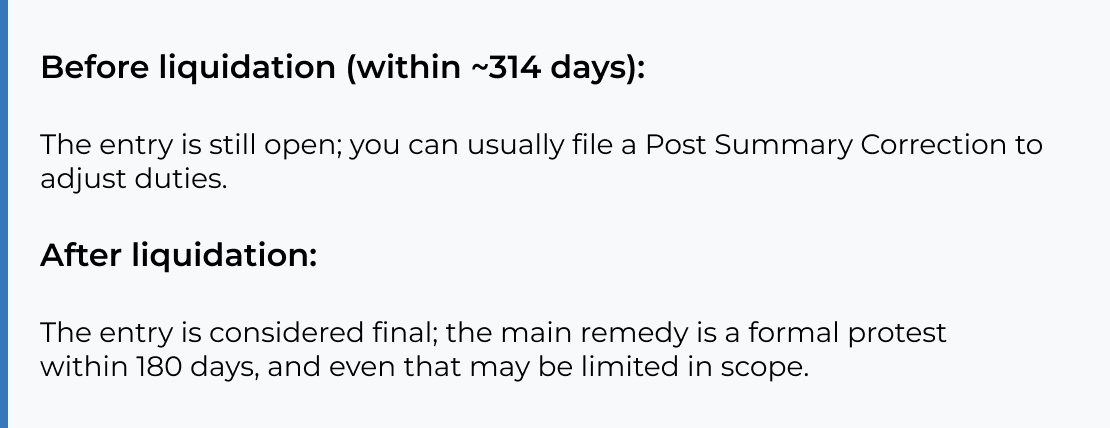
U.S. Customs and Border Protection (CBP) doesn't finalize the amount of duty owed on an entry the day it arrives. In most cases, entries are "liquidated" (made final) roughly 314 days after the date of entry.
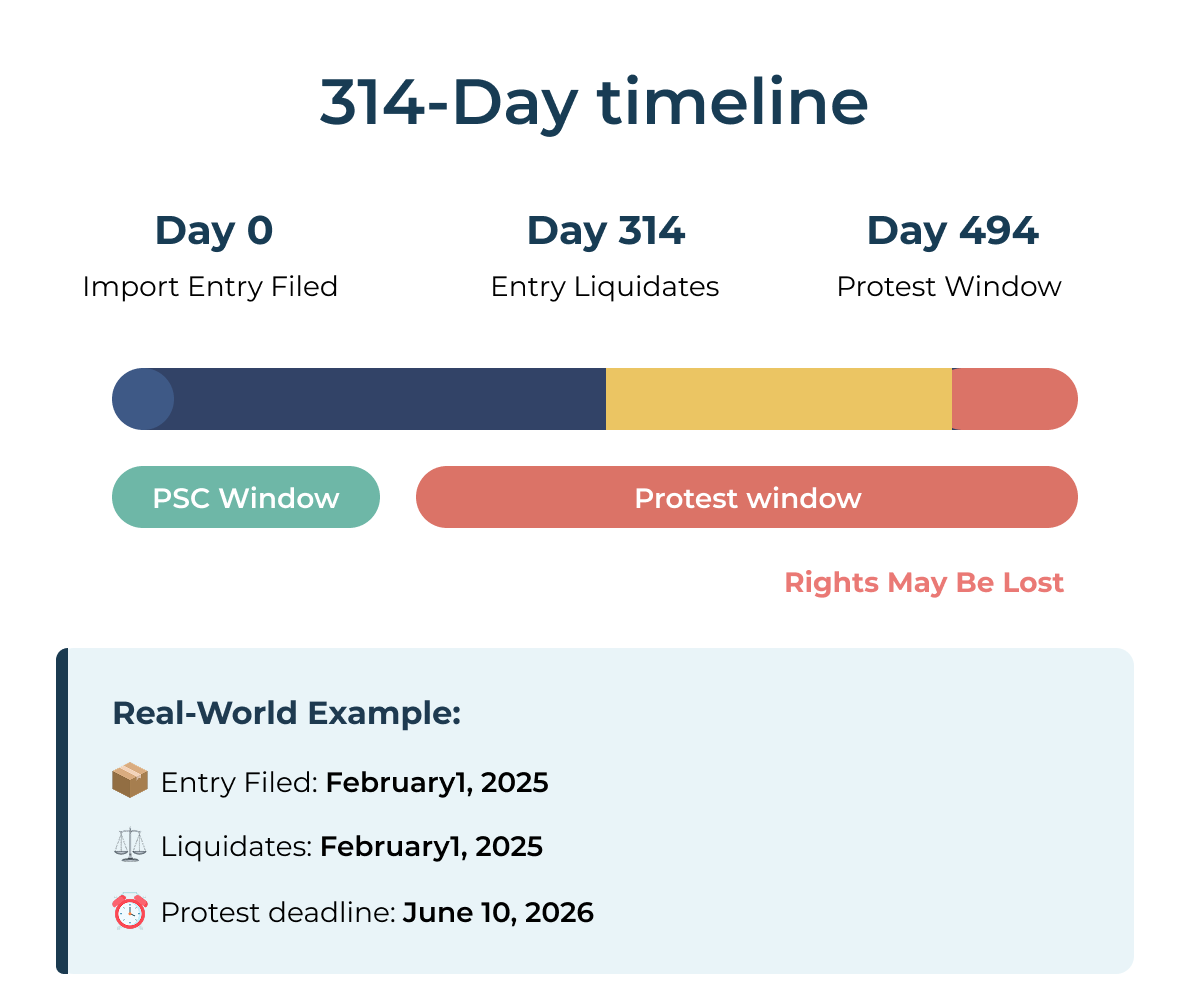
IEEPA-based tariffs first took effect in early February 2025, which is why the earliest entries begin to liquidate in mid-December 2025. That timing explains why Costco asked CBP to extend liquidation and, when CBP refused, filed a protective lawsuit to preserve its refund rights before those entries were locked in
3. The "Importer of Record" Trap
Even if tariffs are struck down and you act in time, another issue can surprise CFOs:
CBP generally issues refunds to the "Importer of Record" (IOR), not necessarily the party that ultimately bore the cost.
In many straightforward cases, the IOR is the importer. But there are notable exceptions:
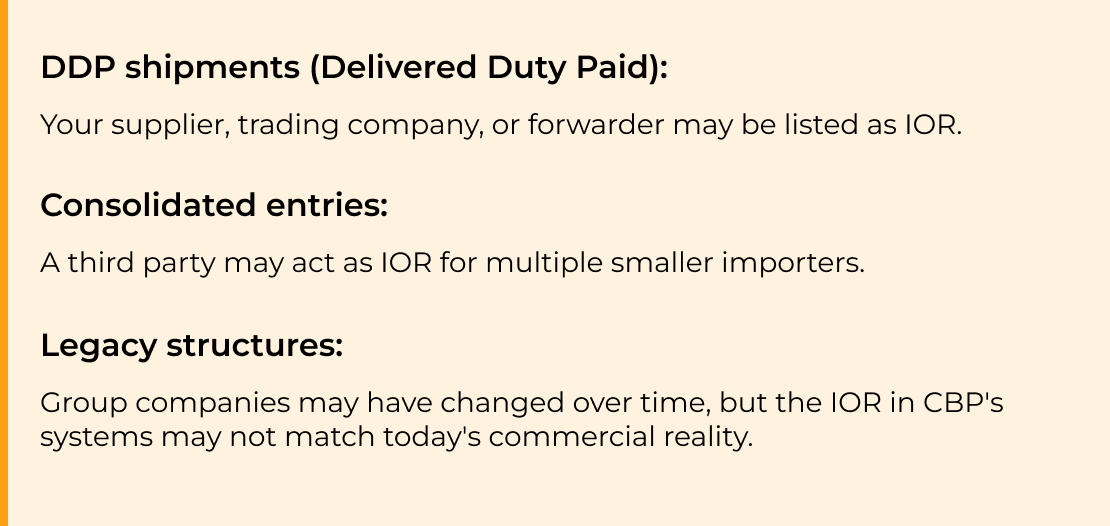
If you're not the IOR on the entry, you're not the one CBP will refund, even if the economic burden ultimately fell on you via pricing.
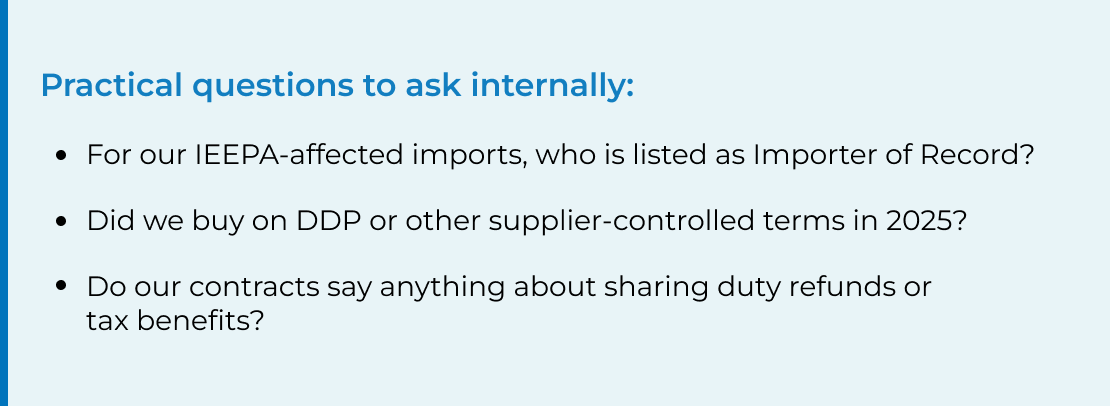
This is where legal and commercial issues intersect: the entity that paid the invoice is not always the one that appears in CBP's records.
4. The "Pass-Through" Problem
Even if you are the Importer of Record, there's another layer:
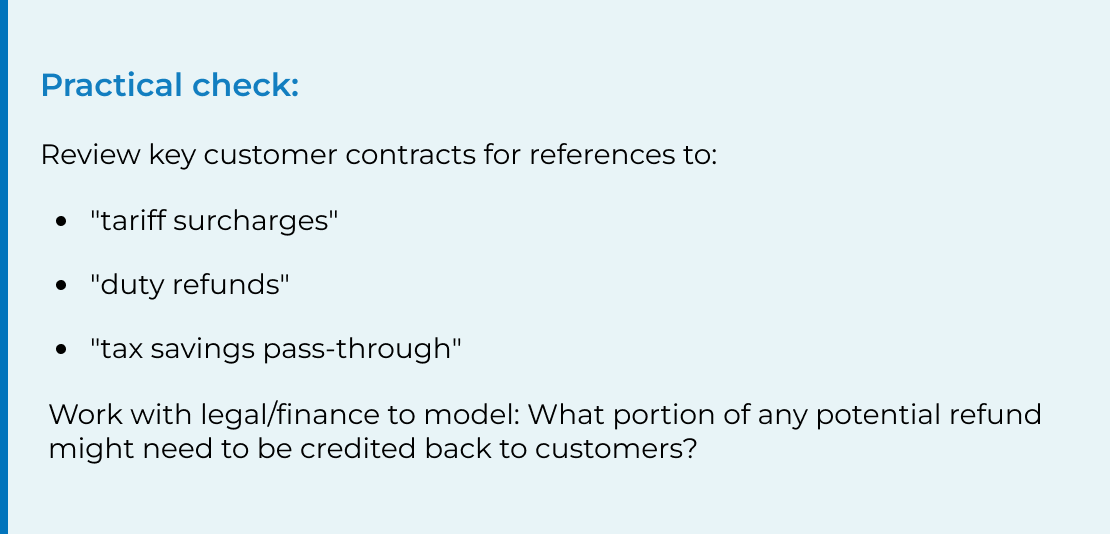
If you passed tariff costs on to your customers, can you legally and contractually keep a refund?
In practice:
Many importers added a "tariff surcharge" to invoices.
Major retailers sometimes require pass-through of tax savings in their vendor agreements.
Some pricing structures effectively embed duties in the product cost.
If tariffs are refunded later, some customers—especially large retailers—may point to contract language and say:
"You charged us for this. If you're getting it back, we want our share."
This doesn't mean refunds aren't worth pursuing. But it does mean:
The economic benefit may need to be shared.
The legal right to the refund and the commercial outcome may not be identical.
5. The Administrative Reality: PSCs, Protests, and Court Options
Assuming the Supreme Court eventually rules the IEEPA tariffs unlawful (still an open question), importers will generally need to take active steps to recover duties already paid.
For unliquidated entries (within ~314 days of entry)
Tool: Post Summary Corrections (PSCs)
What it does: Amend the entry summary to remove the IEEPA tariff line. If CBP accepts, a refund can be processed at the entry level. PSCs can take several weeks to months to process, depending on complexity and CBP workload.
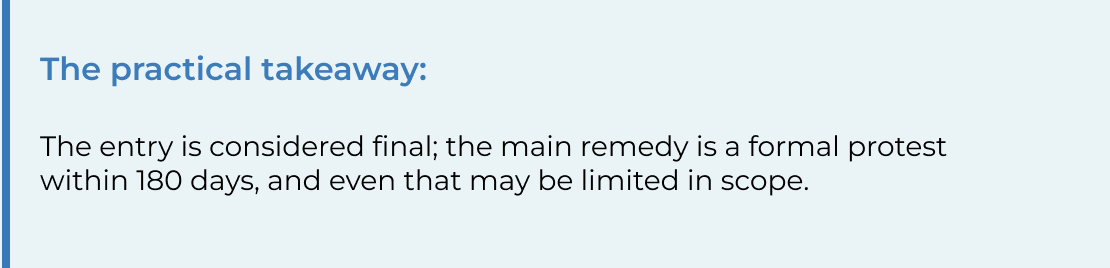
For liquidated entries (beyond ~314 days)
Tool: Protests under 19 U.S.C. § 1514
Deadline: Typically within 180 days of liquidation.
Complication:
CBP may view certain challenges as attacking the underlying law rather than a specific administrative decision, which can limit what a protest can achieve.
Process:
Protests involve more formal procedures and typically require customs counsel review. Processing times vary but can take many months.
If protests are denied, importers may then consider filing in the Court of International Trade (CIT) to challenge those denials and seek refunds. That is exactly the kind of litigation strategy we're now seeing from large brands like Costco.
None of these steps are automatic. Each requires:
Correct entry-level data
Awareness of deadlines (entry date, liquidation date, protest deadline)
Coordination with customs brokers and counsel
6. What Importers Can Do Now (Before Any Ruling)
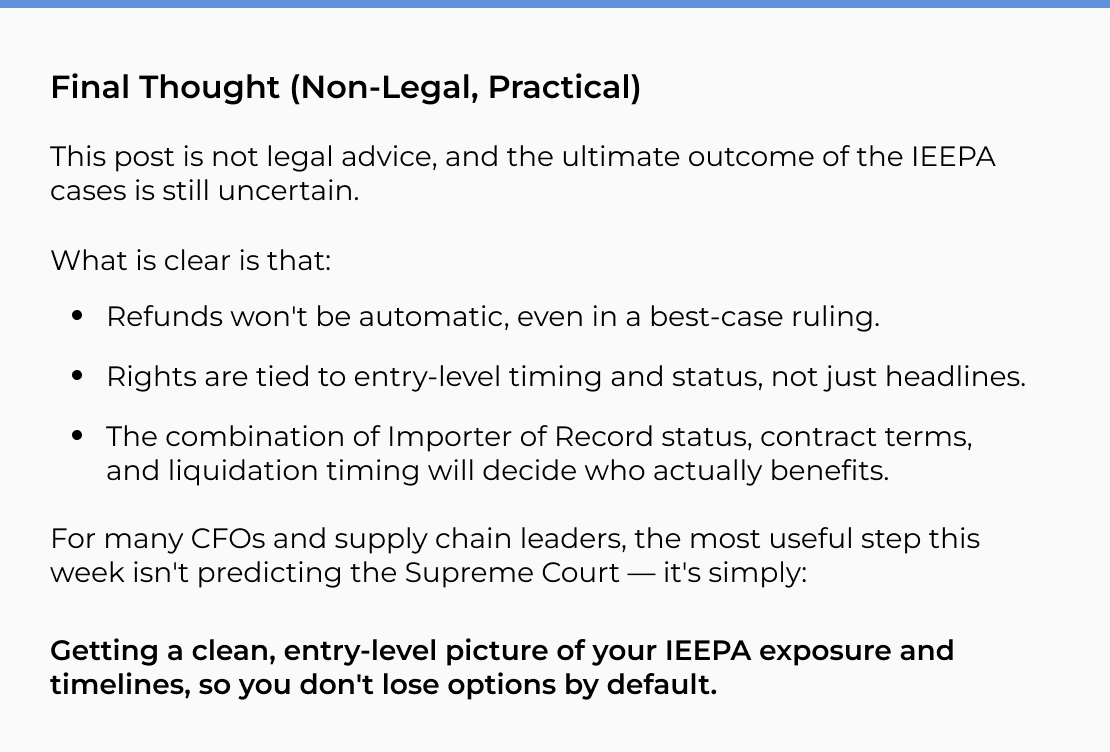
This isn't about predicting what the Supreme Court will decide. It's about not losing rights by default.
Here's a practical, neutral checklist to prepare:
A. Map Your Exposure
Here's a practical, neutral checklist to prepare:
. Identify which HTS lines and suppliers are subject to IEEPA tariffs.
. Quantify total duties paid under IEEPA for 2025 YTD.
. Prioritize high-value entries (by duty amount, not just shipment value).
B. Get Clarity on Importer of Record
. Request an IOR listing from your customs broker for all IEEPA-affected entries.
. Flag entries where the IOR is:
A foreign supplier
A trading house
A different group entity
. Discuss with legal/commercial teams whether contracts address refunds or pass-through obligations.
C. Track Liquidation Dates
Ask your broker for a report showing:
Entry date
Estimated/actual liquidation date
Duty paid under IEEPA by entry
Pay special attention to:
Entries approaching the 314-day window, where PSCs may no longer be possible.
Liquidated entries within the 180-day protest window.
Recent client alerts suggest that the earliest entries subject to IEEPA tariffs (from February 2025) begin to liquidate around mid-December 2025, which is why some large importers are acting now to extend liquidation or file protective claims.
D. Coordinate with Trade Counsel
This landscape sits at the intersection of:
Customs law (PSC, protest, CIT challenges)
Contract law (who keeps any refund)
Tax/accounting (how potential refunds are treated in your books)
Questions to frame your discussion:
For our IEEPA-affected entries, which remedies are realistically available (PSC vs protest vs litigation)?
Do we need to request liquidation extensions on specific entries?
How should we document our strategy in case of later audit or dispute?
7. The Reality Check: Who Actually Gets Paid If Tariffs Fall?
If the Supreme Court eventually rules that these tariffs exceeded IEEPA authority, there are three key filters between a theoretical refund and actual money in the bank:
Legal outcome – the Court's decision and how narrowly or broadly it is written
Procedural posture – whether each entry is still open (PSC), recently liquidated (protest window), or long closed
Commercial structure – who the Importer of Record is, and what your contracts say about sharing refunds
The Costco lawsuit is, in many ways, an attempt to align all three:
Preserve rights before liquidation deadlines hit
Secure standing as a party entitled to claim refunds
Position the company for recovery if the Supreme Court ultimately rules in favor of importers
Most importers don't need to mirror Costco's litigation strategy. But they do need to know where they stand before the clock runs on their own entries.
Get a quote for your shipment
Have a shipment to move? Send the origin, the destination, the cargo and the container or weight; we reply with the rate, the routing and the services included.