


Importing from India to the US? Which Tariffs Actually Apply to Your Shipment?
There isn't one tariff rate for everything imported from India into the United States.
You may see 10% in a headline. An older quotation may show another percentage. Neither necessarily tells you what applies to your shipment.
The actual duty depends on what you're importing, how it's classified, and which trade measures apply.
So instead of asking:
“What's the tariff on goods from India?”
A better question is:
“What duties apply to my product?”
Here's how to check.
1. Start with the HTS code
Your product's HTS classification is the starting point.
It determines the normal US duty rate for the product and helps establish whether additional tariffs or exclusions apply.
Two shipments can both come from India, have the same value and arrive at the same US port — and still have different duty calculations.
Start with the product, not the headline percentage.
2. Check the base duty
Every HTS classification has its own customs treatment under the Harmonized Tariff Schedule of the United States.
Depending on the product, the normal or MFN duty rate may be zero or may carry a percentage duty.
This is the starting point for the calculation.
Then you need to determine whether any additional trade measures apply.
3. Does the additional 10% Section 301 duty apply?
This is where the current India-US tariff discussion can become confusing.
In July 2026, USTR placed India in the 10% tier under its Section 301 action concerning forced-labor import prohibitions.
But there is an important distinction:
That does not mean every product imported from India automatically attracts an additional 10%.
There are product exemptions.
India's Ministry of Commerce estimates that approximately 45% of Indian exports to the US are outside the scope of this additional 10% duty, including generic pharmaceuticals, smartphones and certain other products.
Approximately 55% are estimated to fall within the measure.
So when you hear:
“India is at 10%.”
the next question should be:
“Does that additional 10% apply to my product?”
4. Check whether another trade measure applies
Some products have their own tariff treatment.
Certain steel, aluminium and automotive products, for example, are covered by Section 232 measures.
India's Ministry of Commerce states that products already covered by Section 232 are not subject to the additional 10% forced-labor Section 301 duty.
So don't simply add 10% to every shipment from India.
Check all trade measures that may apply to the product's classification.
5. What happened to the other 10% tariff?
If you've seen a different 10% surcharge in an older quotation, article or landed-cost worksheet, there may be a reason.
Earlier this year, the US introduced a temporary 10% Section 122 import surcharge.
It became effective February 24, 2026.
That measure was temporary and ended on July 24, 2026.
So don't assume that the tariff treatment used for an earlier shipment still applies to an entry being made today.
The entry date matters too.
6. There's another Section 301 investigation — but don't price it in yet
USTR is also conducting a separate Section 301 investigation into structural excess capacity and production in manufacturing sectors. India is one of the economies included.
But there's an important distinction:
An investigation is not an implemented tariff.
As of September 6, 2026, this investigation should not be added to today's landed-cost calculation as another duty.
If USTR takes final action, the products covered, rate and effective date will need to be reviewed.
For now:
Watch it. Don't price it in.
Before your next shipment, check these five things
You don't need to become a tariff expert.
But before your shipment reaches the entry stage, make sure these five questions have been answered:
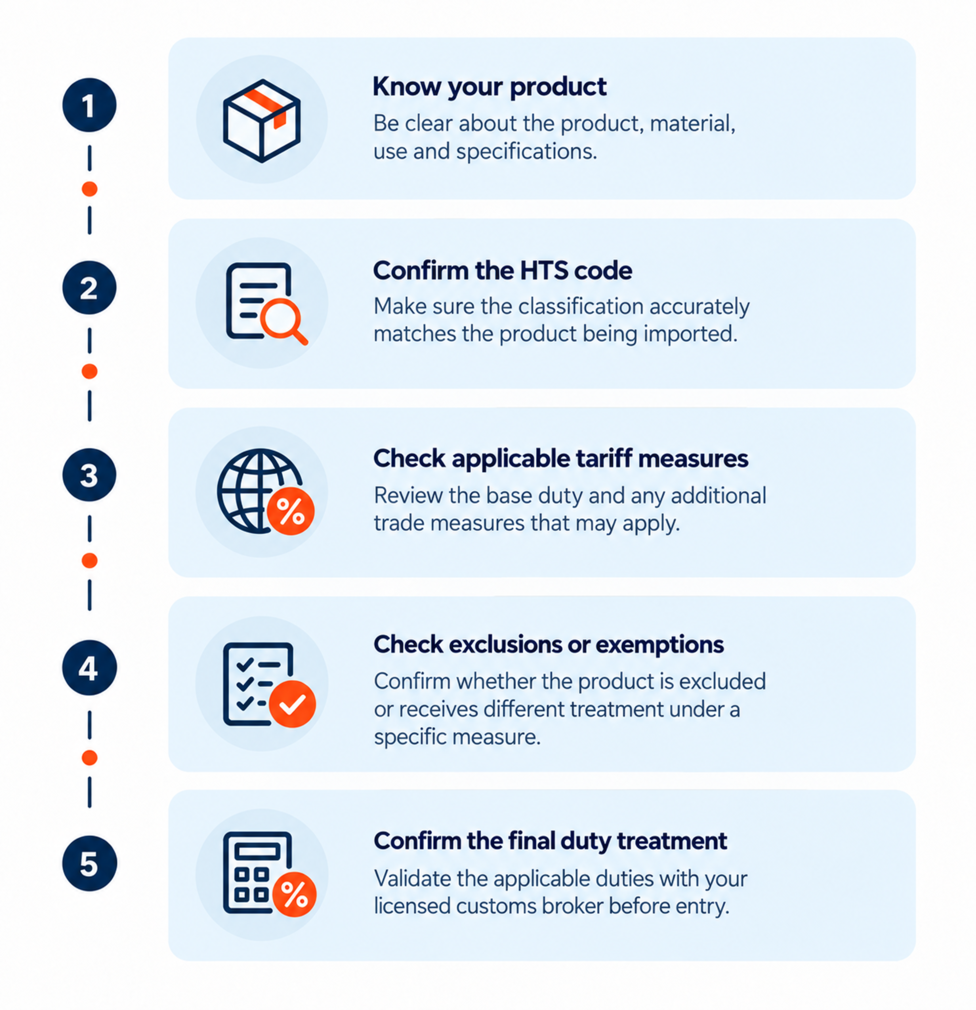
1. Is the HTS classification correct?
If the product, composition or specifications have changed, don't assume a classification used previously still applies.
2. What is the base duty?
Check the current duty treatment for that HTS classification.
3. Does the additional Section 301 duty apply?
Confirm whether the product is covered or falls within an applicable exemption.
4. Does another trade measure apply?
Check whether Section 232 or another product-specific measure affects the entry.
5. Has your customs broker confirmed the current treatment?
Validate the duty treatment against the shipment being entered — not an old quotation, spreadsheet or headline.
Why this matters for landed cost
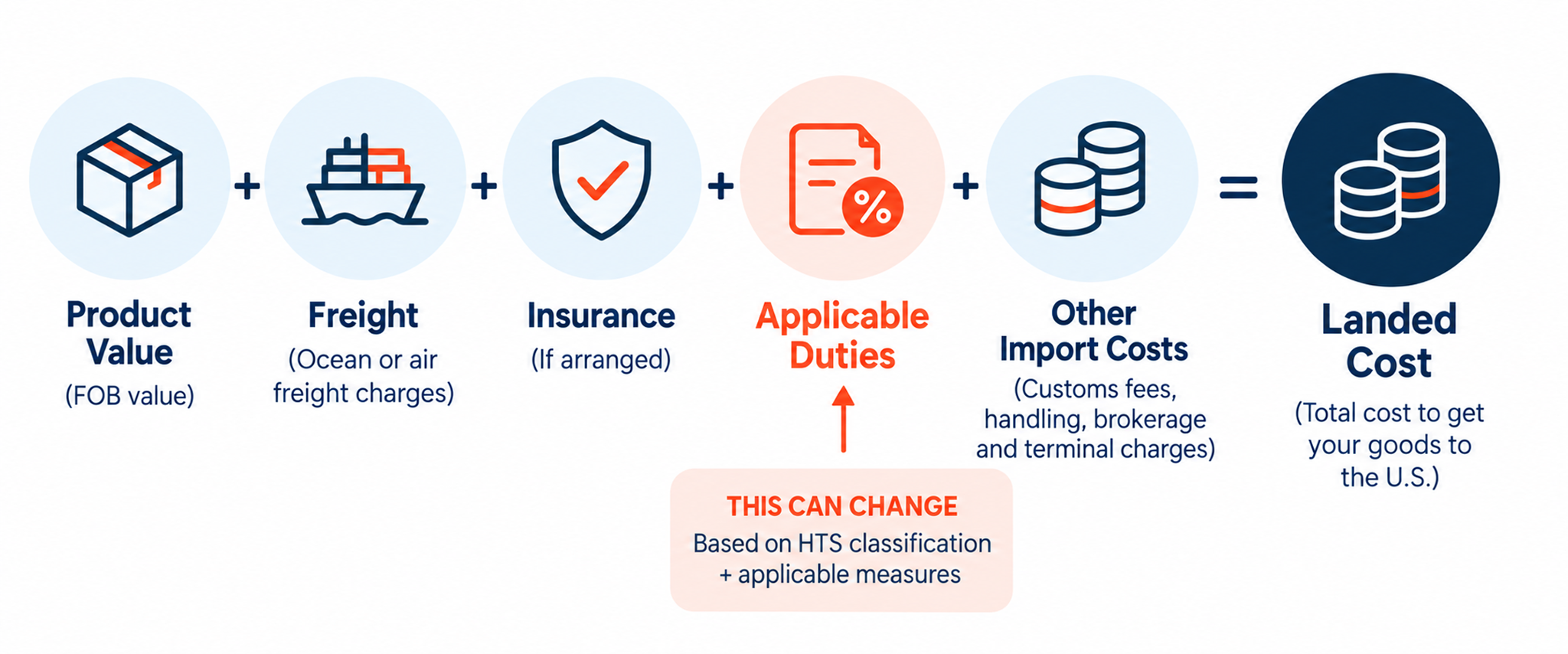
Freight is only one part of what an imported shipment ultimately costs.
Product value + Freight + Insurance + Applicable duties + Other import costs = Landed cost
If the tariff assumption is wrong, the landed-cost calculation can be wrong even when the freight rate is accurate.
That's why tariff verification belongs before the final landed-cost decision — not after the cargo arrives.
The takeaway
Don't start with:
“What's the tariff on India?”
Start with:
“What am I importing, how is it classified, and which duties apply to this entry?”
There isn't one “India tariff rate.”
There is the tariff treatment that applies to your product and your entry.
Before your next India-US shipment, confirm the HTS classification and applicable tariff treatment with your licensed customs broker.
Current as of September 6, 2026.
This article is for general informational purposes and does not constitute customs, legal or tax advice. Tariff treatment depends on the product, classification, country of origin, entry date and other circumstances. Importers should confirm the applicable treatment with a licensed customs broker or qualified trade professional.
Primary sources
Office of the United States Trade Representative (USTR) — USTR Takes Action in Forced Labor Section 301 Investigations, July 23, 2026
USTR — Fact Sheet: USTR Section 301 Action in Response to the Failure of 60 Economies to Ban Imports Produced with Forced Labor, July 23, 2026
Government of India, Ministry of Commerce & Industry, via Press Information Bureau — Final US Section 301 Measures on Forced Labour: India Placed in Lower Tariff Tier at 10%, July 25, 2026
The White House — Presidential action establishing the temporary Section 122 import surcharge
USTR — Section 301 investigation into structural excess capacity and production in manufacturing sectors, initiated March 11, 2026