


Ocean Freight from India to the US: 7 Things to Check Before Choosing a Freight Rate
When two ocean freight quotations arrive for the same India-to-US shipment, the comparison usually starts with one number: the rate.
And it should. Price matters.
But two quotations showing the same origin, destination and container type can still represent very different shipping options.
One may use a different carrier service or routing. One may apply to a different sailing window. Charges may be structured differently. And the assumptions behind the quoted rate may not be identical.
So before comparing the numbers, compare what sits behind them.
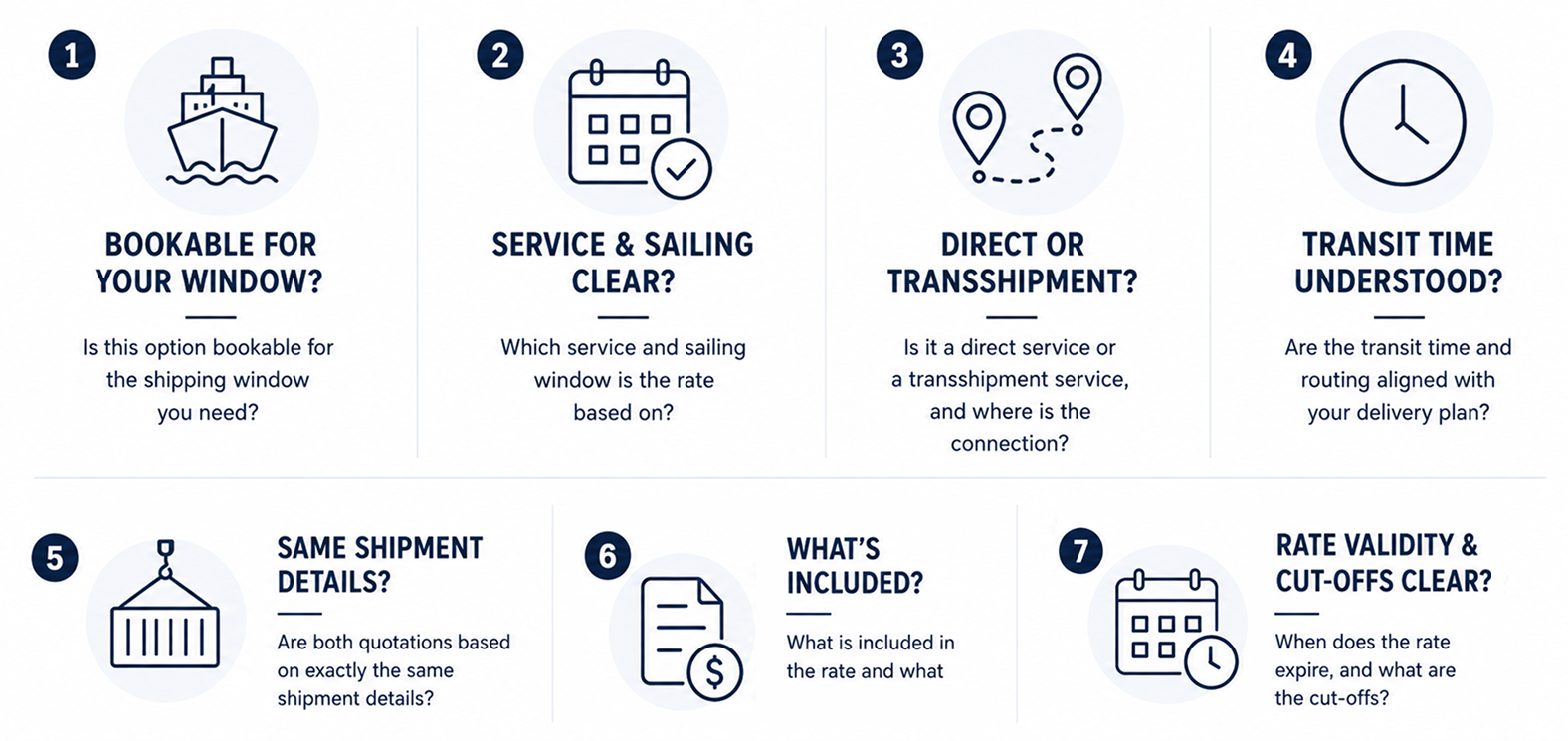
Here are seven things worth checking before choosing an India-to-US ocean freight quotation.
1. Is the rate bookable for the window you actually need?
A freight quotation and a confirmed booking are not the same thing.
A forwarder may be able to quote a rate for a particular service or validity period, but vessel space still needs to be secured when the booking is placed.
That matters when capacity is tight. A competitive rate has limited value if the sailing you need is no longer available by the time your cargo is ready.
Ask:
Is this option currently bookable for my required shipping window, and how early should I place the booking?
That tells you whether the quoted option fits the shipment you are actually planning — not simply whether the price looks attractive.
2. Which service and sailing window is the rate based on?
Don’t stop at the port pair.
Two quotations from Nhava Sheva to New York, for example, may show the same origin and destination while being based on different carrier services, sailing windows or routing options.
Ask which service the quotation is based on and what sailing period is being considered.
A rate available for one period may not apply if your cargo becomes ready later. A different sailing may also mean a different schedule, routing or applicable rate.
If your cargo has a firm delivery requirement in the US, this matters even more.
You are not simply buying transportation from Port A to Port B. You are planning around a period in which that transportation needs to happen.
3. Is the routing direct or does it involve transshipment?
Two quotations for the same India-US lane can take very different paths.
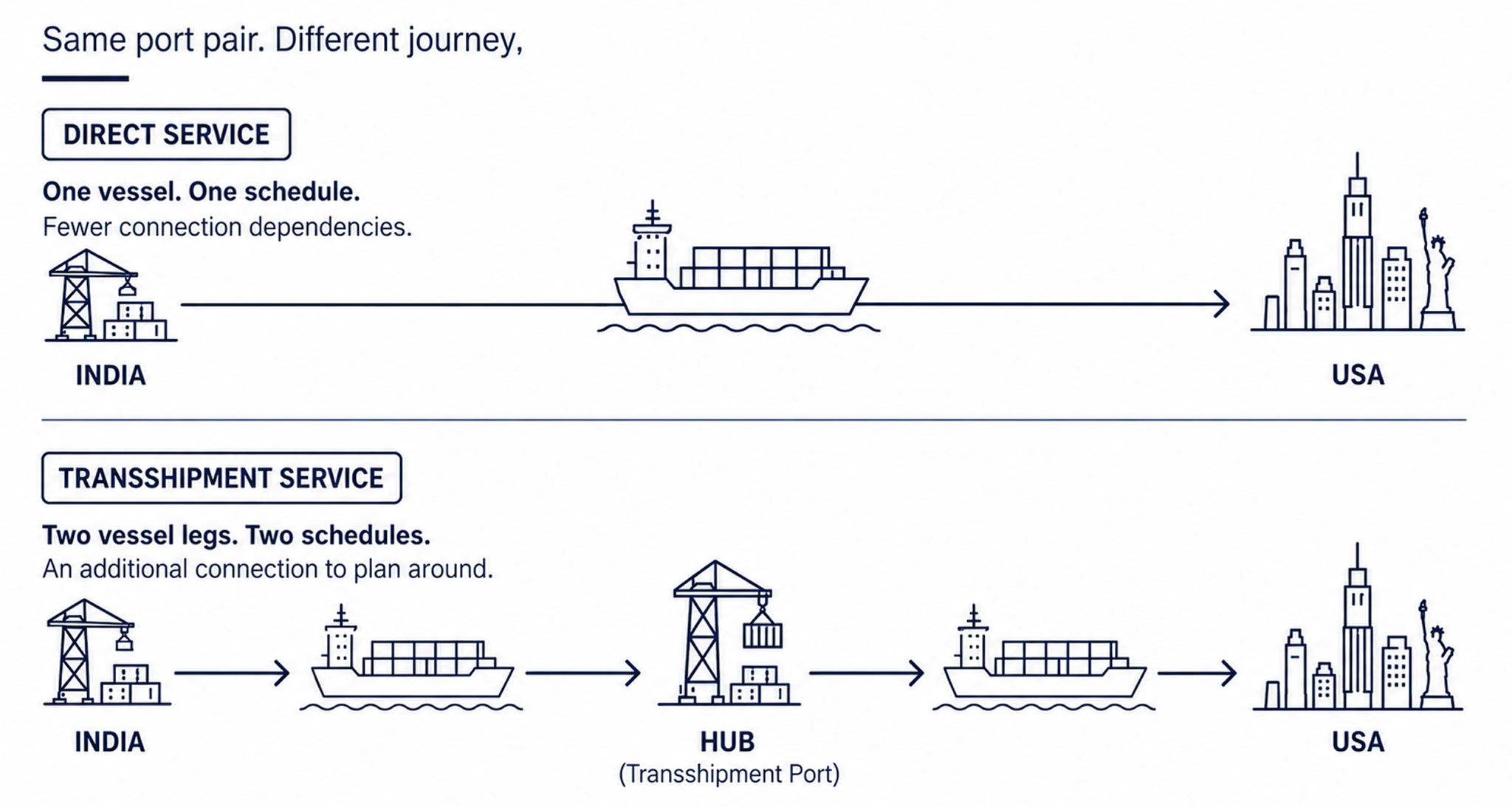
One service may move directly to the destination region. Another may connect through a transshipment hub before continuing to the US.
Transshipment is not automatically a disadvantage. Depending on the origin, destination and carrier network, it can be a practical and reliable option.
But it changes what you are comparing.
A transshipment introduces another connection into the journey, which means the schedule depends on both the first vessel and the onward connection.
Before choosing an option based on price or advertised transit time, understand how the container is actually getting from India to the US.
Ask:
Is this a direct service or a transshipment service, and where does the connection take place?
4. What transit time are you actually comparing?
A transit time shown on a quotation needs context.
Is it port-to-port?
Does the service involve transshipment?
And if you require inland delivery in the US, what happens after the container reaches the discharge port?
A shorter advertised transit time does not automatically mean the shipment will reach its final destination sooner. The sailing schedule, routing and inland movement all contribute to the overall shipment plan.
If your cargo is working against a delivery deadline, don’t compare transit-time numbers in isolation.
Compare the routing, sailing schedule and transit time together.
That gives you a more realistic picture of when the cargo can reach its destination.
5. Are both quotations based on the same shipment details?
This is one of the easiest things to overlook.
Before deciding that one forwarder is cheaper, make sure both forwarders are actually pricing the same requirement.
Check that the quotations use the same:
Container type and quantity
Cargo weight
Commodity
Port of loading
Port of discharge
Inland destination or ramp, where applicable
Door-delivery requirement, if applicable
Cargo weight deserves particular attention.
Carrier requirements and charges can vary depending on cargo weight, equipment and routing. If one quotation is based on different cargo assumptions, the two rates may not be directly comparable.
The same applies to the destination.
A rate to a US port, an inland rail ramp and a customer’s door are different transportation requirements even when they ultimately serve the same market.
A common comparison issue in India-US freight is that two rates appear to serve the same destination while one ends at the port or inland ramp and the other includes an additional delivery leg.
Before comparing rates, compare the inputs used to build them.
6. What is included — and what could still change?
The number labelled ocean freight is not necessarily the total transportation cost.
Depending on how a quotation is structured, there may also be applicable:
Origin charges
Destination charges
Documentation fees
Inland transportation charges
Carrier surcharges
Other shipment-specific charges
One forwarder may show certain charges within a combined amount while another lists them separately.
That can make one quotation appear cheaper at first glance even when the overall cost difference is much smaller.
It is also important to understand which components apply for the quoted period and which may remain subject to carrier or market changes.
Where applicable, GRIs, peak-season surcharges or other carrier adjustments can change the economics of a shipment after an earlier comparison.
So instead of asking only:
“What is your ocean freight rate?”
Ask:
“What is included in this quotation, and what could still change before I book?”
That creates a much cleaner comparison.
7. When does the rate expire — and what are the cut-offs?
Every quotation has a usable window.
The rate may be valid only for a defined period, and the intended sailing will have its own operational deadlines.
Depending on the shipment, these can include:
Booking deadlines
Documentation cut-offs
Container gate-in or cargo cut-offs
VGM cut-offs
Other carrier or terminal requirements
If your cargo is not ready within the required window, the option you originally evaluated may no longer be available under the same conditions.
Before approving a quotation, establish three things:
How long is the rate valid?
By when should the booking be placed?
When must the cargo and documentation be ready?
Those dates can be just as important as the rate itself.
The real comparison isn’t rate versus rate
None of this means the cheaper quotation is the wrong choice.
Sometimes it will be the best choice.
The point is that price becomes meaningful only when you know what you’re comparing.
A useful ocean freight comparison considers the rate alongside the service, sailing window, routing, transit time, shipment details, included charges and validity.
A price difference tells you very little if the quotations are not based on equivalent shipping options.
And a slightly higher rate may make sense if it better fits the cargo-ready date, required routing or delivery plan.
Equally, if two options genuinely provide comparable service under comparable conditions, price becomes a much more meaningful differentiator.
The objective is not to avoid choosing the cheaper rate.
It is to understand why one rate is cheaper before you choose it.
Because ultimately, you are not buying a number on a quotation.
You are choosing how your cargo gets from India to the US.
Before you choose your next India-US ocean freight quote
Check the service.
Check the routing.
Check the sailing window.
Check the shipment assumptions.
Check what is included.
Check the validity and cut-offs.
Then compare the price.
Planning an India-to-US shipment?
Search available India-US ocean freight options with Airlift and compare the details behind the rate.
Search India–US Ocean Freight Rates → [INSERT ACTUAL RATE SEARCH URL FROM AIRLIFTUSA.COM]