

A Container Leaves India With One Cost. It Can Arrive With Another.
What the August 15 quartz tariff-rate quota changes for India–U.S. shipments
A quartz slab shipment leaves an Indian port in early August.
The cost sheet is final. The purchase order is confirmed. The importer has already priced the project for which the material is intended.
The container is still on the water when August 15 arrives.
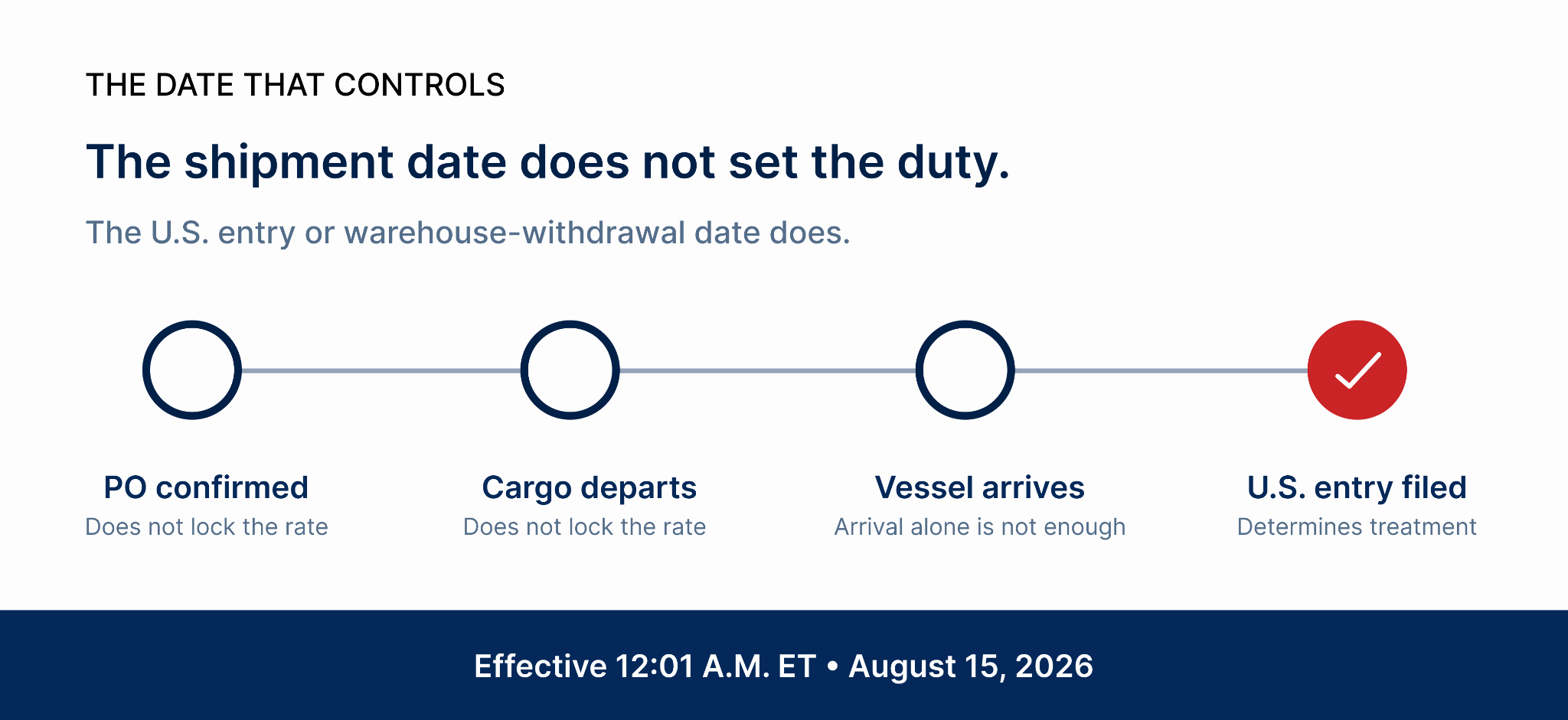
That alone does not change the shipment’s duty treatment. But if the merchandise is entered for consumption in the United States on or after August 15, the cost calculation may change significantly.
The reason is easy to overlook: the applicable safeguard treatment is not determined by when the shipment was booked, loaded or dispatched from India. It is determined when the goods are entered for consumption—or withdrawn from a U.S. warehouse for consumption.
A shipment priced under the previous rules can therefore be entered under the new ones.
For India–U.S. quartz importers, this is not merely a compliance update. It is a new financial variable that needs to be included before the next purchase order, quotation or shipment is approved.
What changes on August 15
On July 31, 2026, the White House issued a proclamation establishing a four-year safeguard tariff-rate quota on covered quartz surface products.
The action followed a U.S. International Trade Commission finding that increased imports were a substantial cause of serious injury to the domestic industry producing competing products.
The measure begins at 12:01 a.m. Eastern Time on August 15, 2026.
Covered products can include engineered quartz slabs, countertops, backsplashes, vanity tops, worktops, tiles and other qualifying surfaces. The written scope is based on the product’s material composition and characteristics—not simply the commercial name used on an invoice.
Natural quarried stone products such as granite, marble, soapstone and quartzite are excluded.
How the tariff-rate quota works
A tariff-rate quota applies different duty rates depending on whether quota remains available when an entry is filed.
During the first year:
Covered entries made while quota remains available face an additional 25% safeguard duty.
Covered entries made after the available quota is filled face an additional 50% safeguard duty.
The first-year annual quota is 13,006,426 square meters, or approximately 140 million square feet.
That amount is divided into four quarterly allocations of 3,251,606 square meters each. Unused quota from one quarter may be carried into the following quarter.
The quota is shared across imports from all covered, non-exempt countries. It is not reserved separately for India, an individual supplier or a particular importer.
The applicable rate can therefore depend on quota availability when the U.S. entry is filed.
The safeguard rates decline gradually over the four-year program:
Year 1: 25% within quota; 50% above quota
Year 2: 23% within quota; 49% above quota
Year 3: 21% within quota; 48% above quota
Year 4: 19% within quota; 47% above quota
For shipments entering after August 15, however, the immediate planning question is the Year 1 exposure.
Why India requires a separate calculation
India is not among the countries excluded from the safeguard measure.
There is also a second duty layer to consider.
The United States has maintained antidumping and countervailing duty orders on certain quartz surface products from India since 2020. Those orders were continued in January 2026 following sunset reviews.
The new safeguard duty does not replace those orders.
For merchandise covered by both measures, the safeguard duty is cumulative. Applicable regular customs duties, antidumping and countervailing duties, the new safeguard duty and other applicable charges may all contribute to the final duty exposure.
The applicable AD/CVD cash-deposit rate can depend on the producer, exporter and entry circumstances. Importers should therefore confirm the correct rate for their supplier rather than relying on a general India-wide assumption.
In practical terms, the 25% and 50% figures shown in the new measure are additional duties—not total landed-duty rates.
The date that can catch importers
August 15 should not be treated as a deadline merely to have the cargo moving.
The proclamation applies to covered goods entered for consumption, or withdrawn from warehouse for consumption, on or after 12:01 a.m. Eastern Time on August 15.
It does not create a general exemption for goods that:
Were ordered before August 15
Were booked before August 15
Departed India before August 15
Were already on the water when the measure began
The safer planning question is therefore not:
“Did the cargo ship before August 15?”
It is:
“When will the U.S. entry be filed, and what quota treatment will be available at that time?”
Importers should work with their customs broker to monitor official quota availability. Shipment timing may help with planning, but it cannot by itself guarantee the within-quota rate.
The difference quota status can make
Assume a covered shipment has a dutiable customs value of $100,000.
If quota is available when the entry is filed, the new safeguard component would be $25,000.
If the quota has filled, that component would be $50,000.
The difference is $25,000 on the same customs value—before adding applicable regular duty, antidumping duty, countervailing duty or other charges.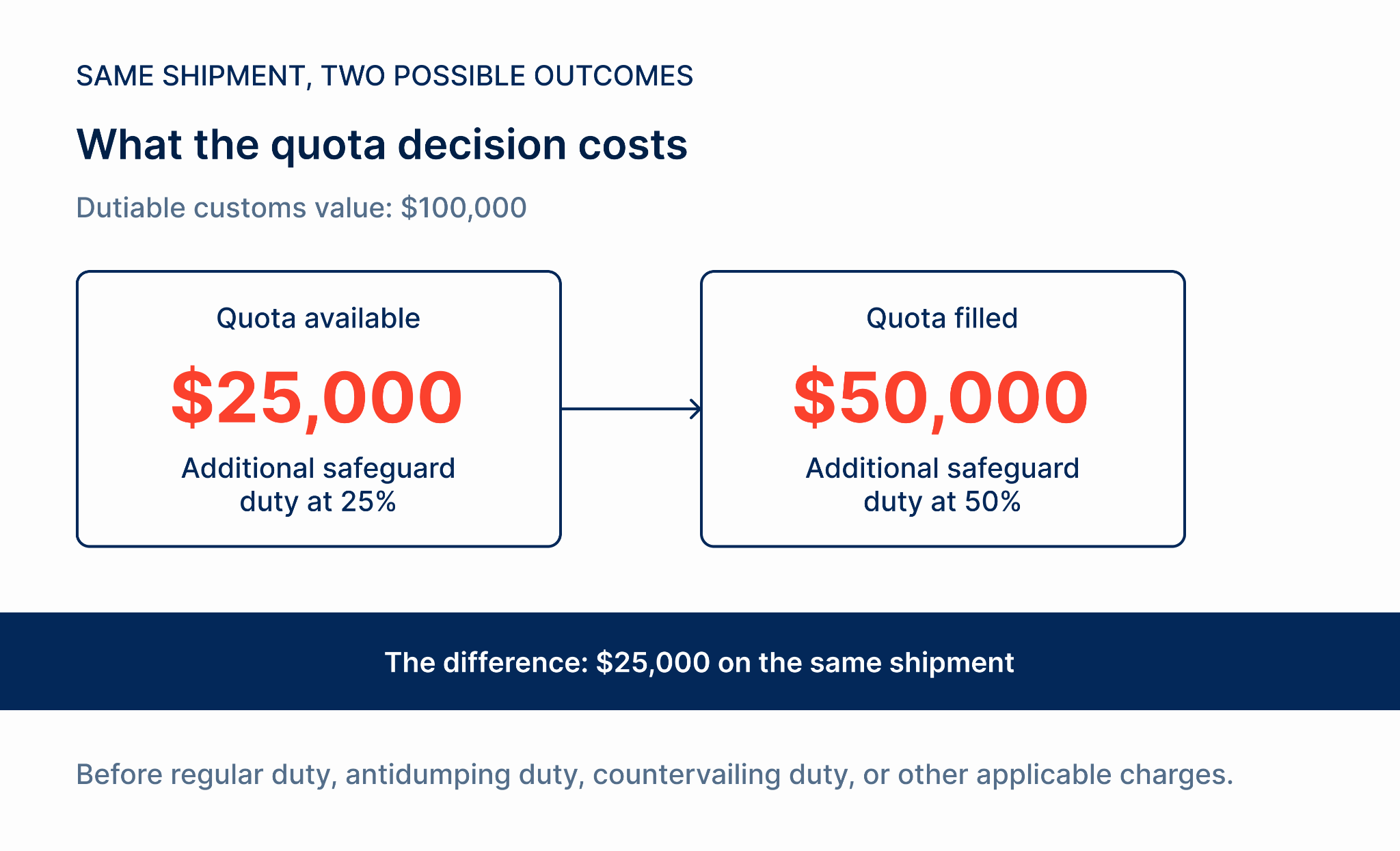
The final calculation will depend on the merchandise, producer, exporter and entry details. But this example shows why both quota scenarios must be modeled before the commercial price is approved.
What to confirm before approving the next shipment
Landed cost on a covered quartz shipment should now be calculated under two scenarios: one assuming the entry receives within-quota treatment, and another assuming it receives above-quota treatment.
Before approving or booking an India-origin quartz shipment, confirm:
Product scope: Does the merchandise satisfy the written definition of covered quartz surface products?
Classification: Is it properly classified under HTSUS 6810.99.0020, 6810.99.0040 or 7020.00.6000?
Entry timing: What is the realistic U.S. entry or warehouse-withdrawal date?
Quota availability: What does the customs broker see in the official quota status when the entry is being prepared?
AD/CVD exposure: What producer- or exporter-specific cash-deposit rates apply?
Stacked landed cost: Does the transaction remain commercially viable under both the additional 25% and additional 50% safeguard scenarios?
The difference between those two calculations should be understood before cargo moves—not discovered after the customs entry is filed.
The cost sheet is no longer settled at origin
The new measure is not, by itself, a reason to stop every quartz shipment from India.
It is a reason to stop treating the cost sheet as fixed simply because the purchase order has been issued or the container has left the origin port.
Beginning August 15, entry timing, quota availability and existing duty exposure can all affect the final landed cost.
The important question is no longer only what the shipment cost when it left India.
It is what the shipment will cost when it enters the United States.
Primary sources
White House proclamation establishing the quartz safeguard measure
Official White House Annex containing the scope, quota quantities and duty rates
Federal Register notice continuing the India and Türkiye quartz AD/CVD orders
This article provides general trade information and is not customs or legal advice. Product scope, classification, origin, quota availability and applicable duty rates should be confirmed with a licensed customs broker for each entry.