

The Market Keeps Changing. The Lesson Doesn't.
Over the past few weeks, importers have been navigating a familiar combination of challenges.
On several trade lanes, carriers have tightened space allocations, booking confirmations have become more selective, and service networks continue to evolve as carriers redesign schedules and adjust capacity. For many businesses, negotiating a competitive freight rate is no longer the hardest part of moving cargo.
Securing reliable space is.
None of these developments is unusual on its own. Shipping has always experienced cycles of tighter capacity, changing services and fluctuating demand.
What is different is how frequently these changes are occurring—and how quickly businesses are expected to respond.
Taken together, they point to something larger than another peak-season challenge.
The businesses performing best today are not necessarily those that found the lowest freight rate.
They are the ones that have built supply chains capable of adapting when the market changes around them.
Every Market Disruption Has Been Pointing in the Same Direction
Over the past few years, global trade has experienced a succession of disruptions that appeared unrelated. The pandemic created port congestion and equipment shortages that disrupted shipping for months. The Red Sea crisis forced carriers to reroute vessels, extending transit times and increasing operating costs. Trade policy changes accelerated purchasing decisions, compressing demand into shorter periods and putting unexpected pressure on ocean capacity. More recently, carrier network restructuring across key trade lanes—including India–U.S. services—and tightening space availability have once again changed how importers plan shipments.
Different events.
Different causes.
The same operational challenge.
Each disruption reduced certainty.
Importers had to make sourcing, inventory and transportation decisions with less confidence than before.
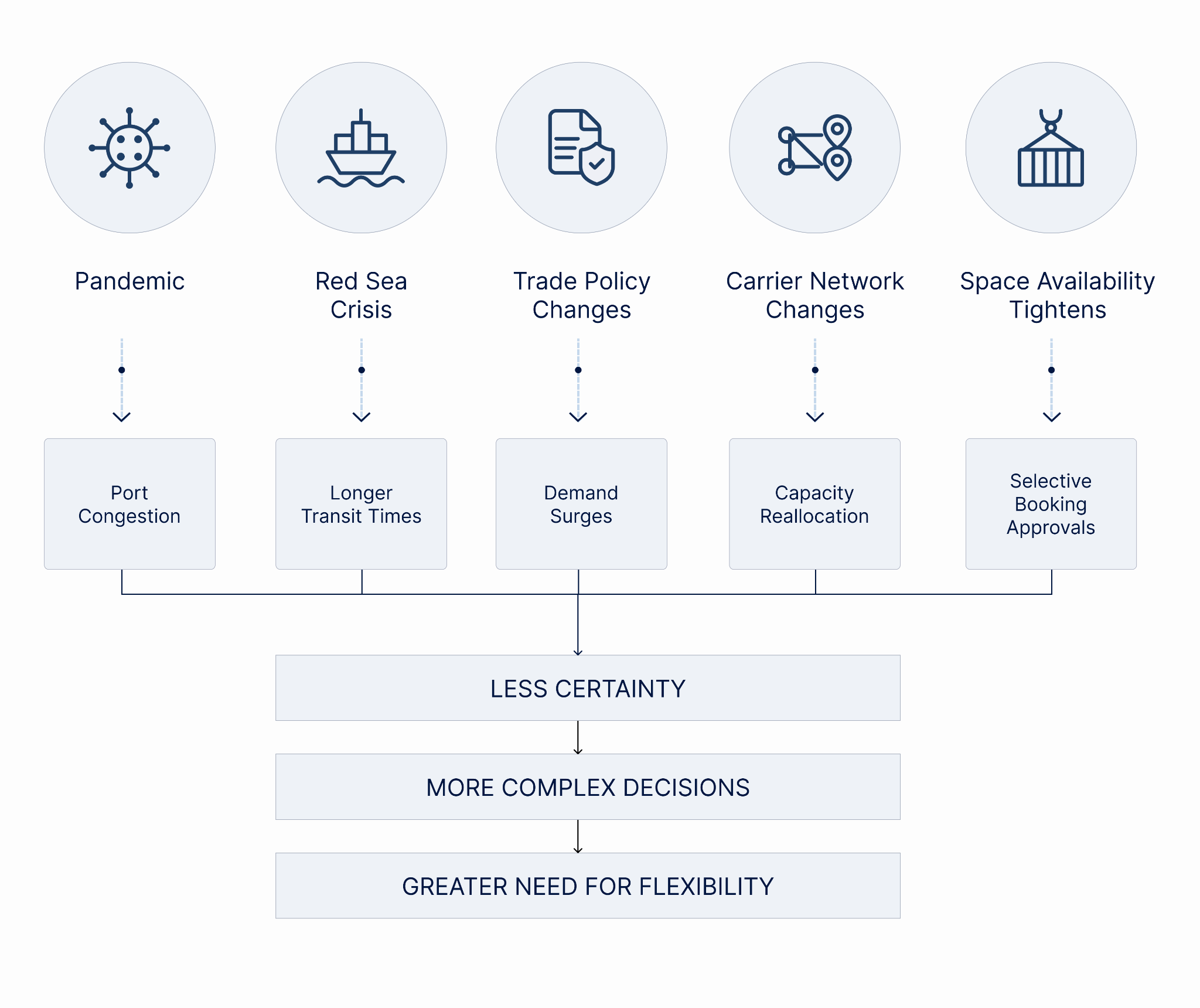
The lesson is no longer about a single event. It is about recognising that uncertainty has become part of the operating environment.
The Real Competitive Advantage Has Changed
For decades, supply chains were designed to maximise efficiency.
Inventory was reduced. Suppliers were consolidated. Preferred carriers were established. Transportation costs were negotiated aggressively. These decisions improved performance because market conditions were relatively predictable.
But every efficiency decision also removed an alternative.
One supplier instead of three.
One preferred carrier instead of several.
One routing instead of two.
Under stable conditions, those decisions reduced cost without significantly increasing risk.
Today's market has changed that equation.
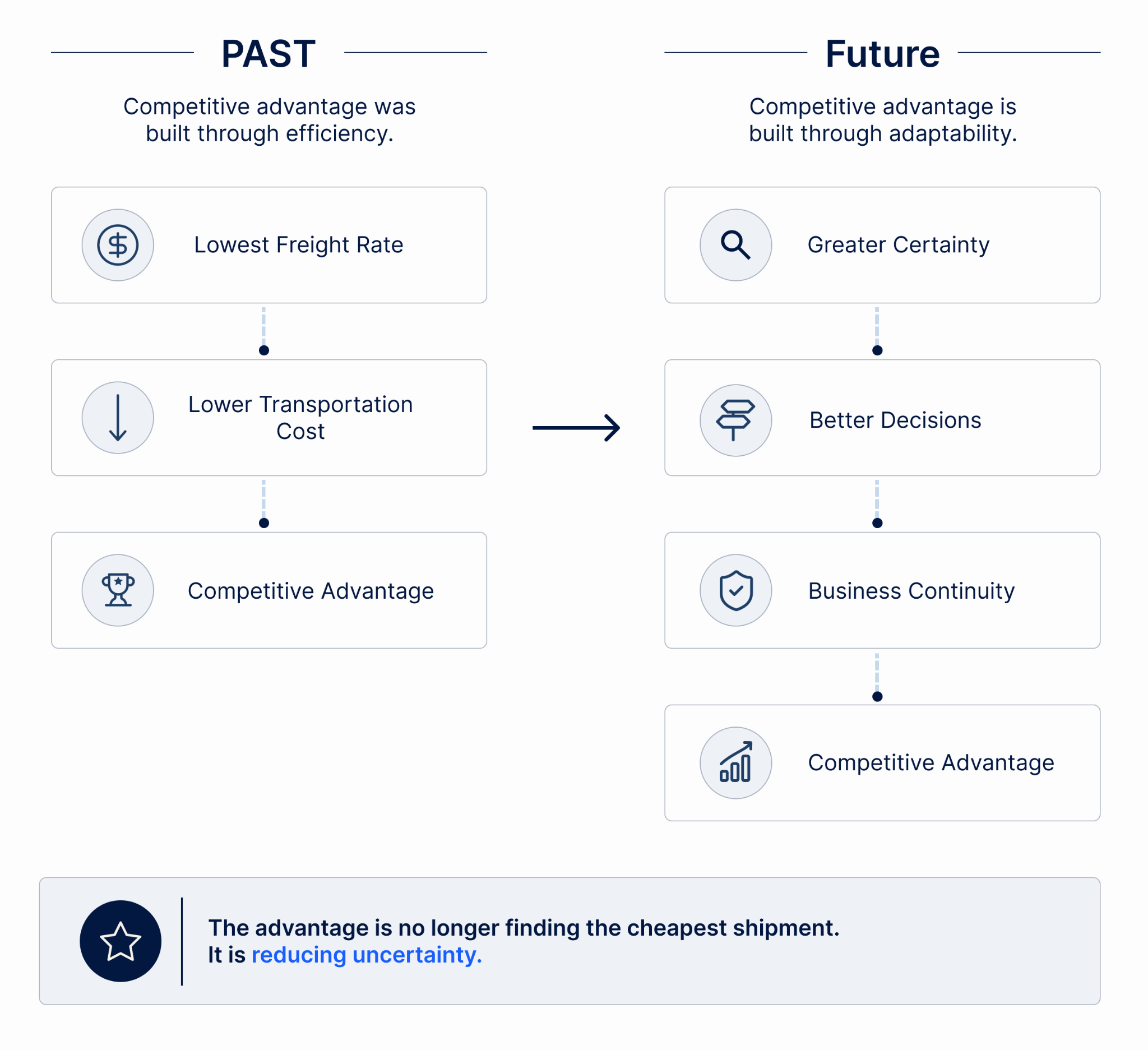
When a carrier suspends a service, capacity tightens unexpectedly or demand surges because of a policy change, businesses with limited alternatives quickly discover that the biggest constraint is not transportation.
It is dependent.
Looking Beyond Freight Rates
Freight rates remain an important part of every logistics decision.
They should not be the only ones.
When capacity becomes constrained, the difference between cargo moving on schedule and cargo waiting for the next available vessel is rarely determined by who negotiated the lowest rate.
It is determined by preparation.
Businesses that maintain relationships with multiple carriers, understand alternative routing options and monitor market developments before they become operational problems are generally able to respond faster when conditions change.
The advantage is not better forecasting.
It has more options available.
The Cost of Waiting
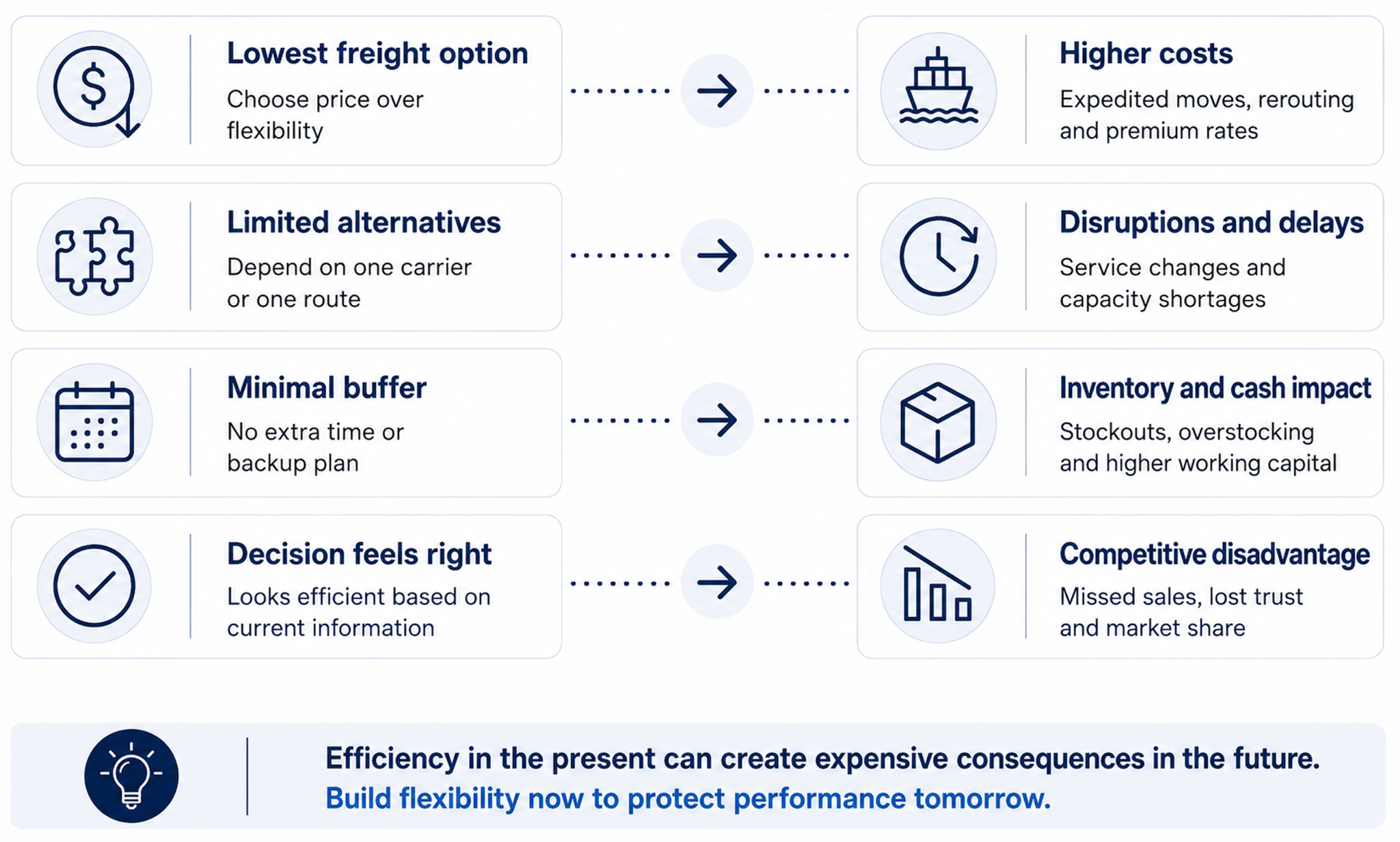
Many supply chain decisions appear economical while markets are stable.
Relying on a single carrier reduces administrative effort. Consolidating suppliers improves purchasing leverage. Booking freight only when cargo is ready may seem operationally efficient.
Those decisions often work well—until conditions change.
When disruption occurs, the calculation becomes very different.
Production delays, inventory shortages, emergency transportation, missed customer commitments and lost sales frequently outweigh the savings that originally justified those decisions.
The cost of flexibility is visible.
The cost of dependence usually isn't—until it's too late.
Building Resilience into Everyday Planning
Resilience is often described as the ability to recover from disruption.
In practice, it begins much earlier.
It is built through everyday planning decisions.
Businesses that consistently perform well during uncertain market conditions tend to follow a similar approach.
They monitor changes in carrier networks, capacity and trade policy rather than reacting after the impact is already visible.
They develop alternative carriers, routings and sourcing strategies before they become necessary.
They identify which shipments are critical to production or customer commitments and prioritise them accordingly.
Most importantly, they evaluate logistics decisions based on total business impact—not simply freight cost.
Resilience is not a project completed during disruption.
It is a capability developed before disruption occurs
The Airlift Perspective
At Airlift, we've found that resilient supply chains are built around four connected disciplines.
Visibility means understanding changes in markets, regulations and carrier networks before they affect operations.
Flexibility means creating alternatives in carriers, routings and sourcing strategies rather than relying on a single option.
Preparedness means identifying operational risks and contingency plans while market conditions remain stable.
Execution means making decisions that protect business continuity, customer commitments and long-term performance—not simply reducing transportation costs.
None of these principles is new on its own.
Together, however, they create something many supply chains are increasingly competing for.
Certainty.
Questions Worth Asking
Before the next market shift occurs, every importer should be able to answer a few simple questions.
If your preferred carrier suspended tomorrow's sailing, what would you do?
If demand suddenly increased, where would additional capacity come from?
If a trade policy change accelerated purchasing decisions, which shipments would receive priority?
If the answer to those questions depends on making decisions after disruption begins, your supply chain may be more exposed than it appears.
The strongest supply chains are rarely those that avoid disruption.
They are the ones prepared for multiple outcomes before disruption occurs.
The Market Keeps Changing. The Lesson Doesn't.
Carrier networks will continue to evolve.
Trade policies will continue to change.
Capacity will tighten and ease in cycles.
New disruptions will emerge that no one can fully predict.
Those events will generate headlines.
The more important story is what they continue to teach.
Global supply chains are no longer competing on efficiency alone.
They are increasingly competing on adaptability.
Businesses that recognise this shift will not only respond better to disruption—they will make better decisions long before disruption occurs.
Because while the market keeps changing, the lesson has remained remarkably consistent.
The businesses best prepared for uncertainty are usually the ones best positioned to succeed through it.
About Airlift USA
Airlift USA helps importers navigate changing market conditions through freight forwarding, trade compliance and market intelligence. By combining operational expertise with timely insights, we help businesses improve visibility, strengthen decision-making and build supply chains that are prepared for whatever comes next