


MSC has consolidated its India–US East Coast network. Here is what changed, what remains, and what shippers should review before Q3.
Immediate Action Required
If you have bookings or open quotes on India–South America lanes via MSC, do not confirm shipments until revised routings are published.
MSC has advised customers to hold bookings and quotations until further notice.
What Happened
MSC has suspended its Indus Express service, removing one of the carrier's key India–US East Coast loops and consolidating cargo onto its remaining Indusa service.
The last sailing under Indus Express was MSC Pratiti, which departed Mundra on June 4 and is expected to arrive in New York on July 13.
The move comes as India–US East Coast container volumes continue to soften. Imports from India into the US East Coast fell to approximately 61,500 TEUs in April, down 25% year over year and below March volumes of 73,420 TEUs.
At the same time, carriers continue adding capacity to the trade. Maersk is expected to deploy larger vessels on its MECL service later this month, increasing competition on a corridor already facing weaker demand.
For MSC, this is the latest step in a broader network consolidation strategy. The carrier previously suspended its Indus 2 loop before streamlining services across the trade. With Indus Express now withdrawn, Indusa becomes MSC's primary India–US East Coast service.
Rates have remained relatively resilient despite weaker volumes. Rather than allowing utilization to deteriorate further, MSC has chosen to concentrate cargo onto a smaller network and preserve vessel economics heading into peak season.
The New Routing Structure
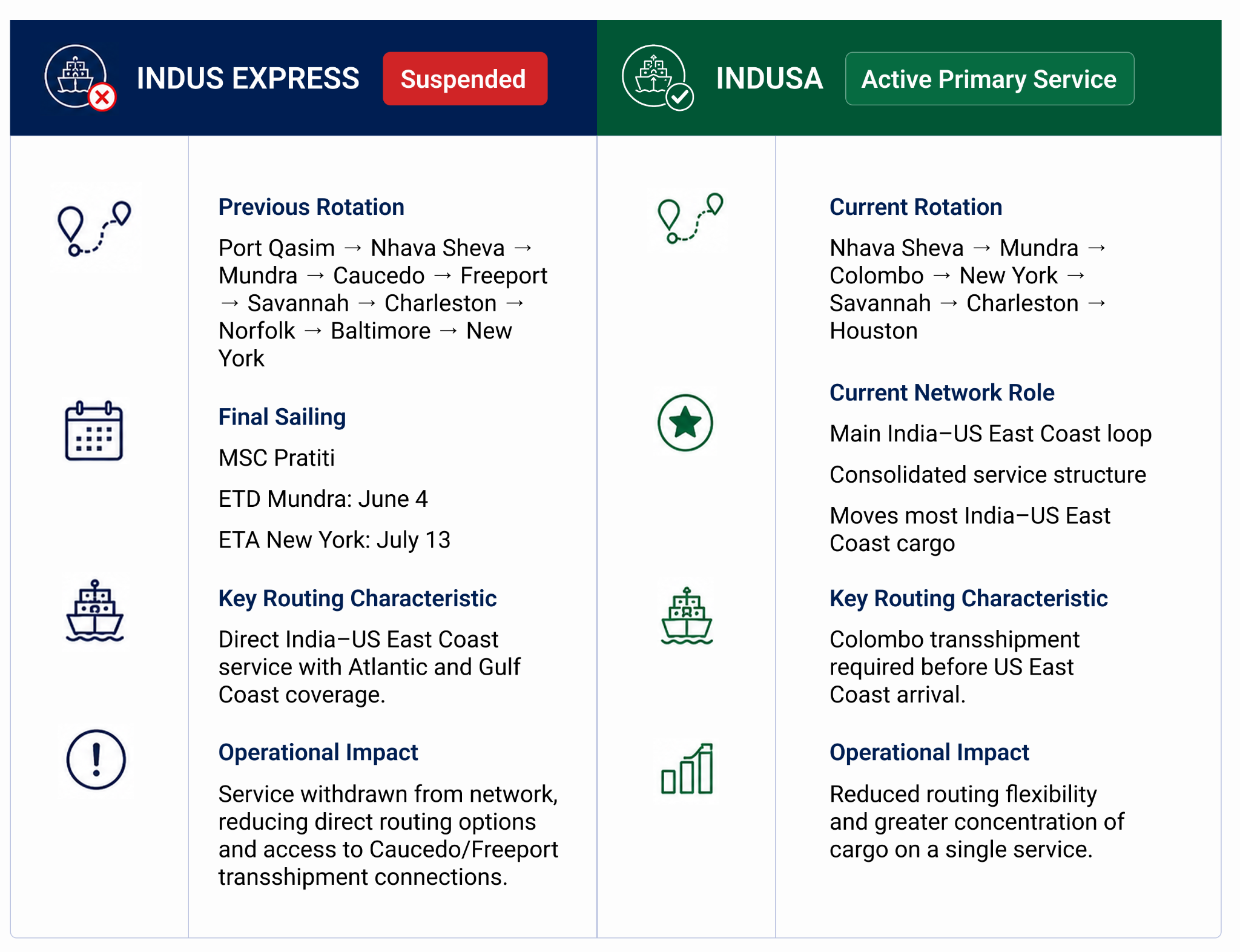
Indus Express: Suspended
Previous Rotation
Port Qasim → Nhava Sheva → Mundra → Caucedo → Freeport → Savannah → Charleston → Norfolk → Baltimore → New York
Final Sailing
MSC Pratiti
ETD Mundra: June 4
ETA New York: July 13
Indusa: Active Primary Service
Current Rotation
Nhava Sheva → Mundra → Colombo → New York → Savannah → Charleston → Houston
Key Consideration
Indusa relies on Colombo transshipment and now carries MSC's primary India–US East Coast capacity.
India–South America cargo is more directly affected. Indus Express served Caucedo and Freeport, both of which functioned as important transshipment hubs for onward South American connections. MSC has not yet published revised routings for these origin-destination pairs.
Potential Impact for Shippers
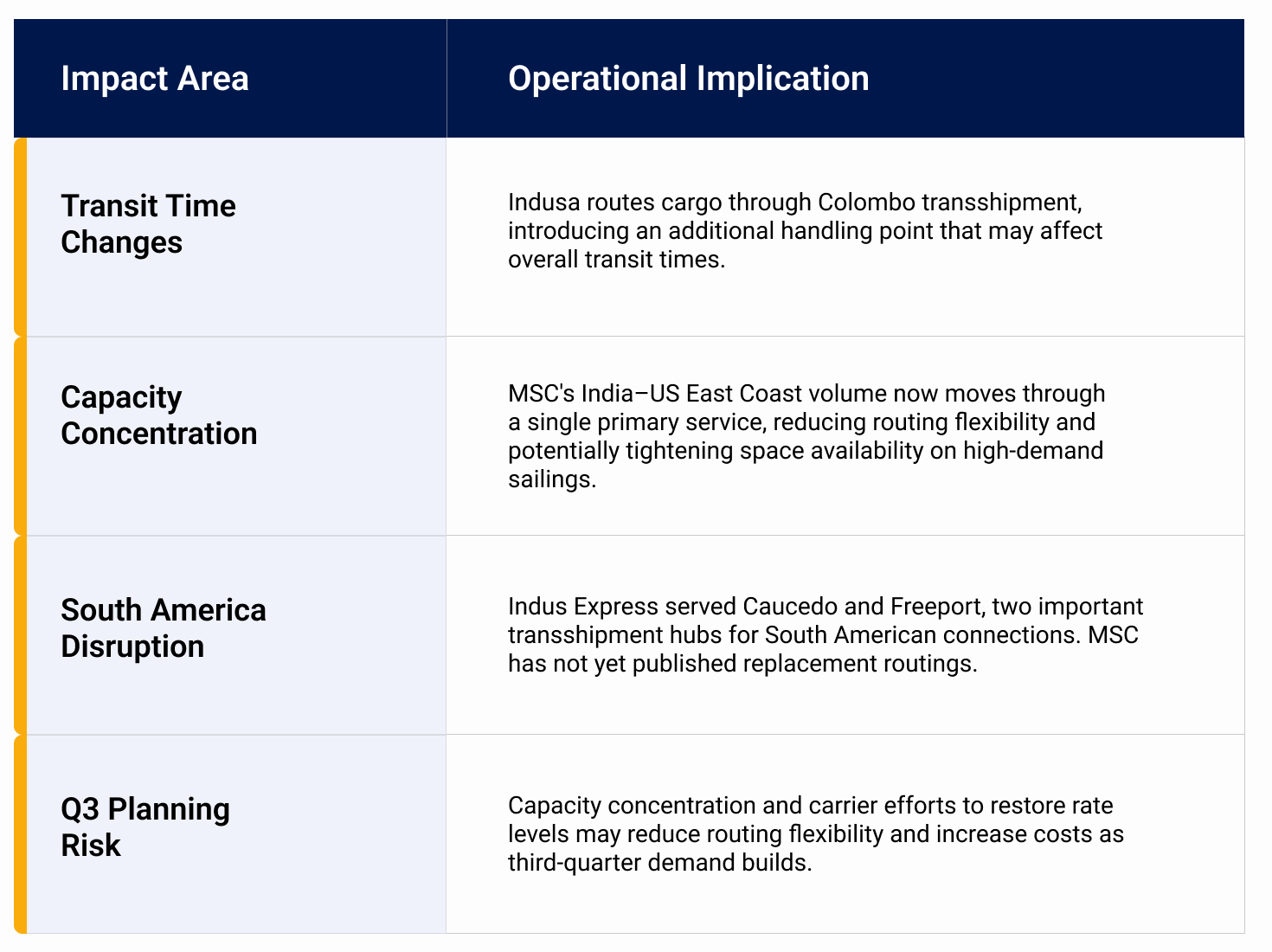
The service suspension creates four operational consequences that importers and exporters should assess now.
Transit Time Changes
Indusa routes cargo through Colombo, introducing a transshipment leg that was not part of many Indus Express routings. Importers and exporters should review transit assumptions for time-sensitive cargo.
Capacity Concentration
MSC's India–US East Coast volume now moves through one primary service. Space availability may tighten on high-demand sailings, particularly as Q3 approaches.
South America Disruption
The most immediate operational uncertainty affects India–South America cargo. MSC has not yet published replacement routings and has advised customers not to issue new quotes or confirm bookings until further notice.
Q3 Planning Risk
Capacity concentration and ongoing carrier GRI activity may reduce routing flexibility and increase costs as third-quarter demand builds.
What Importers and Exporters Should Do Now
1. Confirm Routing for Existing Bookings
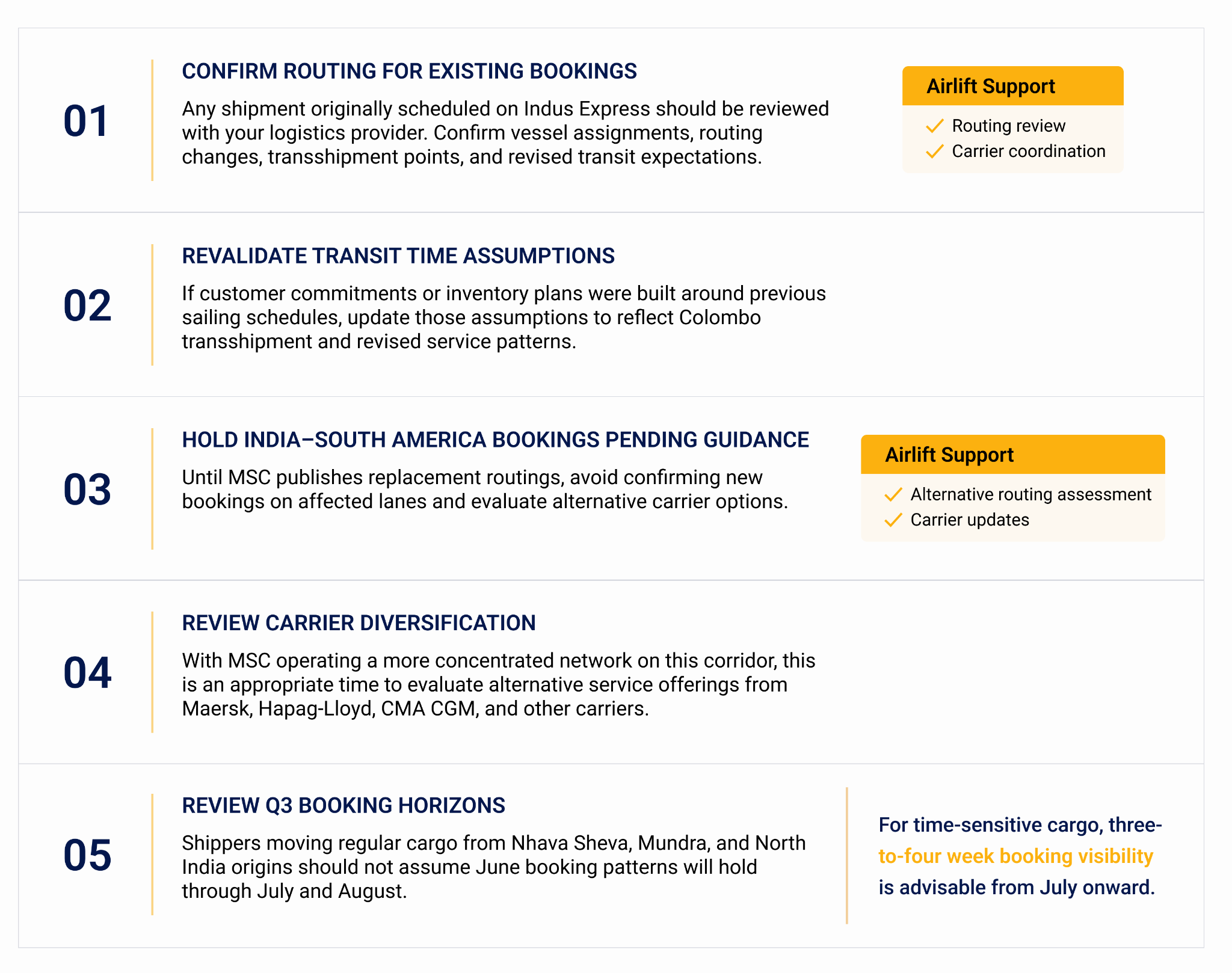
Any shipment originally scheduled on Indus Express should be reviewed with your logistics provider. Confirm vessel assignments, routing changes, transshipment points, and revised transit expectations.
2. Revalidate Transit Time Assumptions
If customer commitments or inventory plans were built around previous sailing schedules, update those assumptions to reflect Colombo transshipment and revised service patterns.
3. Hold India–South America Bookings Pending Guidance
Until MSC publishes replacement routings, avoid confirming new bookings on affected lanes and evaluate alternative carrier options.
4. Review Carrier Diversification
With MSC operating a more concentrated network on this corridor, this is an appropriate time to evaluate alternative service offerings from Maersk, Hapag-Lloyd, CMA CGM, and other carriers.
5. Review Q3 Booking Horizons
Shippers moving regular cargo from Nhava Sheva, Mundra, and North India origins should not assume June booking patterns will hold through July and August.
A corridor supported by multiple service options has now become more concentrated. That does not automatically create a capacity shortage, but it does reduce flexibility when sailings fill or schedules change.
For time-sensitive cargo, booking visibility three to four weeks ahead is likely to become more important than it was earlier in the year.
Airlift Perspective
Carrier Network Decisions Move Faster Than Supply Chains
The most important implication of MSC's decision is not the service suspension itself. It is the reduction in routing flexibility.
Under Indus Express, shippers had access to a direct India–US East Coast option covering multiple Atlantic and Gulf destinations. Under the new structure, a larger share of cargo will move through Colombo transshipment and a single primary service loop.
That matters because supply chains absorb disruption differently than carrier networks do. A carrier can remove a service in a single announcement. Importers often need weeks or months to adjust inventory plans, customer commitments, distribution schedules, and transportation budgets.
For companies shipping regularly from North India, the question is no longer whether MSC has suspended Indus Express. The question is whether current transit assumptions, booking lead times, and delivery commitments still reflect the network that now exists.
The businesses most affected by this change will not be those that react after a delayed shipment. They will be those that continue planning Q3 cargo using Q1 routing assumptions.
Review Your India–US East Coast Routing Strategy
MSC's network has changed. Transit assumptions, routing options, and booking timelines may need to change with it.
If your organization has India–US East Coast cargo moving in Q3, contact Airlift to review routing assumptions and confirm space options before peak season closes that window.